
 Spotify
  Pandora
  Apple
Apple  YouTube
  iHeartRadio
 Solve Your Staffing Crisis: How Adult Day Services Let You Serve 50 Clients with Just 8 Staff
You're all worried about the skyrocketing demand for home ...
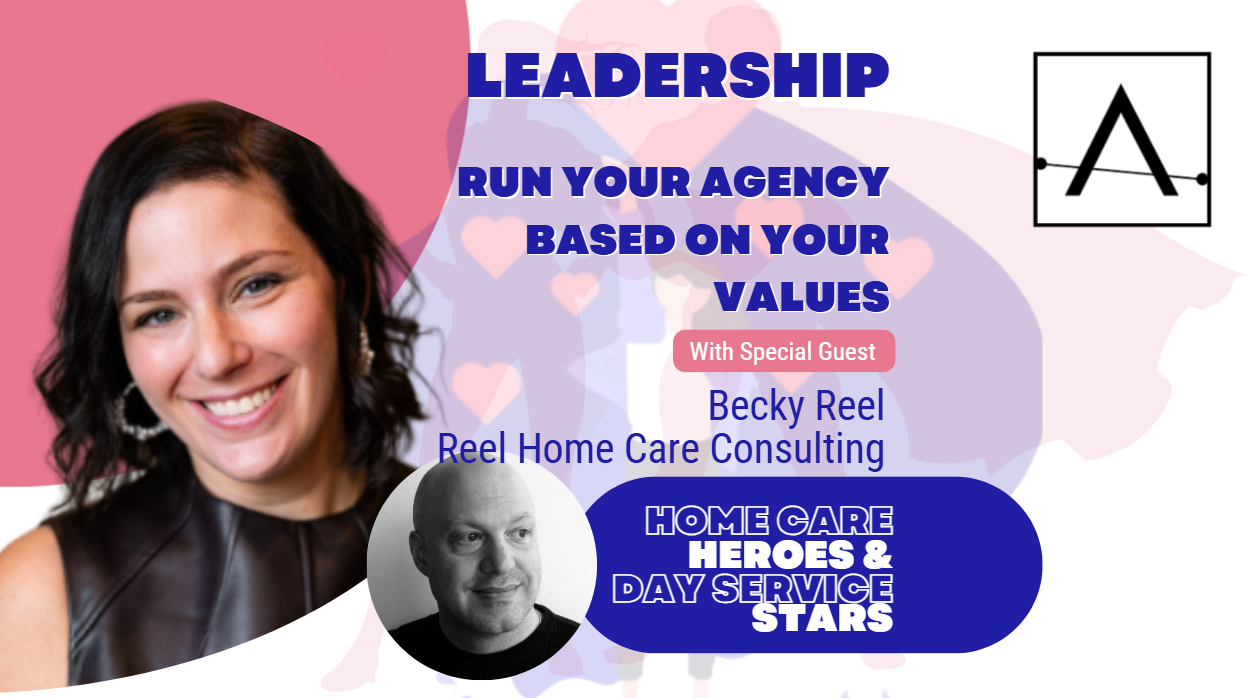
Running a home care agency shouldn’t mean your agency runs you. In this episode, home care consultant and former agency owner Becky Reel shares how leaders can build an agency rooted in their values, with clear boundaries, a healthier culture, and clients and caregivers who actually fit. Becky breaks down why most owners get into home care in the first place, how things drift off-course, and the practical moves that bring you back to a business that supports your life instead of consuming it.
What you’ll learn
A story you won’t forget
Becky tells the powerful story of a hospice case where her team did the right thing even when it meant walking away from revenue, a decision that later generated significant growth through trust, reputation, and one unforgettable review. The lesson: revenue matters, but it can’t be your only metric.
Episode highlights
About Becky Reel
Becky Reel is the founder of Reel Home Care Consulting and former owner of For Papa’s Sake, a nationally recognized home care agency. She now works with private pay home care agencies to improve culture, operations, referrals, and long-term sustainability through coaching and small-group events.
Resources and links
Call to action
Becky’s book (March release)
Borrowed Time: What Home Care Taught Me About Living
A business book with memoir elements, written for agency owners and entrepreneurs who want to build something meaningful without losing themselves in the process.
Events

About the host
Hosted by Kenneth Accardi of ANKOTA, supporting home care and HCBS organizations with tools that reduce admin burden and help teams stay focused on care.
Podcast: Home Care Heroes and Day Service Stars
Home Care Heroes and Day Service Stars is produced and sponsored by Ankota - If you provide services that enable older or disabled people to continue living at home , Ankota can provide you the software to successfully run your agency. Visit us at https://www.ankota. Home Care Heroes and Day Service Stars is produced and sponsored by Ankota - If you provide services that enable older or disabled people to continue living at home , Ankota can provide you the software to successfully run your agency. Visit us at https://www.ankota.com.
Kenneth Accardi (ANKOTA):
Hi, welcome to another installment of Home Care Heroes. Today, I’m privileged to have, for the second time on the podcast, Becky Reel, who runs Reel Home Care Consulting.
The first time we had Becky on the podcast, we talked about her agency, For Papa’s Sake, and her story of why she built it. At the time, she had just won the award for best agency nationwide, as identified by Home Care Pulse, now known as Activated Insights.
Back then, after we finished recording, Becky told me she was going to start consulting. Now it’s a few years later, and that consulting practice has taken off, with some great events happening. We’ll talk about this at the end, but there’s also a book coming out and a book launch happening in Chicago in April.
With that, welcome, Becky Reel.
Becky Reel (Reel Home Care Consulting):
Thank you.
Why owners get into home care
Kenneth:
It’s great to have you here. Every time we talk, you’re passionate about making it your agency, rooted in your values. In our first episode, a lot of your stories were about shifting from always saying yes, just to survive, to learning when to say no, taking control of work-life balance, and building culture.
Let’s start with the idea of why people get into this business. What have you found, and how do you coach agencies around that?
Becky:
Thanks again for having me. It’s always fun to talk with you.
Most people get into this industry because something happened, good or bad. They had a great experience with home care that changed their perspective, or they saw gaps in care and wanted to make a difference. That was my story, too. We saw how people fall through the cracks and knew we needed to do something.
I’ve found people get into home care for one of four reasons, or some combination of them:
Home care isn’t something most people pick because it sounds easy or fun. It’s fulfilling, but it’s hard. That’s why it’s so important to understand why you got into it.
When the agency starts running the owner
Kenneth:
That’s a helpful framework. Where do owners go astray? They come in with good intentions, but end up feeling like the agency is running them instead of the other way around.
Becky:
A lot of it comes down to boundaries, but before you can build boundaries, you need to understand who you are as an agency.
Many owners think they have to serve everybody. They don’t want to say no because they got into this to help people. A lot of agency owners are people pleasers.
But you can’t be everything to everyone. Whether you’re a franchise or independent, there has to be something unique about you. It can’t just be “we hire and train caregivers.” It has to be your story, what drives you, and what makes you different.
Caregivers can work for any agency. So why should they work for you?
Once you’re clear on who you are in the market, you can build the agency to fit the owner’s life and the staff’s life. Most traditional models burn owners out.
The 80/20 rule shows up constantly. If 20% of your clients are causing 80% of your headaches, you need to look at your client load and be more selective. The same goes for caregivers. Agencies hold onto caregivers because they think they need the bodies, but if a caregiver is creating problems instead of solving them, that’s a warning sign.
I had one client whose wife was upset by everything we did. We even brought a holiday gift, a charcuterie board, and that upset her because it disrupted her day. When that number called, everyone’s stomach sank. That’s not how I wanted to run the business, so we had to let them go. She fought it, but it wasn’t a good fit.
You also need clear policies and to stick to them. If your agency runs on ACH and a client refuses, you can say, “I’m sorry, that’s not how we run our business.” If they create friction at the beginning, it’s going to be worse later.
And just because you can serve anywhere geographically doesn’t mean you should. When I ran my agency, the smaller we made our service area, the faster we grew. We were more specialized and more hands-on.
The hospice story: values and long-term trust
Kenneth:
I know from our first podcast and your agency’s values that you have a story about a hospice client with a big revenue opportunity. Can you share that?
Becky:
Yes, I still tell that story, and it’s been seven or eight years.
We had a client where the daughter lived in New York and we were in the Chicago area. It was going to be a 24/7 case. Every other day, we’d hear “he’s being discharged,” and then “no, there’s an infection,” so it was constant false starts. We had a full 24/7 staff lined up, and we kept having to tell them to wait. We tried to keep them working with fill-in shifts, but we were preparing for this placement.
Finally, he was discharged. Our caregiver was at the home ready to meet them and start, and he passed away in transit from the hospital to home.
We were devastated. I was thinking about our caregivers, because they were losing hours. The daughter said something like, “I know you did a lot of work. Tell me what I owe you.”
We told her, “You owe us nothing. We’re so sorry for your loss. Let us know if you need anything.”
Money matters, but I always operate from doing what’s right for clients and caregivers. When you operate from the right place, the money comes.
The daughter wrote the most incredible online review. It’s still up. It’s on Yelp. It’s in my book. She wrote about our hearts and how much we cared.
At one point, I analyzed how much business came from that one review. Just from callers who referenced it directly, I could attribute over $30,000 in new revenue. That doesn’t even include the people who read it and never mentioned it.
We lost a significant amount of potential revenue when he passed away. That wasn’t anyone’s fault. We did the right thing, and it came back in a bigger way. It’s a reminder that revenue isn’t the only metric that matters.
Becky’s book
Kenneth:
That’s a great story, and I’m looking forward to the book. What’s the title?
Becky:
The title went through a lot of iterations. At first it was going to be Coming Home, but that felt too home care-specific. As the book evolved, it became a reflection of my life and time in home care, and what home care teaches you about how precious life is.
So we changed it to: Borrowed Time: What Home Care Taught Me About Living.
It’s a business book with elements of memoir, but it’s really for any entrepreneur or anyone trying to find their footing and purpose.
Kenneth:
That sounds fantastic.
Culture and retention: what “culture” really means
Kenneth:
You do seminars on culture and caregiver retention. How do you help owners translate their “why” into an actual culture that retains caregivers?
Becky:
Caregivers can work for multiple agencies. In my opinion, it’s not always about pay. Pay matters, and caregivers should earn a respectable wage, but it’s not the whole story.
Culture is not a holiday party. Culture is getting people who genuinely want to be part of what you’re doing. It’s ongoing. Happy caregivers drive better care.
Unhappy caregivers leave, or worse, they stay and become toxic. I talk a lot about the cost of turnover. Agencies don’t always understand how expensive one bad hire is, between onboarding, training, productivity loss, and then the risk of putting that person with a client. One bad hire can cost thousands.
Culture is what happens when you’re not in the room. It’s what caregivers say about you to clients. It comes down to consistency, communication, and genuinely caring about caregivers, not only checking in when there’s a scheduling problem.
Staying connected to caregivers in a distributed workforce
Kenneth:
This is a business where caregivers aren’t in the office every day. How do you help owners stay connected so caregivers don’t feel isolated?
Becky:
Technology can help bridge the gap, but it comes down to being involved and checking in beyond annual reviews.
Watch for trends: if someone’s enthusiasm fades, if they used to volunteer and now they don’t, don’t wait for something to break. Use it as a reason to check in.
Make the time. Meet them for coffee. Get out of the office. Stop by a client’s home and bring coffee. Do something out of the ordinary. If a valuable caregiver seems off, it might be personal, not work-related.
Caregivers often won’t tell you what’s going on. In many caregiver cultures, people are taught to push through and not complain. They might fear judgment or worry they’ll lose hours.
Look for warning signs:
Approach it from concern, not anger: “I noticed you’ve been calling off on Fridays, is everything okay?” If childcare fell through or they’re going through a divorce, your job is to support them and problem-solve. Maybe the schedule needs to change, or maybe they need resources.
Scaling culture as the agency grows
Kenneth:
As agencies grow, the owner isn’t the point person for every caregiver. Care coordinators and managers step in. How do you prevent culture from getting lost?
Becky:
Hire based on culture more than anything. You want people who share the mission and values, and who complement your weaknesses.
I don’t care as much about home care experience because you can teach that. I didn’t have home care experience. I came from marketing and sales, but I cared about people. That mattered most.
If you hire people with good hearts and align them to your mission, it flows through the organization. Culture is top-down.
We also used accountability systems with metrics and KPIs, but not only quantitative KPIs. You need qualitative measures too. If you take care of people, they take care of people.
Ways to work with Becky Reel Consulting
Kenneth:
If someone wants to work with you, what are the options?
Becky:
We do one-on-one coaching, and my partner Kristen is involved as well. We don’t do much group coaching because every agency is different. We want to understand the agency and build something sustainable based on where they are and what their goals are.
We also do the Dinner Series across the country. The reason is that when I had my agency, I felt alone and isolated. I was caring for caregivers, clients, referral sources, office staff, and my family, but I didn’t have a safe space to talk with other owners who understood it.
The Dinner Series is an intimate dinner with 20–25 people max, with a facilitated conversation. Our next one is February 22 in Austin. We also have Philadelphia, Denver, Orlando, and Chicago slated this year.
And we have the book launch party April 16 in Chicago.
Closing: book title + contact info
Kenneth:
Tell us one more time the book title, and how people can reach you.
Becky:
The book is Borrowed Time: What Home Care Taught Me About Living. It’ll be available on Amazon and various online retailers and bookstores in March.
The launch party is April 16 in Chicago, and the dinner series and book launch information are on our website: reelhomecareconsulting.com.
My last name is spelled R-E-E-L, like a fishing reel. You can also find me on Instagram, Facebook, and LinkedIn.
Kenneth:
Perfect. Thanks so much for everything you shared. I know these stories will resonate with agency owners. Thanks again for being here on Home Care Heroes.
Becky:
Thank you. I appreciate it.

Ken is the founder and CEO of Ankota, a company that helps any organization that helps older or disabled people live independently in their home of choice. Having grown up with a disability and a passion for healthcare, this is Ken's mission


Trusted by home care agencies nationwide