
Chapter 1: Alabama
The state of Alabama Medicaid team has chosen the state mandated system model and selected a system called AuthentiCare. It is mandated that agencies need to use this system for EVV.
Here’s the Alabama EVV Web Page.

The official Medicaid contact for Alabama is as follows:

Chapter 2: Alaska
Alaska Medicaid has chosen the state provided solution with provider option to choose an alternative vendor model. An RFP was issued in June seeking the state provided solution. Replies from vendors were required by early July. Note that Ankota did NOT apply to the RFP because we are a provider solution. We will monitor the state site for updated news.
For a free EVV consultation, click here.
Here’s the Alaska EVV Web Page.
The official Medicaid contact for Alaska is as follows:

Chapter 3: Arizona
Arizona Medicaid has chosen the state provided solution with provider option to choose an alternative vendor approach. The state’s vendor is Sandata but you can also use an alternate system like Ankota so long as your vendor provides required EVV information to Sandata. Ankota has integrated with Sandata in other states. Provider EVV best practices dictate that you should evaluate the state offering and at least one other vendor such as Ankota. For a free EVV consultation, click here.
Here’s the Arizona EVV Web Page.
The official Medicaid contact for Arizona is as follows:

Chapter 4: Arkansas
Arkansas Medicaid has chosen the Open Vendor Model . The state’s vendor is Careify but you can also use an alternate system like Ankota. Provider EVV best practices dictate that you should evaluate the state offering and at least one other vendor such as Ankota. For a free EVV consultation, click here.
At this time we’re not able to find an Arkansas Medicaid EVV web page.
The official Medicaid contact for Arkansas is as follows:

Chapter 5: California
California Medicaid has chosen the Open Vendor Model . The state has a legacy solution called CMIPS that predates the EVV mandate. It seems clear that CMIPS will not be the system of the future and that providers can choose a system like Ankota. Provider EVV best practices dictate that you should evaluate the state offering and at least one other vendor such as Ankota. For a free EVV consultation, click here.
Unofficially we can share that California providers have been informed that personal cell phone use by their care providers will require reimbursement, but the details are not yet clear. We’re working with providers who are working on tiered plans where they will offer a monthly fee to caregivers who use their own phones and also offer alternatives like telephony from client phones and agency provided phones.
Here’s a link to the California EVV site. Here’s an additional useful site describing California’s EVV Phase II plans.

The official Medicaid contact for California is as follows:

Chapter 6: Colorado
Colorado Medicaid has chosen the the state provided solution with provider option to choose an alternative vendor model. The state’s vendor is Sandata but you can also use an alternate system like Ankota. Ankota has integrated with Sandata in other states and can pass them EVV information. Provider EVV best practices dictate that you should evaluate the state offering and at least one other vendor such as Ankota. For a free EVV consultation, click here.
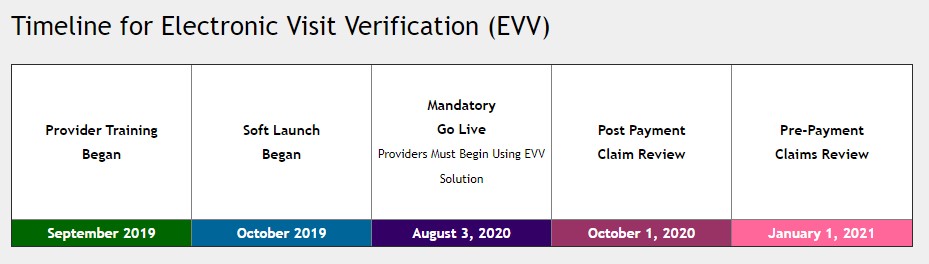
Here’s a link to Colorado’s state Medicaid EVV website
The official Medicaid contact for Colorado is as follows:

Chapter 7: Connecticut
The state of Connecticut Medicaid team has chosen the state mandated system model and selected the Sandata system. It is mandated that agencies need to use this system for EVV.
Ankota is working with agencies in Connecticut for their private pay, VA, long-term-care-insurance and other payers but presently not directly with Sandata or Connecticut Medicaid.
Here’s the Connecticut EVV Web Page.

The official Medicaid contact for Connecticut is as follows:

Chapter 8: Delaware
Like essentially all of the other states, Delaware Medicaid has petitioned the federal government for an extension to January 1, 2021 to complete their EVV implementation. These extensions are granted based on the state working in good faith to comply with the 21st century cures act, but in the case of Delaware we haven’t yet seen definitive plans.
Ankota complies with the federal EVV requirements, but we are waiting for a more definitive answer from Delaware before actively working with Medicaid agencies in Delaware. If you know more about Delaware’s plans or if you’d like a free EVV consultation, click here.
Here’s an official request for inputs from Delaware agencies. We’re looking forward to replacing this with an official Delaware EVV page.
The official Medicaid contact for Delaware is as follows:

Chapter 9: Florida
Florida Medicaid has chosen the MCO Choice Model . The state has seven MCOs. Four of the MCOs have chosen Tellus as their billing vendor and the other three have chosen HHA Exchange. This means that you need to be able to bill them both. Some vendors including Ankota can seamlessly bill both. EVV best practices dictate that you should evaluate multiplesolutions to see what’s best for your agency. For a free EVV consultation, click here.
Here’s a link to Florida Medicaid’s EVV site.
The official Medicaid contact for Florida is as follows:
Chapter 10: Georgia
Georgia Medicaid has chosen the provider choice model allowing each home care agency to choose the agency management system that will best service their needs. For a free EVV consultation, click here.
Here’s the Georgia Medicaid EVV web page.
The official Medicaid contact for Georgia is as follows:

Chapter 11: Hawaii
Hawaii Medicaid has chosen the Open Vendor Model . They collaborated with Arizona and collectively those state’s chose Sandataas their vendor, but you can also use an alternate system like Ankota so long as your vendor provides required EVV information to Sandata. Ankota has integrated with Sandata in other states. Provider EVV best practices dictate that you should evaluate the state offering and at least one other vendor such as Ankota. For a free EVV consultation, click here.
Here’s the Hawaii Medicaid EVV page.

The official Medicaid contact for Hawaii is as follows:

Chapter 12: Idaho
Like essentially all the other states, Idaho Medicaid has petitioned the federal government for an extension to January 1, 2021 to complete their EVV implementation. These extensions are granted based on the state working in good faith to comply with the 21st century cures act, but in the case of Idaho we haven’t yet seen definitive plans.
We have it on good authority (although not officially from the state) that Idaho will follow the provider choice model and each agency can choose the system that best meets their needs. The state is planning to use Sandata as the EVV aggregator. We've further heard that the state is planning to officially announce their plans in July 2020 and expects providers to be fully compliant by the moddle of 2021.
One of the tricky things about Idaho is the need to split time between Personal Care and Homemaker. We can help with that and many other things. If you'd like a consultation, please click here.
Here’s the Idaho Medicaid EVV page.


Chapter 13: Illinois
Illinois Medicaid has chosen the state mandated solution model. The state-provided solution is called Santrax from the company Sandata.
Here’s the Illinois Medicaid EVV page.



Chapter 14: Indiana
Indiana Medicaid has chosen the state provided solution with provider option to choose an alternative vendor model allowing each home care agency to choose the agency management system that will best service their needs. For a free EVV consultation, click here.
Here’s the Indiana Medicaid EVV page.

Chapter 15: Iowa
Ankota complies with the federal EVV requirements, but we are waiting for a more definitive answer from Idaho before actively working with Medicaid agencies in the state. If you know more about Idaho’s plans or if you’d like a free EVV consultation, click here.
Here’s the Iowa’s Medicaid EVV page.

Chapter 16: Kansas
The state of Kansas Medicaid team has chosen the state mandated system model and selected a system called AuthentiCare. It is mandated that agencies need to use this system for EVV.
Here’s the Kansas EVV Policy Statement.

Chapter 17: Kentucky
Kentucky has now announced definitive EVV plans. Kentucky will follow the has chosen the state provided solution with provider option to choose an alternative vendor mode. The state provided solution is called Tellus. Ankota is integrated with Tellus in other states)
Some important things to know about Kentucky are that there’s a good amount of Adult Day Health Care provided in conjunction with home care and there are cross-connections between the two. For example, if the same consumer has both home care and adult day health care in the same day you can only bill $200 per the day in total.
if you’d like a free EVV consultation, click here.
We can’t find a page specific to EVV on the Kentucky Medicaid page, but here’s a link to the main Kentucky Medicaid site.

Chapter 18: Louisiana
Louisiana Medicaid has chosen the Open Vendor Model . The state provides its own EVV tracking system that is part of a system called LaSRS (the Louisiana State Reporting System) but you can also use the system of your choice so long as your vendor provides EVV data to LaSRS.
For a free EVV consultation, click here.
Here’s the Louisiana EVV Web Page.


Chapter 19: Maine
Maine Medicaid has chosen the Open Vendor Model . The state’s system is developed internally and is called MIHMAbut you can also use an alternate system like Ankota so long as your vendor provides required EVV information to MIHIS. Provider EVV best practices dictate that you should evaluate the state offering and at least one other vendor such as Ankota. For a free EVV consultation, click here.
Here’s the Maine Medicaid EVV page.

Chapter 20: Maryland
The state of Maryland Medicaid team has chosen the state mandated system model and they provide a system called In-home Supports Assurance System (ISAS ), which is part of the state’s LTSSMaryland System. It is mandated that agencies need to use this system for EVV.
Here’s a state of Maryland briefing memo on the subject.

Chapter 21: Massachusetts
Massachusetts Medicaid has chosen the Open Vendor Model . The state’s system is developed internally and is called MyTimesheetEVV but you can also use an alternate system like Ankota so long as your vendor provides required EVV information to the Massachusetts EVV data aggregator. Provider EVV best practices dictate that you should evaluate the state offering and at least one other vendor such as Ankota. For a free EVV consultation, click here.
Here’s the Massachusetts Medicaid EVV page.

Chapter 22: Michigan
Michigan Medicaid has a website (linked below) but the site doesn’t clarify what their EVV model is. If anyone has more detail on the Michigan plan, please let us know.For a free EVV consultation, click here.
Here’s the Michigan Medicaid EVV site.
Chapter 23: Minnesota

Chapter 24: Mississippi
The state of Mississippi Medicaid team has chosen the state mandated system model and provided a system called MediKey.. It is mandated that agencies need to use this system for EVV.
Here’s a Mississippi briefing deck dated 2/14/2020.

Chapter 25: Missouri
Missouri Medicaid has chosen the provider choice model allowing each home care agency to choose the agency management system that will best service their needs. Late in 2019, they announced that providers will need to communicate EVV information to an aggregator for which an RFP process is underway. Claims will continue to need to be sent to EMOMED. In addition to the federal EVV attribution, Missouri is also requiring providers to include completed care plan items along with their EVV data. Some of the other challenges in Missouri are that there is no rounding of visit duration. Instead you can only bill complete units, but you can accrue additional minutes and bill additional units once 15 minutes are accrued.
Ankota has extensive experience with Missouri Medicaid providers. For a free EVV consultation, click here.
Here’s the Missouri Medicaid EVV page.


Chapter 26: Montana
Like essentially all the other states, Montana Medicaid has petitioned the federal government for an extension to January 1, 2021 to complete their EVV implementation. These extensions are granted based on the state working in good faith to comply with the 21st century cures act, but in the case of Montana we haven’t yet seen their definitive plans. We have seen a request for proposal for an EVV system for Montana so that implies that they are either going to mandate a solution or offer open systems model.
Ankota complies with the federal EVV requirements, and we’re at the ready to support Montana agencies. if you’d like a free EVV consultation, click here.
We can’t find a page specific to EVV on the Montana Medicaid page, but here’s a link to the Montana EVV system Request for Proposal


Chapter 27: Nebraska
Nebraska has now announced definitive EVV plans. Nebraska will follow the state provided solution with provider option to choose an alternative vendor mode. The state provided solution is called Tellus. Ankota is integrated with Tellus in other states.
The timeline for Nebraska EVV has been announced and there is literally a "clock ticking" on the state's EVV web page indicating a deadline of October 25, 2020 for compliance.
Ankota complies with the federal EVV requirements, and we’re at the ready to support Nebraska agencies. if you’d like a free EVV consultation, click here.
The official Medicaid contact for Nebraska is as follows:

Chapter 28: Nevada
The state of Nevada Medicaid team has chosen the state mandated system model and selected a system calledAuthenticare. It is mandated that agencies need to use this system for EVV.
Here’s the Nevada Medicaid EVV page.

Chapter 29: New Hampshire
Like essentially all the other states, New Hampshire Medicaid has petitioned the federal government for an extension to January 1, 2021 to complete their EVV implementation. These extensions are granted based on the state working in good faith to comply with the 21st century cures act, but in the case of New Hampshire we haven’t yet seen their definitive plans. There’s more information on the state Medicaid EVV page below.
Ankota complies with the federal EVV requirements, and we’re working with home care providers around the state. If you’d like a free EVV consultation, click here.
We found the following New Hampshire EVV page.


Chapter 30: New Jersey
New Jersey Medicaid has chosen the provider choice model allowing each home care agency to choose the agency management system that will best service their needs. We have been informed that New Jersey has issued an RFP for an aggregator that all vendors will need to submit EVV information to For a free EVV consultation, click here.
Here’s the New Jersey’s Medicaid EVV page.


Chapter 31: New Mexico
The state of New Mexico Medicaid team has chosen the state mandated system model and selected a system called Authenticare. It is mandated that agencies need to use this system for EVV.
Here’s the New Mexico Medicaid EVV page.


Chapter 32: New York
New York Medicaid has chosen the provider choice model allowing each home care agency to choose the agency management system that will best service their needs.
For a free EVV consultation, click here.
Here’s the New York Medicaid EVV web page.


Chapter 33: North Carolina
North Carolina Medicaid has chosen the provider choice model allowing each home care agency to choose the agency management system that will best service their needs.
For a free EVV consultation, click here.
Here’s the North Carolina Medicaid EVV page.


Chapter 34: North Dakota
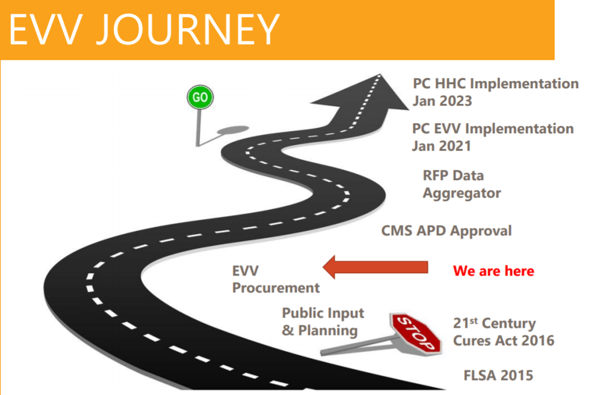
North Dakota Medicaid has the Open Vendor Model . The state will be providing a solution called Therap LTS but providers are also able to choose an alternate solution such as Ankota. . Provider EVV best practices dictate that you should evaluate the state offering and at least one other vendor such as Ankota. For a free EVV consultation, click here.
Here’s a web page that takes you through a presentation on North Dakota’s plan.
The official Medicaid contact for North Dakota is as follows:

Chapter 35: Ohio
Ohio Medicaid has the Open Vendor Model . The state will be providing Sandatabut providers are also able to choose an alternate solution such as Ankota. . Provider EVV best practices dictate that you should evaluate the state offering and at least one other vendor such as Ankota. For a free EVV consultation, click here.
Here’s an Ohio Medicaid EVV page.

Chapter 36: Oklahoma
The state of Oklahoma Medicaid team has chosen the state mandated system model and selected a system that all agencies must use.
Here’s the Oklahoma EVV Web Page.

Chapter 37: Oregon
Oregon Medicaid has the Open Vendor Model . The state provides a solution called EVV eXPRS but providers are also able to choose an alternate solution such as Ankota and have Ankota upload records to eXPRS. Provider EVV best practices dictate that you should evaluate the state offering and at least one other vendor such as Ankota. For a free EVV consultation, click here.
Here’s a link to the Oregon EVV page.

.svg)
Chapter 38: Pennsylvania
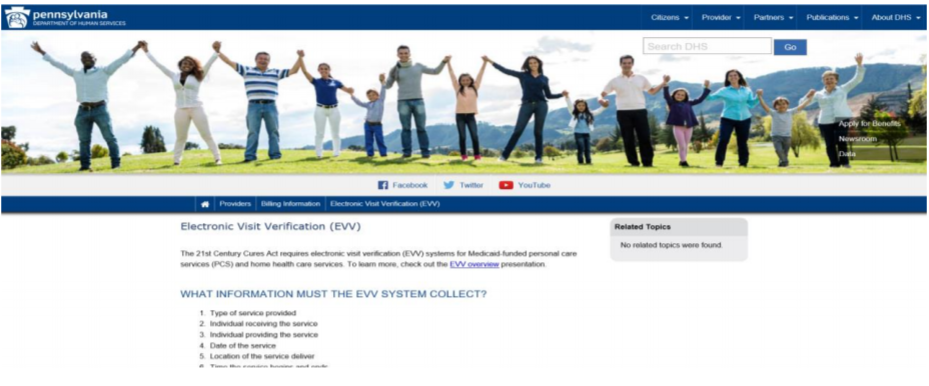
Pennsylvania Medicaid has the Open Vendor Model . The state provides HHAExchange but providers are also able to choose an alternate solution such as Ankota so long as the vendor can upload completed visit records with EVV attribution to HHAExchange. Provider EVV best practices dictate that you should evaluate the state offering and at least one other vendor such as Ankota. For a free EVV consultation, click here.
Here’s a link to the PA Medicaid EVV page.


Chapter 39: Rhode Island
The state of Rhode Island Medicaid team has chosen the state mandated system model and selected Sandata. It is mandated that agencies need to use this system for EVV.
Here’s the Rhode Island Medicaid EVV page.
The official Medicaid contact for Rhode Island is as follows:

Chapter 40: South Carolina
The state of South Carolina Medicaid team has chosen the state mandated system model and they provide a system called Care Call. It is mandated that agencies need to use this system for EVV.
We couldn’t specifically find a South Carolina Medicaid EVV page but we found a link to this South Carolina Provider User’s Manual that explains their approach.
We have been referencing this page to see the status of EVV good faith requests to delay the implementation of EVV to January 1, 2021 to confirm the exemption status and learn who made the request on behalf of the state Medicaid organization. At this time South Carolina appears not to have an extension granted.
The official Medicaid contact for South Carolina is as follows:

Chapter 41: South Dakota
The state of South Dakota Medicaid team has chosen the state mandated system model and selected a system called Therap. It is mandated that agencies need to use this system for EVV.
Here’s a state of South Dakota information page about EVV.
The official Medicaid contact for South Dakota is as follows:

Chapter 42: Tennessee
The state of Tennessee Medicaid team has chosen the state mandated system model and selected Sandata. We also read that for consumer directed mental health services there is a different software . It is mandated that agencies need to use these system for EVV
Here’s a Tennessee Medicaid EVV page.
We have been referencing this page to see the status of EVV good faith requests to delay the implementation of EVV to January 1, 2021 to confirm the exemption status and learn who made the request on behalf of the state Medicaid organization. At this time Tennessee does not seem to have requested to defer.
The official Medicaid contact for Tennessee is as follows:

Chapter 43: Texas
The state of Texas Medicaid team has chosen the state mandated system model and selected a small list of authorized software vendors. Ankota is currently not approved as a Texas vendor but we would like to be. It is mandated that agencies need to use one of the state approved EVV vendors.
Here’s the Texas Medicaid EVV Web Page.
The official Medicaid contact for Texas is as follows:

Chapter 44: Utah
Utah Medicaid has chosen the provider choice model allowing each home care agency to choose the agency management system that will best service their needs. For a free EVV consultation, click here.
Here’s the Utah Medicaid EVV page.


Chapter 45: Vermont
VermontMedicaid has the Open Vendor Model . The state provider is Sandata but providers are also able to choose an alternate solution such as Ankota and have Ankota upload records to Sandata. Provider EVV best practices dictate that you should evaluate the state offering and at least one other vendor such as Ankota. For a free EVV consultation, click here.
Here’s the Vermont Medicaid EVV page.


Chapter 46: Virginia
Virginia Medicaid has chosen the provider choice model allowing each home care agency to choose the agency management system that will best service their needs. Virginia’s Medicaid program is administered by the Department of Medical Assistance Services (DMAS - see link below) but each participant is signed up with a specific MCO. To further complicate matters, some of the MCOs accept claims with EVV attribution but others have instead required that you submit EVV visit data through a specific provider (e.g., Anthem requires that you submit through Tellus).
Although this is tricky, Ankota has a great deal of expertise in helping Virginia Medicaid agencies. For a free EVV consultation, click here.
Here’s the DMAS web site.


Chapter 47: Washington
The state of Washington Medicaid has chosen the provider choice model allowing each home care agency to choose the agency management system that will best service their needs. They have implemented an aggregator system called ProviderOne whereby the home care agency can choose any software it wants, but their software must submit EVV data to ProviderOne.
For a free EVV consultation, click here.
Here’s a provider implementation guide from the Washington Medicaid site.
The official Medicaid contact for Washington is as follows:

Ms. MaryAnne LindebladDirector, Washington Health Care Authority 626 8th Avenue, PO Box 45502 Olympia, WA 98504-5050
Chapter 48: West Virginia
West Virginia Medicaid has the Open Vendor Model meaning that the state is providing a solution but providers are also able to choose an alternate solution such as Ankota. We have a link to the state’s EVV page below but it doesn’t say who the state provider is. Provider EVV best practices dictate that you should evaluate the state offering and at least one other vendor such as Ankota. For a free EVV consultation, click here.
Here’s the West Virginia Medicaid EVV page.

Chapter 49: Wisconsin
The state of AlabamaWisconsin Medicaid team has chosen the state mandated system model and selected Sandata. It is mandated that agencies need to use this system for EVV. There has been some indication that they are considering allowing providers to choose other systems (that will need to feed EVV data to Sandata) but there is not official communication to this affect.
Here’s the Wisconsin EVV page.

Chapter 50: Wyoming
Like essentially all the other states, Wyoming Medicaid has petitioned the federal government for an extension to January 1, 2021 to complete their EVV implementation. These extensions are granted based on the state working in good faith to comply with the 21st century cures act, but in the case of Wyoming we haven’t yet seen their definitive plans. We've emailed the state to see if there's an update. There’s more information on the state Medicaid EVV page below.
Ankota complies with the federal EVV requirements, and we’re working with home care providers around the state. If you’d like a free EVV consultation, click here.
We found the following Wyoming Medicaid EVV page.
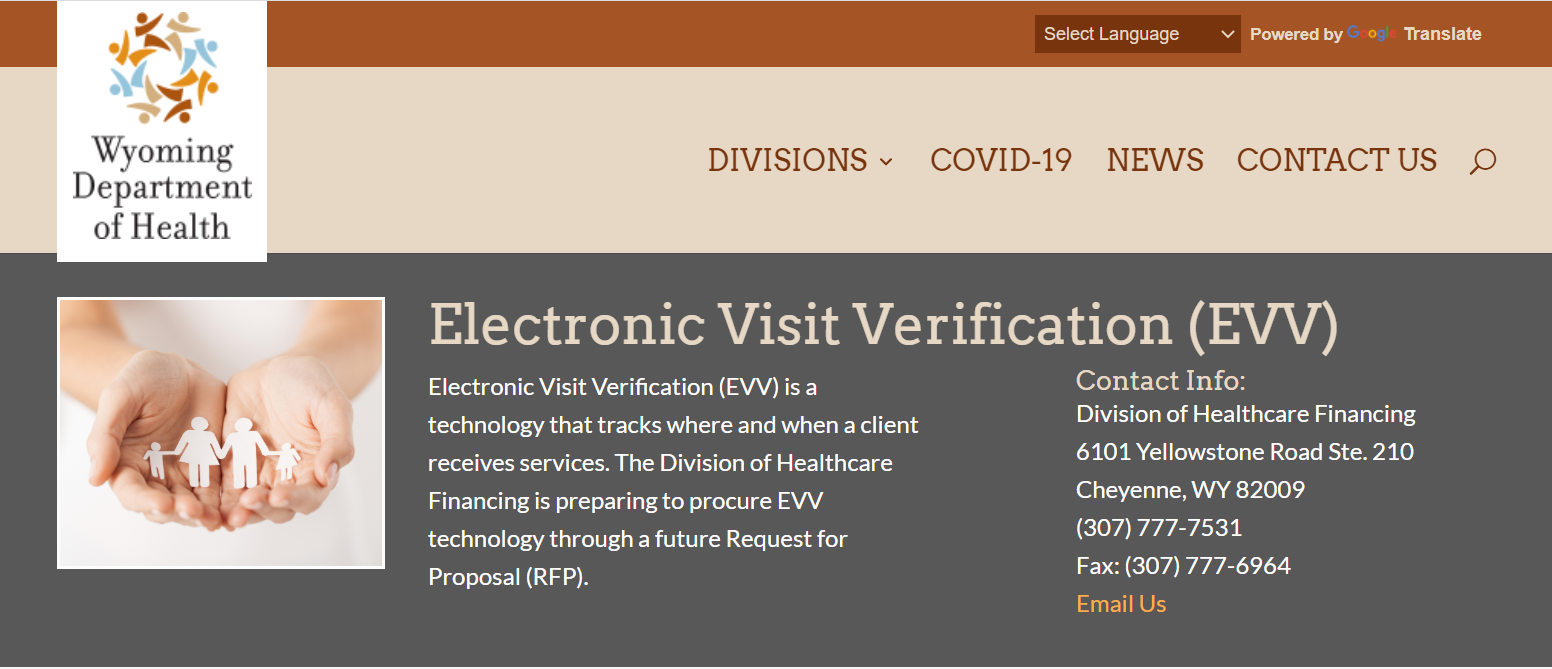
The official Medicaid contact for Wyoming is as follows: