Attracting Clients & Caregivers to Home Care Agencies with Video
Host: Ken Accardi
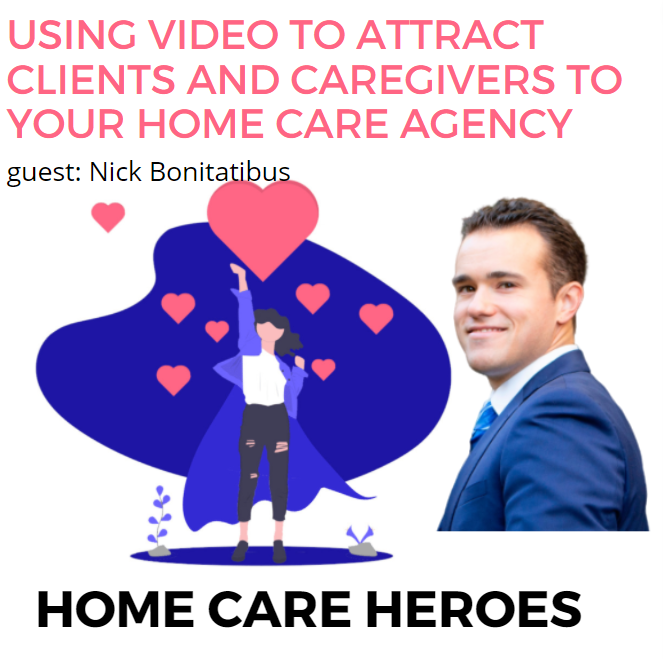
Guest: Nick Bonitatibus (The Digital Champs)
Show: Home Care Heroes Podcast
Ken Accardi: Today on Home Care Heroes, we have a real treat. Nick Bonitatibus from The Digital Champs is going to take us through how to create videos that are easy to make and will attract both caregivers and clients to your home care agency. Enjoy!
Ken Accardi: Well, hey everybody, welcome to today's episode of Home Care Heroes. I have a super special guest today. His name is Nick Bonitatibus, and he is joining us from his home studio in San Diego, California. It is a bright and sunny day where he is today; I'm here in Boston, Mass, and it's getting a little bit dark out. We're going to talk about a great topic, which is how to attract more clients and caregivers for your home care agency online and using social media. That's kind of Nick's wheelhouse. So with that, let me first say welcome to Nick Bonitatibus.
Nick Bonitatibus: Thank you so much for having me, and you nailed my name, so very impressive, well done! Thank you so much for having me.
Ken Accardi: Excellent, well it's great to have you here. I actually met Nick face-to-face at one of the conferences with our mutual friend Steve the Hurricane, and that was in the cold winter in Valley Forge, Pennsylvania, just like George Washington spent one there. I really did learn a lot from Nick. Nick was the master of ceremonies, and I had the pleasure of having a nice dinner with Nick and learning a lot about him. I'm really honored and happy that he's here on the podcast with you today.
Okay, so this is a great topic that you've teed up, and I guess really the first question we'll start with is: how do you formulate an effective online strategy for digital marketing, for recruiting new clients and new caregivers?
Nick Bonitatibus: Yeah, absolutely. When it comes to home care, this is a very personal business. You're dealing with patients, you're dealing with loved ones, you're dealing with social workers referring you to people that they want to make sure are taken care of. And so building relationships and getting people to know, like, and trust you is such a huge part of this business because we don't want to just give our business to anyone; we want to make sure we're in good hands.
When we can leverage tools like social media, we're able to present our business, our brand, and the people around our brand as those individuals, getting people to know who we are, what the goals are, what your mission is, what your "why" is. That's something that people can get behind; that's what people want to hear about. They don't want these stock photos; they don't want this thing that everyone else is doing. Social media presents us with this opportunity to showcase our brand in a way that allows us to really connect with people, from caregivers to referral sources to clients, across that full spectrum to build that trust factor.
The truth is, when it comes to social media, it is word of mouth. It's a fundamental piece. We all know that word-of-mouth referrals are by far one of the best referral sources you can possibly have, and by doing that on social media, you can expand your reach so much greater. There are thousands upon thousands of people on social media, billions across platforms worldwide, and you never know who's going to see you and want to refer you. We have this opportunity to connect and be in front of so many more people at a much lower cost. You don't need these crazy million-dollar Super Bowl commercials; we can leverage our own community and our own audience by utilizing social media.
Ken Accardi: Okay, so we have our website, and then what would you say are the top social media platforms for a home care agency to be on top of?
Nick Bonitatibus: Absolutely. Right now, I recommend Facebook and Instagram. I've really been pushing a lot of my clients to get onto Instagram. I think some are hesitant, but if you're already using Facebook, you might as well start leveraging Instagram.
The other one is LinkedIn, which is very underutilized. When it comes to LinkedIn, this is really good for referral sources because you can see where people work. If there are certain referral sources that you want to connect with, you can see, "Okay, this is the company; they're referring X amount of patients a month, we want to target them and reach out to them." And now you can see mutual connections: "Hey, can you make an introduction?" You don't have that at your disposal in many other places where it literally tells you who these people are and where they work. At the same time, you get people to know you by having an active presence and posting on LinkedIn once you've connected, so they continue to refer you.
Then the last one is YouTube, and that is by far the most underutilized one, both from an SEO perspective and because YouTube is the second largest search engine behind Google, and Google owns YouTube. When people are looking for information, they type it into Google. If you can create resources, tools, and video content around answering frequently asked questions that people are searching, that's going to be super powerful. Having a YouTube video on your website actually increases your SEO as well. And circling back to the "know, like, and trust" factor, being on video really improves that by having a face, a real person in front of you to connect with, seeing that this isn't just a logo. It's a real person.
Ken Accardi: Fantastic. There's just so much fascinating stuff here, I want to drill a little bit deeper. We've all seen the websites with the exact same stock photos of elderly people in home care, and we get to that site and we're like, "Oh man, that old guy again." What would you recommend instead? Here I am, I have a story: "I got into home care because I took care of my mom, and I found out I was good at it, and more people kept asking me." I have this great story I want to tell, but what should people see when they come to your website so right away you're differentiated?
Nick Bonitatibus: Absolutely. If you guys have ever read the book Start with Why by Simon Sinek (I talk about it all the time because I think it's such a powerful book), people do business with who they know, like, and trust, but they also want to get behind brands with a "why." This works with caregivers too, getting your organization behind your "why." What I love about home care in my experience since 2014 is that everyone's got a very unique story of why they got into home care.
That's always the first video that I recommend people create and put front and center on their website. It's twofold: one, it helps you connect with your audience on a personal level by sharing that story. Second, video converts higher than any other medium, so you get more people signing up for your services because they're watching you on video and building that trust.
It doesn't need to be fancy; it's about being real, because that's what people want in today's world. Super polished is not what's winning in the marketplace right now. It's real, it's raw, it's real people. Showcasing you as the owner is going to be your best marketing tool: showcasing yourself, your story, and your team.
On your website, put real photos of real clients, of you, and of your team. You can hire an amateur photographer. Ask on Facebook and pay someone $100 for the day. It doesn't have to be a crazy professional wedding photographer; you can even take pictures on your phone. Getting pictures of your team and of you all over your website is so much more impactful. Seeing real people (who answers the phone, who shows up for a home consultation) prior to contacting you increases the likelihood that they'll reach out.
Ken Accardi: Very good. I want to move on to part two here, which is: when we spoke before recording, you really impressed upon me that it's not just about attracting clients for your agency today; it's really about attracting caregivers as much as clients. When I talk to small agencies struggling with growth, they say, "I'm not getting the clients." But if I talk to large agencies that can't help but grow, they say, "It's because I have the caregivers." It sounds like the website and digital presence are just as important, if not more, for attracting caregivers.
In terms of messaging, everyone says, "We'll help your mom with hygiene, give her a bath, clean the kitchen." Everybody does that. What does that prospective client or prospective caregiver want to hear that makes it more about them than about you?
Nick Bonitatibus: Yeah, that's such a great question. This is a fundamental piece in all marketing: when we think about our audience, that's what really matters, thinking about them and less about what we're doing for them. In other words, we want to focus on the results and what our target audience is going to get.
When it comes to attracting clients, saying "we do medication reminders and light housekeeping," they don't care about that; they want the results that come from that. In working with clients, it's the result of peace of mind, or less stress for the adult child getting care for their parent. Most of the time, we're not targeting the seniors; we're targeting the adult child who needs to care for their parent and is stressed and overwhelmed with their own family and responsibilities. When we speak directly to them about peace of mind, increased energy, and helping their loved one live a happier life, that's what we're really selling. Light housekeeping is just part of the process.
The same thing works from the caregiver element: instead of selling from the job description (and I use the word "selling" very intentionally), recruiting caregivers is 100% sales. We need to think about it from a sales mindset, not just "we need caregivers, let's get them." What do they want? If you study the Home Care Pulse reports, most caregivers are in this business because they want to care for people and make a difference. That's how our marketing should attract: "Do you want to make a difference in the lives of your community?" That's the hook.
From a messaging standpoint, we don't want to use the same messaging for everyone because audiences differ:
- Nursing students: "Are you an aspiring nurse looking to get hands-on experience?" Now someone who wants to be a nurse says, "Oh wow, this is for me."
- Facility / Assisted Living workers: They may have so many patients that they're overwhelmed, earning the same amount they would with you for just one client. Address that pain point: "Are you working in a facility and tired of rushing around with tons of patients? How would you like to work one-on-one with just one client?"
In everything we do (social media, videos, emails, flyers, brochures), focus messaging on the ideal audience, speaking to them rather than about ourselves. When people don't feel talked at, but talked to, it drives more engagement and more applications.
Ken Accardi: Incredible breakdown. One thing I've learned is that caregivers often leave because of hours. They sign up with an agency, get 15 hours, but they need 36 or 40 hours. When I'm appealing personally on video, saying something like, "I view my job as getting you the hours that you want," does that work as a differentiator?
Nick Bonitatibus: Absolutely, focusing on the retention process. A lot of times caregivers just want to feel appreciated, and there are ways to incentivize loyalty and sticking around:
- Tenure incentives: Milestone rewards for staying one year, etc.
- Bonus/Points systems: Earning reward points for great work that can be redeemed for prizes.
- Referral bonuses: Letting them know how they can earn more money by referring clients or fellow caregivers.
- Performance & Education: Educating caregivers on what makes a great employee so they can earn more. Not everyone has had mentorship on professionalism, showing up on time, and reliability. If you educate them on the exact behaviors that allow you to pay them more, you're speaking their language. Offering ongoing training or certifications tied to wage increases attracts ambitious caregivers and aids retention.
And as a side note on appreciation: one of my all-time favorite things to do is sending a personal video message to someone telling them how much you appreciate them. You can send this to caregivers, referral sources, clients, or friends. Just take out your phone and say: "Hey Ken, I appreciate you so much. Thank you so much for having me on the podcast and for all that you do for this industry. I'm so glad we connected at the boot camp and I'm excited to work with you in the future. Thank you!"
That took 30 seconds. So many people don't send videos because they're scared or think it needs to be fancy. It doesn't need a mic or studio lighting. Just pull out your phone. Send it to a caregiver when they've done an excellent job, or on their birthday. Birthdays are a great trigger point. Because almost nobody receives personal video messages, doing this makes you stand out completely from other agencies competing for that caregiver or referral source.
Ken Accardi: I'm a pretty high-tech guy, but I'm not sure I know the exact mechanics of sending a video message. How are you recording it and sending it?
Nick Bonitatibus: There are two main ways:
1. Loom (loom.com): You can record quick videos on your phone or computer. Loom generates a simple link you can text or email, and it notifies you the moment they open and watch it. It also solves cross-platform MMS compression issues between iPhone and Android.
2. Direct in-app social messaging (LinkedIn, Instagram, Facebook): Pull out your phone, record a quick selfie video directly inside the app's direct message thread, and hit send. Keeping the conversation inside the native DM tells the platform's algorithm that you two are connected, which actually increases the visibility of your organic posts in their feed.
Ken Accardi: Don't overthink it, it doesn't have to be perfect. Just "sing your song." We've covered so much ground: building know/like/trust, Simon Sinek's "Why," putting a real face to your brand, selling peace of mind to clients, and treating caregiver recruiting as sales by addressing their pain points and desired hours.
Nick, tell us a little bit about what you offer at The Digital Champs and where people can find your training.
Nick Bonitatibus: For me, it's about giving you the skill set so you can implement these strategies yourself. I'm a business coach specializing in helping home care agency owners leverage social media to get more leads, clients, and caregivers.
I have a free training called Social Media Success that breaks down exactly what to do step-by-step. You can get instant access at thedigitalchamps.com/social.
Ken Accardi: We'll put that link right in the show notes on YouTube and at 4homecareheroes.com. Nick, I'll give you the final word.
Nick Bonitatibus: One thing to always remember: my slogan on my shirt says "Let's grow together." We're all on this planet together, and things are a lot better when we collaborate and work together. That's really my mission: helping more people work together so that we can all grow.
Ken Accardi: What a great closing note. Thanks again, Nick, and have a great day, everybody!

 Spotify
 Pandora
 Apple
 YouTube
 iHeartRadio