
All home care agencies use software for managing their businesses.
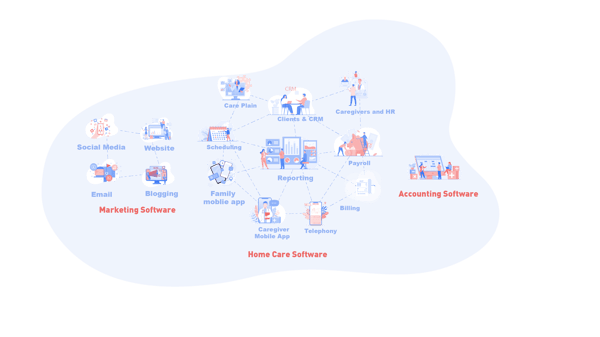

This definitive guide describes the full spectrum of home care software. At the most basic level, every home care business needs to track their work (clients, caregivers, visits, billing, payroll), some accounting software (most agencies we work with use Quickbooks), and a way to be found (a website), so if you’re a home care start-up those are the pieces that you should focus on.
As agencies grow, they use additional software and more sophisticated software. Some vendors, like Ankota, have software that you can afford as a start-up and will support you as you grow to a multi-million-dollar agency.
Chapter 1: Home Care Agency Management Software
Chapter 2: Client Management
-
Demographics: Name, address, phone numbers and related items like client identification numbers
-
Contacts: There are often family members, case managers, referral sources, physicians and other related contacts associated with clients
-
Clinical Records: As explained, the focus of this page is on the ongoing care that keeps elderly and disabled individuals living at home, but there is also “medical home care” that will require tracking of some health records like diagnoses and medications. Note that home care software is generally not expected to be an electronic medical records (EMR) system like they have at hospitals and doctor’s offices.
-
Authorizations: In most cases home care recipients are wealthy or poor. Wealthy individuals are able to afford to pay for the care out of pocket, whereas the poor receive home care benefits through Medicaid. The Medicaid world pays for home care because sending a caregiver for a few hours a day is much lower than the cost of round-the-clock nursing home care (averaging from $60K - $90K per year). Plus the quality of life is much better too! Medicaid and other government programs that pay for home care authorize a specific amount of care that they will reimburse and for agencies serving these patient communities, authorization management is a critical function
-
Care Plans: The term “Care Plan” has many different meanings depending on the discipline of care that is being provided. For ongoing home care, the care plan is generally the list of tasks that the caregiver performs on behalf of the individual. A typical care plan will include help with Activities or Daily Living (ADLs) like dressing and grooming, meal preparation, light cleaning, assistance with bathing and toileting and similar tasks.
-
Schedules: Most home care agencies schedule their caregiving activities for a specific number of hours per week on specific days, and scheduling is a very important part of home care software. There is a family of home care programs called Consumer Directed Services (CDS) where the scheduling is done by the person receiving the care. In some agencies CDS care is not scheduled but instead the visits are “created” when the care is delivered.
-
Special Requirements and Preferences: It’s best to match a caregiver who is compatible with each client, so home care software tracks items like when the client needs a Hoyer lift, spoken language and preferences or habits like pets, smoking, or even “likes to watch sports” that are used for caregiver matching.
-
Methods of payment: The system should track how the bills will be paid such as via credit card, bank draft, through Medicaid or other methods.
Chapter 3: Caregiver Management
-
Demographics: Like name address and caregiver IDs (required so that they can use apps for clocking in and out of their visits)
-
Pay Rates: Often a single hourly rate is set, but some agencies pay different rates for different services
-
Skills and Preferences: Home Care software must track the work that a caregiver is qualified for. In many homecare agencies skills are only assigned to staff who can perform special function like supervisory visits or nursing functions. However, others keep track of spoken languages, preferences such as whether the caregiver is ok serving a client with pets or who is a smoker and other attributes used for matching caregivers to clients.
-
Certifications: Some states require that home care providers be trained and certified to perform CPR or to have had a TB Test each year.
-
Schedules: The software also tracks schedules and caregiver visit history
Chapter 4: Caregiver HR
.jpg?width=600&name=Untitled%20design%20(3).jpg)
-
Applicant Tracking: for prospective caregivers. This tracks where the caregiver was found (or who referred them), education, interview notes, and more.
-
Background checks: Some states and agencies require background checks such as making sure that the caregiver is not listed in the Family Care Safety Registry, the Office of the Inspector General (OIG) List of individuals precluded from providing care or others.
-
Online application form: Ankota’s software provides a way for caregivers to apply online (that can be embedded into your company website)
-
Documentation: This tracks forms filled out or provided by caregivers such as I9, W4, and certificates for things like CPR training.
-
Workflow: Sometimes attaining and keeping up with caregiver information is a process. For example, when it’s time to renew CPR training, you need to inform the caregiver to sign-up for a class, make sure that they attended, make sure that they passed their test and more. A sophisticated system can automate these steps.
Chapter 5: Home Care Scheduling
.jpg?width=600&name=Untitled%20design%20(4).jpg)
Here is a rundown of how home care scheduling works. The modes of scheduling required by an individual home care or home health care business will depend on the types of services that it performs
-
Weekly Recurring Care: For example: Mary goes to see Mrs. Johnson Monday through Friday from 8:00 until noon.
-
Self-scheduled care recurring care: In some “consumer directed care” models, the person receiving the care tells the caregiver when to come and the visits are created when the caregiver arrives.
-
Episodes of Care: On the home health nursing side, including physical therapy, occupational therapy and speech therapy in the home, there is a model called “episodes of care” and there’s a special notation that is used where, for example, they can say 3w2;2w4 to mean that the care is delivered 3 times a week for 2 weeks then twice a week for 4 weeks.
-
Periodic Care: Sometimes nursing and supervisory care is delivered one a month or it may be more complicated such as “the next assessment must be completed within 90 days of the previous assessment”
-
Route optimization: One form of home care is deliveries such as for Meals on Wheels or Home Medical Equipment (HME). In this case the software should optimize the driver’s route to minimize driving time
Chapter 6: Electronic Visit Verification (EVV) for Clocking in and Clocking Out of home care visits

-
EVV has been mandated by the 21st Century Cures Act. In summary, when a caregiver clocks in or out of a visit, the home care agency needs to provide electronic proof of the client, the type of service, the caregiver, and the location. Although the law and mandate is for government reimbursed home care (mostly Medicaid and Veterans care), EVV has been adopted as the standard for private pay home care as well.
-
There are 3 primary ways of gathering EVV data as follows:
-
Mobile GPS App: Caregivers location of arrival and departure is verified by GPS
-
Voice Telephony: Caregivers dial in from the client’s home phone and caller ID is used for location verification
-
FOB Token: A FOB is affixed in the home and generates a code at the arrival and departure time
-
Visits are reviewed electronically for errors: If there is an error in the EVV data or other visit parameters like the duration, the office reviews it, verifies the facts with the client and caregiver, indicates how the issue was resolved with exception codes, and in most cases backs up the facts with a paper timesheet.
Chapter 7: Home Care Billing
-
Private Pay:The agency creates invoices and sends them to the client or their designated payer (such as their daughter). Many private pay clients agree to have their fees charged to credit cards or drawn from their bank account via and ACH payment.
-
Long Term Care Insurance (LTCI):Most LTCI agencies want a detailed description of the care received by the client. There is generally a requirement in LTCI policies for the client to need help with at least two and sometimes three Activities of Daily Living (ADLs)
-
Medicaid:Medicaid services are generally billed as 15 minute units of care. Historically small agencies have entered their claims on a Medicaid portal via Direct Data Entry (DDE) or have submitted 837 claims. Medicaid is administered on a state-by-state basis and as states move over to EVV, the payment methods are changing. In some states, additional information is added to the claim, whereas in other cases visit records are sent to an EVV aggregator that turns it into a claim.
-
Managed Care Organizations Some states have outsourced their Medicaid billing administration and EVV programs to MCOs (most of which are insurance companies). In this case the MCO specifies how claims are to be submitted.
-
Other forms of billing:Most other payers accept some type of paper invoice, paper claim (like a CMS1500 or UB04) or an electronic claim
Chapter 8: Home Care Payroll Processing
-
Overtime:In most cases overtime is payable after 40 hours
-
Travel:Travel pay rules vary greatly by agency. The most typical approach is not to pay to the first visit of the day or to pay for the travel home from the last visit, but payment is generally made for travel from the home of one client to another and for mileage in the caregiver’s personal vehicle for running errands on behalf of their client.
Chapter 9: Remittance Tracking (tracking payments from care recipients and payers)
-
Automatic payments:When bank drafts are taken or credit cards are charged, the charges can be automatically marked as paid
-
Checks:Checks can be entered to pay one or more invoices fully or partially. It’s not uncommon for a client to overpay their balance. In this case the software should track the overpayment and apply it as a credit towards the client’s next bill.
-
Electronic Remittance:Most government payers (Medicaid, VA and MCOs) will deposit your payments into your bank account and they will send a Remittance Advice file (EDI 835). The home care software will apply the payments and based on the 835 will document any rejected claims or partial payments.
Chapter 10: Forms Management
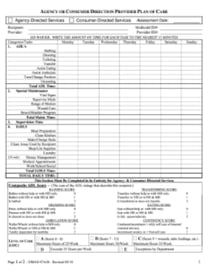
Although home care caregivers mostly work with care plans in the form of check lists, there are documents required as part of the client onboarding process and for initial and ongoing assessments and supervisory purposes. Since many agencies and states have made their own forms, a rich home care software solution will have a form builder.
Additionally, the home care software will have the ability to associate forms with clients and with visits. Another important feature is the ability to fill forms at the point of care in a mobile app, and for that app to work both online and offline.
Chapter 11: Intelligent Notifications
-
Caregiver Notifications:
-
Upcoming visit reminders
-
Late arrivals
-
Time to clock-out
-
Late clock-out warnings
-
Newly assigned visits
-
Available shifts
-
Upcoming expirations of certifications or other items
-
Home Care office staff notifications
-
Late arrivals and departures
-
Visits needing review
-
Expiration of HR Requirements
-
Upcoming birthdays
-
Client Notifications:
-
Reminders of upcoming appointments
-
Notifications of customer satisfaction surveys
Chapter 12: Sales Tracking – Home Care CRM
-
Client demographics
-
Client contacts, most importantly the person contracting for care
-
How the lead was generated (website, post card, referral partner, etc.)
-
Who the referral was from
-
Which marketer or salesperson is in charge of the lead
-
Meetings (such as a home visit) associated with the lead
-
If the client is not won, why not?
Chapter 13: Website and Social Media Marketing
-
Agency name
-
Geographic coverage
-
Personal story – why did you start the business
-
What services do you offer
-
What makes you special or different
-
How can you be contacted (there should be a phone number and web form)

-
A plan to update the site on a regular basis
-
Ability to send an email newsletter
-
Note that a good approach for achieving these items is to tell stories on your website in the form of blog articles and to have those blog articles pushed to social media such as Facebook, Instagram and Twitter
Chapter 14: Accounting Software
-
Track revenue
-
Track expenses
-
Organize the revenue and expenses into a general ledger
-
Track your assets and liabilities (presented on a Balance Sheet)
-
View profit and loss in a statement of cash flows
Chapter 15: Home Health Software

-
Creates an OASIS E (Outcome and Assessment Information Set) for assessing care and determining the reimbursement rate
-
Medical Record tracking (such as diagnoses)
-
Adheres to the PDGM standard (Patient Driven Groupings Model)
-
Allows nurses and therapists to document their patient visits
Chapter 16: Home Health Therapy (Physical, Occupational and Speech)
Chapter 17: Home Infusion and Specialty Pharma
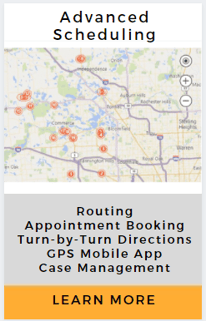
Providing dialysis and other IV drug infusions in the home results in lower costs and less patient exposure to other diseases when compared to having the patients receive treatment in dialysis centers. Home infusion software needs to optimize driving routes for the therapists who administer the treatments. It must also coordinate with the specialty pharma to make sure that the compounded drugs and infusion pumps necessary for treatment are supplied.
Chapter 18: DME/HME - Route Optimization
Durable Medical Equipment (DME) and Home Medical Equipment (HME) are similar terms. DME refers to specific pieces of equipment and HME is the family of services needed to deliver and train the equipment for home use. Most DME/HME businesses have a software package that tracks the equipment that they offer, the quantities on hand, reorder points for inventory management, plus the ability to take orders and bill for those orders.
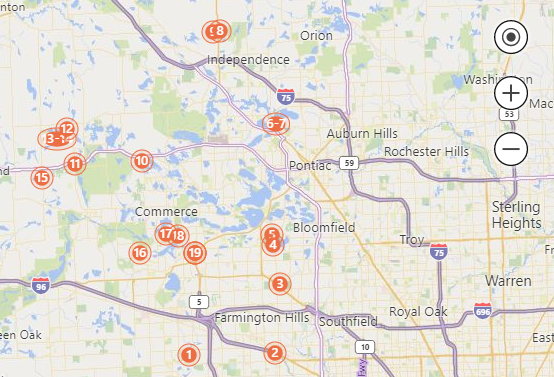
Often DME/HME software needs to be supplemented by software that can track and optimize deliveries.
Chapter 19: Remote Monitoring and Telehealth
In normal times, supervisory personnel and/or on-staff nurses visit with their caregivers and clients on a regular basis for the purposes of supervision and periodic assessment. In order to keep those practices alive during the COVID crisis, telehealth is a great solution.
Additionally, there is a growing shortage of available and qualified caregivers that will only grow. As a result, the need to administer care remotely will grow correspondingly. Today’s seniors are growing in their ability to use technologies like apps, Facetime and Zoom. These factors lead logically to the use of remote patient monitoring and remote chronic care management.
Lastly and importantly, there are a growing number of reimbursable telehealth and remote care services that can be delivered by home care agencies.
Start your free trial