
WE WANT TO HELP YOUR AGENCY TO GROW
If you're on this page, you are likely to be a home care agency owner or manager, and growth is a big topic for you. You've come to the right place.
Our industry needs to grow, and the graph below explains why. Although the time that an individual needs home care varies person to person, looking at the population of 80 year old Americans gives us a good clue, and that number has begun to accelerate.
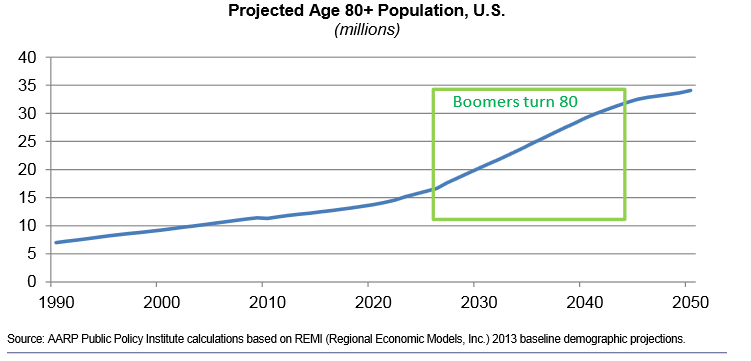
Of course, there are so many other reasons that growth is good for our agencies. As we grow we are able to promote team members, expand our reach in the community, and prosper as owners and managers. Harvard published the article "How Companies can Profit from a Growth Mindset," and summarized with a number of benefits depicted to the right.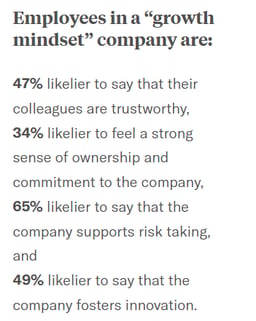
This web-resource here shares many ways that you can grow your agency. The concepts come from experts within the industry, many of whom have been featured on the Home Care Heroes and Day Service Stars Podcast.
The information below is organized into "chapters" and each chapter has successful examples from home care owners and experts like you. Please visit often! We hope that this resource helps you to thrive and we're glad that you're here.
Chapter 1: Make Your Agency Different
Picture a person shopping for home care in your area. I bet the first picture that came to mind was a woman around 45 to 55 years old who is searching for care for her mom.
Next, think of her situation and what's going through her mind. Maybe she just flew to your area when she got the dreaded call that mom fell and is having hip surgery. She left her kids at home, with dad, babysitters, and neighbors helping out. Or maybe she's a family caregiver who has been trying to care for mom on her own but she's exhausted and feeling the toll that caring for mom is taking on her family and her marriage.
She probably found you on Google. Maybe she searched for "Home Care your town" or maybe she tried something different like visiting nurses (which is not what she needs, but it's the first thing she thought of - we'll talk more about that in marketing down below).
Anyway, she got to your site and she's thinking "Should I pick this agency?" or maybe "Should this agency be one of my finalists?" or "Should I give them a call?"
Does Your Agency Stand Out From the Crowd?
A family chooses your agency because something in the first two minutes felt different from the last three agencies they looked at. That is a lower bar than it sounds and most agencies still miss it. The differentiator does not have to be elaborate. It has to be specific, true, and memorable enough that she repeats it to her brother that evening.
- If she sees the same stock photos that she saw on the last three sites and all you say is "Home Care for Elderly People" will she call you?
- If she calls your agency and gets voice mail, how will that make her feel?
- What if instead, your Scheduler answers, tired from a long day dealing with caregiver issue, and the Scheduler says "What do you want?" Will she answer or hang up?
Lesson: Make Your Agency Different
Click here for a full lesson on making your agency different.
Success Stories
Here are a few examples of ways to set your agency apart from others in your market:

Kamran Nassar grew his agency, NuevaCare, so fast that he was listed as one of the fastest growing companies in America. He shared how he did it in his book Caring for Millions and as a guest on the Home Care Heroes and Day Service Stars Podcast.
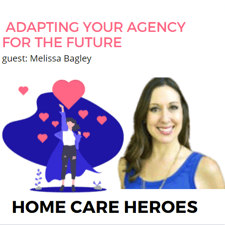
Melissa Bagley is one of the amazing coaches working for Home Care Evolution (the iconic Home Care Consulting firm headlined by Steve the Hurricane). Melissa joined the podcast to teach us about how to prepare our agencies for the future. You can click on Melissa's picture to access her episode where she "deep dives" into managing by the numbers, setting up the right collaborations, and thriving. The episode has complete contact information and also has links to subscribe to the podcast on your favorite podcast player.
One of the anecdotes shared by Kamran (above) was that his agency offered an art therapy program where an artist would come meet with mom, discuss her past memories and represent it with a piece of artwork. This how amazing and different your agency would sound if they had this offering? Kamran also confided that not a lot of clients ended up doing the art therapy project, but just having the offering made the agency different and helped them to achieve their staggering growth.
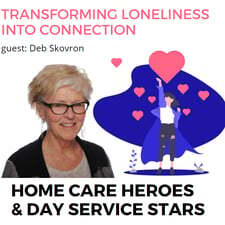
We recently welcomed expert Deb Skovron onto our podcast to discuss her program, CircleTalk. CircleTalk helps caregivers build stronger relationships with their clients and fosters meaningful friendships among home care and adult day care recipients.
Click on Deb’s picture to learn more about CircleTalk and consider whether this could help your agency stand out. If CircleTalk isn’t the right fit, what other innovative programs could set you apart?
You can also listen to our Podcast Episode with Deb Skovron here.
Chapter 2: Recruit and Retain
Recruiting and retaining caregivers is the key to success in the home care industry. The agencies that fail to grow and thrive usually have the opinion that they should get clients first and then recruit caregivers for those clients. By contrast, the agencies who are constantly recruiting gain a reputation for being able to staff cases and fill shifts and they often experience unlimited growth. (99 Recruting Ideas for Hiring Great Caregivers)
But recruiting is only the beginning. According to the Home Care Pulse benchmarking study, the industry as a whole experiences annual attrition > 60%. Many caregivers drop out on the first day they're assigned in the home. Others are recruited away by other agencies, but it's not only for better pay, and in fact the top reason that caregivers go to a different agency is because the other agency can give them the number of hours that they want to work. To combat this, agencies must implement strong retention strategies (12 Ways to Retain Caregivers Longer).

Does Your Team Feel Well-Trained, Supported, and Nurtured?
Caregivers quit most often over hours, not over pay. The top reason caregivers move to a different agency is that the other agency can give them the number of hours they want to work. The second pattern worth knowing is how early the losses happen: a meaningful share of turnover occurs in the first days on assignment, which is an onboarding and support problem rather than a compensation problem.
- Do you provide consistent, thoughtful, individualized, and supportive direction to your team about their job duties? Learn more about Caregiver Quality Assurance - A Process-Based Approach
- Do you make tangible efforts to show appreciation for your team, both individually and as a group? Consider implementing Caregiver Rewards That Make an Impact to boost retention and morale.
- Do you put in the time and thought to create a strong company culture, provide skill building opportunities for employees, and offer incentives such rewarding employees if they generate referrals? 5 Ways to Build a Positive Culture at Your Home Care Agency offers insights into how a thriving culture leads to better retention and
- For more in-depth strategies on caregiver recruitment and retention, check out the Caregiver Recruiting and Retention Bible.
Lesson: Attract, Recruit, and Retain
Click here for a full lesson on attracting, recruiting, and retaining a strong team for your agency
Success Stories
Here are a few examples of ways to set your agency apart from others in your market:

Click the following link for Ankota's comprehensive resource, "Caregiving and Recruiting Retention Bible (Home Care Staffing)" that takes a deeper dive into caregiver recruiting and retention Best Practices.
Stephen Tweed is one of the home care industry's top consultants. I met Stephen at my first home care conference, where he was a keynote speaker. In my view, two things that set Stephen apart are 1) his process-centric approach, and 2) his ability to pull agency owners into "mastermind groups" to establish best practices.

Chapter 3: Marketing That Stands Out
Offering stellar service and compassionate care from a trained caregiving team may feel like enough to stand out from your competition. With so many caring and professional folks in the home care market these days, providing excellent care is just the start of growing a successful home care agency.
How Many of these Marketing Tips is Your Agency Utilizing?
You get more clients by being findable when a family starts looking, credible when they land on you, and fast when they reach out. Most agencies invest heavily in the first, neglect the second, and lose the sale on the third. Median customer acquisition cost was $845 per client in the 2025 Activated Insights Benchmarking Report, so a lead you fail to call back is not a missed opportunity, it is money you already spent and threw away.
- Posting creative, consistent, and engaging content on social media (while interacting with other creators, community organizations, and businesses) Click here for: 4 Ideas for Promoting Your Home Care Agency in Your Community
- Email campaigns and newsletters
- "Snail Mail" outreach to your market
- Participating in or organizing events to present your services and ideas
- Community involvement such as sponsorship, word-of-mouth, and client referrals
- Remarketing or following up with leads via online ads
- Creating "Thought Leadership" posts such as blogs, social media posts, and video content
Lesson: Marketing Tips for Increasing Revenue
Click here for a full lesson on Marketing
Success Stories
Here are a few examples of ways to set your agency apart from others in your market:
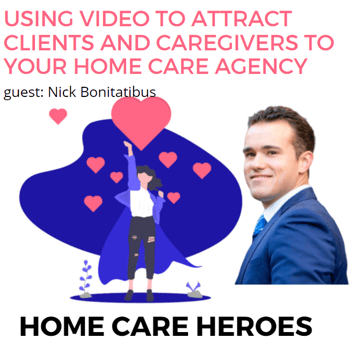
Nick Bonitatibus runs a company called The Digital Champs, which is dedicated to helping home care agencies to create content (mostly easy to make videos) that can attract both clients and caregivers to your home care agency. In this episode of the Home Care Heroes and Day Service Stars podcast. Nick shares his tips for creating content that converts leads to clients.
In today's market, your home care website is critically important. To be effective, it needs to attract visitors and then get them to engage with you. On this episode of the podcast, we have two fantastic experts to tell us how to succeed: Jason Chagnon from Providentia Martketing and Kamran Nassar from AideQuest. Click here to learn more.


Jason Chagnon makes websites and manages the online presence for some of the country's most successful home care agency. On this episode of Home Care Heroes and Day Service Stars, Jason Chagnon), the CEO of Home Care Marketing Pros shares success tips for managing your home care website
Chapter 4: Sales Tips to Blow Away the Competition
We can all agree that finding and "closing" new client leads is integral to a successful home care business. Without a strong pipeline of new clients, a business is unlikely to generate revenue to cover (and hopefully exceed) the cost of doing business. And if you don't have a strong sales process that yields the required revenue to run your business, it's impossible to continue to provide the care and to do the important work that is the reason why we all got into home care.

That all said, for many folks, though we understand and appreciate the need for a strong sales process, even the thought of the word "Salesperson" may make us cringe. I'd guess that many of us have had a negative experience or two of a salesperson being "high pressure", use questionable sales tactics, or just give us a feeling that they are not operating in our best interest.
Ultimately, a business can't survive without sales. The way I view it is that the stronger and more focused an agency's sales process is, the more much needed care they can provide to more clients. Another way to put it is: A better sales process equals more sales which equals more folks getting great care, which equals a win for us all.
What is Your Agency's Sales Process?
A sales process that closes is fast, written down, and owned by a specific person. Speed to first response is the biggest predictable difference between agencies that convert inquiries and agencies that do not, because a family in crisis calls three agencies and often goes with whoever calls back first and sounds like they have done this before.
- Do you have a sales process and is your team well trained on the process? Here's a Home Care Growth Kit: Sales Tips to Blow Away the Competition
- Do you have a Sales Director or a team of folks dedicated to generating, fielding, and following up on sales?
- Do you earn, ask for, and promote glowing clent reviews (via your website or online sources such as Google?) Here's 10 Top Complaints of Clients According to Home Care Pulse.
Lesson: How to Improve Your Sales Process
Click here for a full lesson on creating a sales process, and general sales best practices.
Success Stories
One thing we love is to hear the personal stories of how home care entrepreneurs and agency leaders entered the business and became successful. Karl Pierre is a very interesting and charismatic agency owner with a fun story to share. Check out Karl's story here:

Selling Your Agency

As an agency owner the ultimate sale you can aspire to make is the sale of your agency. If you ever aspire to sell your agency, the time to start thinking about it is now. You can't find a better expert to guide you than Mark Braff from the Braff Group. We were lucky enough to talk to Mark on the Podcast.
Chapter 5: Add New Payers
There are many diverse funding sources for home care. Here are just a few:
- Private Pay
- Long Term Care Insurance
- Medicaid - State Funded
- Disability Services - State Funded
- Veterans
- Medicare Advantage Programs
- and more
Most agencies only focus on one (or perhaps one plus a near neighbor like Private Pay and Long Term Care Insurance). The two biggest "camps" are the Private Pay camp and the Medicaid camp. This makes sense because agencies are usually started to serve the owner's local community and it's rare to have a single community that serves wealthy folks who can afford to pay for home care and economically disadvantages folks who qualify for Medicaid. There are also differences in regulation such as the need for Electronic Visit Verification (EVV) for serving government payers like Medicaid. If you're exploring Medicaid as a funding source, understanding EVV Requirements and its impact on home care operations is crucial.
Is Your Agency Diversifying Services & Sources of Revenue ?
Add a new payer when your growth is capped by the size of your current payer's population rather than by your staffing. Adding a payer is often faster than adding a marketing channel, because the clients already exist and are already looking for a provider. Before you commit, check the rate in your state rather than the rate in general. The same service can be twice as profitable one state over.
- Do you have a long-term plan to expand your service offerings?
- Have you explored ways to increase your service area (geography)?
- Are you taking steps to diversify your team's skills and areas of expertise?
Lesson: Diversifying Can "Future Proof" Your Agency
Click here for a full lesson on making your agency different.
Success Stories
Below are three stories of ways to set your agency apart from others in your market. The first is a way of partnering with an agency who can bring Veterans to your agency. The second is a large home care agency that has partnered with Home Health to support medically complex patients, and the third is an owner who focuses on clients with disabilities:
-1.png?width=350&height=241&name=New%20Source%20of%20Revenue%20Helping%20Veterans%20(with%20guest%20Cheryl%20Hammons)-1.png)
A subset of veterans are entitled to paid home care from the VA, but it's hard to qualify and hard to sustain benefits. This is where Veterans Care Coordination (VCC) comes in.
Podcast guest, Cheryl Hammons, explains how your home care agency can partner with VCC to add a new source of revenue providing home care for veterans on the Home Care Heroes and Day Service Stars Podcast.
BrightStar Care, a $700M national home care franchise set out to prove that their interventions not only result in comfort and quality of life improvements for their clients, but also generate hard healthcare cost savings. They hired a top healthcare research firm, Avalere, to compare the healthcare costs of Medical Care recipients receiving care from BrightStar Care to others who don't.
The results were resoundingly positive showing that on average, BrightStar Care recipients had over $8,000 in healthcare savings, and in some cases the savings were almost $30,000.
In this episode of Home Care Heroes and Day Service Stars podcast, BrightStar Care Founder and CEO Shelly Sun explains why they did the study, what they learned, and how this has effected their work and approach at BrightStar Care.


Lastly, Laseadia "Sean" Pounds provided home care services specifically to medically complex children. Not only did these cases provide a very high reimbursement rate, but Sean's agency was able to grow fast with referrals from other home health, home care and medical agencies who couldn't handle this specialty. Sean spoke on the podcast about the value of mentoring.
Chapter 6: Measurements That Drive Growth
What good is it to read about all of these ways to grow your agency if you're not measuring your growth?
Growth itself is not a specific term. While most businesses want to grow, the specific goals for growth can vary. Some agencies want to grow overall revenue, others want to grow profitability or average hours per client or average time that a caregiver stays on board. You should think about what success means to you and your agency and put the business metrics, sometimes called Key Performance Indicators or KPIs, into place to measure progress.
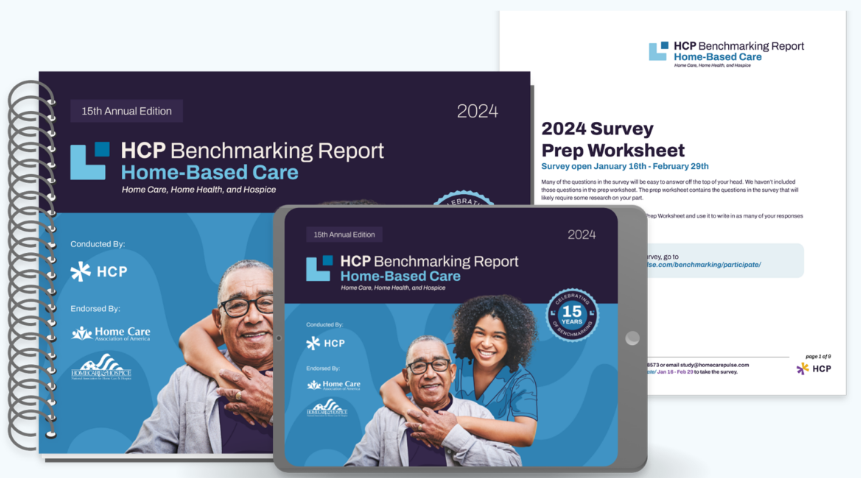
If you're not sure what to measure, the home care industry has a great resource for you to learn more about. It's called the Home Care Pulse Benchmark Report. You can buy last year's report to see what KPIs are being measured in home care and to help you determine the best KPIs for your agency to focus on.
Do You Measure Your Company's Metrics?
Track the numbers that tell you whether you can accept the next case and whether the last one made money. At minimum: total inquiries, inquiry-to-client conversion, customer acquisition cost, revenue, gross margin, hours delivered against hours authorized, caregiver turnover, first-30-day turnover, and client satisfaction. In the 2026 Activated Insights Benchmarking Report, agencies that track every single client inquiry reported median revenue of $3.15 million against $1.40 million for agencies that do not.
- Do you track sales data such as total leads, closed leads, and customer churn?
- Do you measure revenue and your gross margins?
- How about client and employee satisfaction? By what method?
Lesson: Make Your Agency Different
Click here for a full lesson on tracking measurements that drive growth.
Success Stories
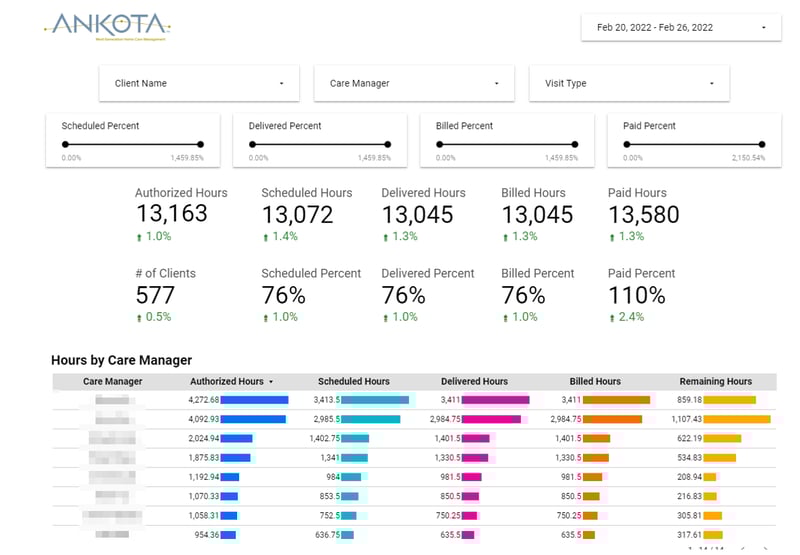
Your home care software should be able to provide you with the metrics you need to support your KPIs. This dashboard from the Ankota Home Care Software shows how an agency is performing relative to the number of hours they're authorized for.
Chapter 7: Add Adult Day Services
At the top of this page, we start with the wonderful news of the growth in the population of folks who need home care and how our industry needs to more than double to meet this demand. The corresponding unfortunate news is that the population of likely candidates for caregiver jobs is declining (and has been for around 15 years).
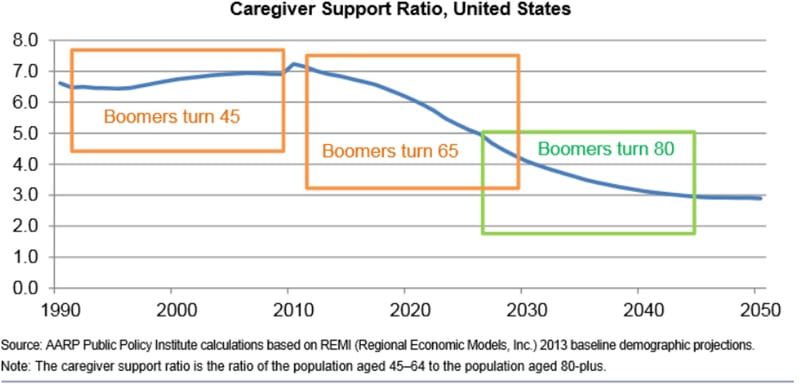
Part of the solution will require us to rethink the our industry and to find ways that we can provide more care with less staff. One way to do that is to add a day services program where folks come to a care center to receive services. The benefits of combining home care and day services are huge:
Adult day services are one of the few structural answers to the caregiver shortage. In home care you need one caregiver per client. In a day services setting one staff member supports several participants at once, so adding a day program changes the arithmetic of your capacity rather than just improving your odds in the same hiring pool. Ratios are set state by state, so confirm yours before modeling anything.
Benefits of Combining Home Care with Adult Day Services:
Here are a few of the key benefits
- One care provider can generally care for up to 5 care recipients (ratios are set state-by-state)
- Your new caregivers can get on the job training in your day center, making them better prepared for when they are the sole provider in a client's home
- Since the combination of scheduled staff plus trainees will push your staffing levels above the required ratios, you're in the position of sending experienced staff to meet with prospects on short notice
- Participants in a day program will be able to make friends and participate in group activities, increasing their experience of care
Success Stories
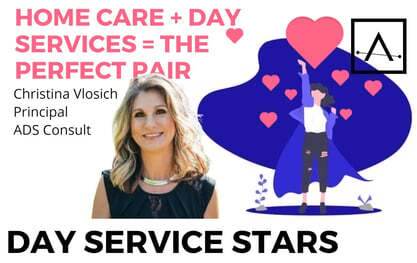
We were able to have one of the top Adult Day Service consultants, Christina Vlosich, join us on the podcast. In fact, her episode was the inaugural episode in which we changed to podcast to be Home Care Heroes and Day Service Stars.
Chapter 8: Add Coordinators (and a New Business Model)
One of home care's most memorable consultants is Steve "the Hurricane" Weiss who runs Home Care Evolution by Hurricane Marketing Enterprises. Steve's organization used to be focused solely on Marketing but now they've branched into many areas including recruiting and retention, operational efficiency and sales. If you want to experience Steve the Hurricane, just Google the name and you'll have a chance to see many educational videos that he offers. But the best way is to meet Steve and his team is to go to one of their home care boot camps.
I attended a recent "Millionaire's Bootcamp" with Steve where over 100 agencies were represented, and learned a ton. One session that stuck out was a session on Care Coordinators, which is a way that some agencies have created career paths, improved care, and grown their profit margins.
Steve joined us on home care heroes to speak specifically about how Care Coordinators have led to this success.
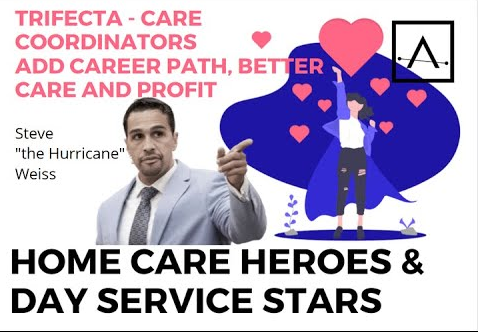
Care coordinators add margin by putting a higher-billing, higher-skill role between your caregivers and your office, which raises the value of the visit and gives your best caregivers somewhere to be promoted to. It solves a retention problem and a profitability problem with the same hire. In most agencies a caregiver's only path up is out of caregiving entirely and into the office, and there are very few office seats.
Chapter 9: Achieve Work/Life Balance
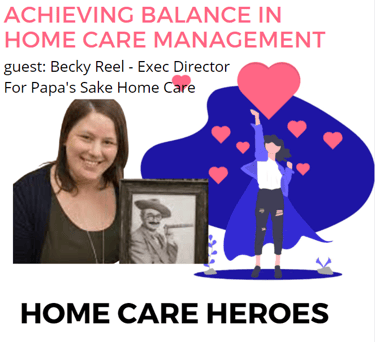
Starting, growing, and running a business is hard and one way to stop your growth is to become so overwhelmed that you are just treading water.
Two of the most respected leaders in the industry experienced this themselves and wanted to share their lessons learned with you. The first is Becky Reel, Executive Director of For Papa's Sake. The winner of Best Agency of the Year in the Home Care Pulse survey. Learn more here.
Grow without burning out by building an agency that runs on process rather than on you. An owner who is the single point of failure for scheduling, sales and staffing has already found the ceiling, and no amount of additional effort raises it.
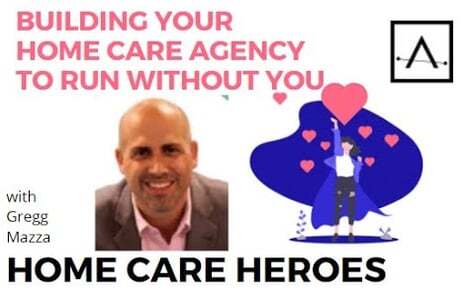
Another industry leader who not only overcame burnout, but teaches others how to do the same is Gregg Mazza, who runs Home Care Breakthrough Solutions. Gregg did an episode on Home Care Heroes entitled Building Your Home Care Agency to run without you.
Another way to be part of the home care community is to join Gregg's Home Care facebook group.
Chapter 10: Keep up with AI and Tech Advances
The first time that I remember hearing about artificial intelligence (AI) was in the 1980s when told the story of a military computer that thought were were facing global nuclear war and the computer was trying to find a way to win.
In more recent history, AI kind of snuck up on us. Amazon.com started recommending what else I might want to buy, Netflix seems to know what I might want to watch next, Gmail can finish my sentences for me, Bank of America can deposit checks through my phone, and more.
Next came ChatGPT. This AI program is very dynamic and can eloquently answer questions as nuanced as: "How does James Cameron's Avatar movie compare with Colonialism in the previous centuries?" It's answer to that question is better than any paper I wrote back in high school.
Click here to for a full lesson about what home care day services need to know about AI.
See Details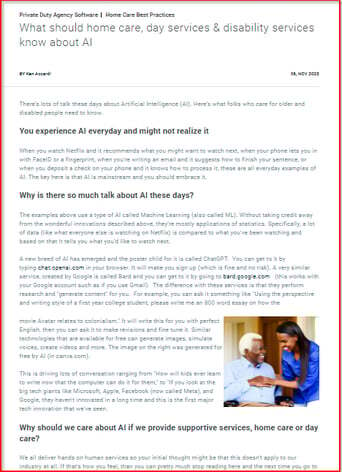
Use AI where it removes repetitive work from your office staff and where it gives you an early warning you did not have before. Start with back-office, low-risk tasks, keep a human on every decision, and never ship raw output to a client or a caregiver. Home care is a relationship business, and done wrong, AI makes you sound robotic.
Success Stories
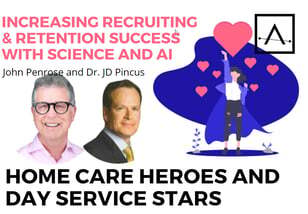
John Penrose, the CEO of a company called Agile Brain, and one of his chief scientists Dr. JD Pincus share how their company can help your recruiting and retention efforts on a recent episode of our Home Care Heroes and Day Service Stars podcast.
Most surveys are long, boring and not very accurate. Participants typically respond without much thought or even understanding. AgileBrain is different. It's a 3-minute exercise where you select images that correspond to ways you feel. So, it's fun, fast and easy to do even for caregivers with limited English language skills. And because AgileBrain is grounded in science, the results are astounding... AgileBrain can predict how long a caregiver candidate is likely to stay and give you early warning about existing caregivers' likelihood to quit. Armed with this information you can take actions to recruit and retain better.

Miki Rosanis, is an Occupational Therapist working for an artificial intelligence (AI) company called SENSI.AI. They have created the world's first Virtual Care Assistant. If you have no idea what this means, then you definitely need to check out this episode of Home Care Heroes and Day Service Stars podcast!
Sensi's technology has been specifically developed to assist home care agencies in the US. The Artificial Intelligence technology senses sounds in the care environment and provides sights to the home care agency and to the client's family.
Our own "Home Care Software Geek" goes over the basics of Artificial Intelligence (AI) starting in this blog post here: "Home Care Software Geek Explains What you Need to Know About Machine Learning and Deep Learning"

Chapter 11: Earn High-Margin Revenue by Assisting with Facility Placements
Sadly some clients will reach a point where facility care is their best option. Also, I'm sure you get calls all the time from families seeking a "Care Home" instead of "Home Care." Today these scenarios are probably just a nuisance. But... what if you could turn then into high margin revenue?
Care facilities (Assisted Living, Continuing Care Retirement Centers [CCRCs], Memory Care Facilities) generally pay a hefty commission for referrals that lead to new residents for their center. In general, when a center has empty rooms they don't cut staff or reduce food purchases, they just lose margin, so if you can bring them someone who joins their center, they'll pay. We've heard of fees ranging from $1,500 to over $8,000 for a single placement.

Can Your Agency Make money by adding a placement service?
Yes, and most agencies leave this money on the table. Assisted living communities, continuing care retirement communities and memory care facilities generally pay a commission for referrals that convert into new residents, with reported fees ranging from $1,500 to over $8,000 for a single placement. You are almost certainly generating these referrals for free already.
- Do clients sometimes need to leave your care and move to a facility?
- Do you receive inquiries from clients who aren't appropriate for home care and would be better off in residential care?
- Do you expect that the residential facilities in your area sometimes refer their clients for home care?
Success Story
The following episode of the Ankota podcast takes a deeper dive into the concepts explained above
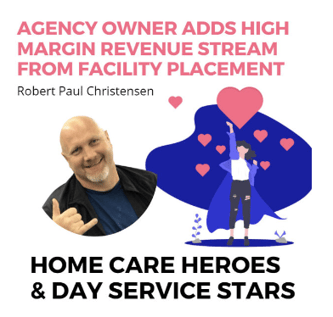
As noted above, Rob Christensen is a home care veteran who has runs 4 agencies and day services. He noted that s
ome clients get to a stage where they need to have 24-hour care and they can't afford to have that service in their home. Rob learned that facilities are willing to pay a handsome finders fee (generally one-month of the facility fee) for a new referral. So Rob added a service for placing clients in facilities. The results have been highly beneficial in a number of ways, described here via this link.
Chapter 12: Articles Related to Home Care Growth
Here are some curated articles to help with home care agency growth:
Software for Home Care Growth

Chapter 13: frequently-asked-questions
Short answers to the questions home care owners and managers ask us most.
How do I grow a home care agency?
Grow a home care agency by expanding your staffing capacity first, then your client acquisition and payer mix. Demand for home care already exceeds industry capacity, so the binding constraint for most agencies is the ability to staff cases rather than the ability to find them. Recruit continuously, reduce first-30-day turnover, and add a second payer source before adding a second marketing channel.
How fast do I need to interview a caregiver applicant?
Within four days. Agencies that interview caregiver applicants in under four days are 100% more likely to hire them, according to Jen Waldron of Augusta Software. Because one-click job applications let a caregiver apply to fifteen or twenty positions at once, agencies compete primarily on who responds first rather than on the job posting itself.
Why do caregivers quit?
Caregivers most often leave because another agency can give them the number of hours they want to work, not because of pay alone. A significant portion of turnover happens within the first days of an assignment, which points to onboarding and support rather than compensation. Median caregiver turnover was 75% in the most recently published Activated Insights Benchmarking Report covering 2024 data.
How can I improve caregiver retention without raising pay?
Hire against named values rather than credentials, and make recognition structural. Consultant Ginny Kenyon screened for compassion, loyalty, dependability, respect, and commitment to lifelong learning, and found values fit more predictive of retention than credentials. She paired it with a tenure ladder of star pins at six months and personalized lab coats at one year.
How much does it cost to acquire a home care client?
Median customer acquisition cost was $845 per client in the 2025 Activated Insights Benchmarking Report, covering 2024 data, which was a six-year high. That figure makes response time on inbound inquiries a financial issue, not just a service issue, since an unreturned call wastes acquisition spend that has already been incurred.
What KPIs should a home care agency track?
Track total inquiries, inquiry-to-client conversion rate, customer acquisition cost, revenue, gross margin, hours delivered against hours authorized, overall and first-30-day caregiver turnover, applicant-to-interview time, and client and caregiver satisfaction. Agencies that track every client inquiry reported median revenue of $3.15 million versus $1.40 million for those that do not.
Is EVV required for Medicaid home care?
Yes. Electronic Visit Verification is required under Section 12006(a) of the 21st Century Cures Act. Compliance was required for Medicaid personal care services as of January 1, 2020 and for home health services as of January 1, 2023. States face incremental reductions in federal matching funds if they are not compliant, so they enforce EVV requirements on providers.
Is self-direction a threat to home care agencies?
Self-direction undercuts traditional agency rates but creates a new service opportunity. Self-directed families typically pay caregivers roughly $18 to $22 per hour against a program rate near $24, compared with agency billing that can approach $60 per hour. The growth position for an agency is on the administrative side, since participants consistently report the employer paperwork burden as the program's main weakness.
How much do home care agencies charge per hour?
The national median rate for a non-medical caregiver was $35.00 per hour in the CareScout Cost of Care Survey covering 2025, released in March 2026, up 3% year over year. CareScout now reports homemaker services and home health aide services as a single non-medical caregiver category rather than two separate rates.
Can a home care agency make money on facility placements?
Yes. Assisted living communities, continuing care retirement communities, and memory care facilities commonly pay a referral commission for a placement that becomes a resident, often around one month of the facility fee. Reported fees range from roughly $1,500 to over $8,000 per placement.
Should a home care agency add adult day services?
Adult day services let one staff member support several participants at once rather than the one-to-one ratio required in home care, which raises capacity without requiring proportionally more hiring. Staffing ratios are set state by state and efficiency improves with scale, so confirm your state's requirements before modeling.
Is the home care industry still growing?
Yes. The US population aged 80 and older grows from 15.0 million in 2025 to 26.8 million in 2040 and 30.1 million in 2050, based on US Census Bureau population estimates and the 2023 National Population Projections. The Bureau of Labor Statistics projects 17% employment growth for home health and personal care aides from 2024 to 2034.
Ankota's mission is to enable the Heroes who keep older and disabled people living at home to focus on care because we take care of the tech. If you need software for home care, EVV, I/DD Services, Self-Direction FMS, Adult Day Care centers, or Caregiver Recruiting, please Contact Ankota. And if you're ready to see how the most innovative agencies are using AI to empower their caregivers and automate the rest, meet your new companion at www.kota.care.