
Adult Day Care Activity Ideas to Keep Clients Engaged
Adult day care centers provide a vital service, offering a ...

The home care "caregiver shortage" isn't always a shortage of people - it's a failure of logistics and geography. Agencies that filter for zip code, availability, and speed-to-interview before they filter for "vibes" win the caregivers everyone else loses. At Ankota, we've seen that the fastest way to fix recruiting is to run it like a logistics business and use AI to scale the precision that small, neighborhood-based agencies already have naturally.
In the home care industry, we talk about the "caregiver shortage" as if it's an unavoidable weather event. It isn't. After reviewing the recent Augusta 2025 Caregiver Recruitment Benchmark Report (an analysis of more than 110,000 applications) and listening to Jen Waldron on the Home Care Strategy Lab Podcast, a different picture emerges: the industry's recruiting problem is less about scarcity and more about how agencies sort, post, and respond.
"I had the chance to welcome Jen on our very own Home Care Heroes and Day Service Stars Podcast a while back and it's great to hear the latest from the expert. That interview was mostly about reducing "ghosting" by caregiver candidates. This updated review dives deep into best practice and includes analysis of over 100,000 interview logs" Ken Accardi
If you're struggling to fill shifts, you are probably making one or more of these four common mistakes.
Most agencies look for "the right heart" first. Empathy is essential, but it's the wrong first filter. The data shows caregivers prioritize two things: "Can I make the money I need?" and "Does this fit into my life?" If a candidate is an angel but lives 30 miles from the client, they aren't a hire. They are a distraction for your recruiting team.
[Ankota Perspective]: "We often tell our partners that home care is, at its heart, a logistics business. You can't provide great care if the person isn't there. By reversing the funnel and filtering for zip code and availability first, you free your recruiters to spend their human energy only on the people who can actually show up for the client."
There is a paradox in our industry: small agencies often have better recruiting conversion than big ones, because the recruiter and the scheduler are the same person. They aren't looking for a "Boston caregiver." They are looking for someone to cover the east side of Natick on Tuesday and Thursday mornings.
When you post a generic "Greater Boston" ad, you end up with a Framingham caregiver applying for a Peabody job. When that candidate realizes the commute is impossible, they feel ignored or misled, and you've likely lost them for any future jobs in their actual neighborhood - even the ones you'll have next month.
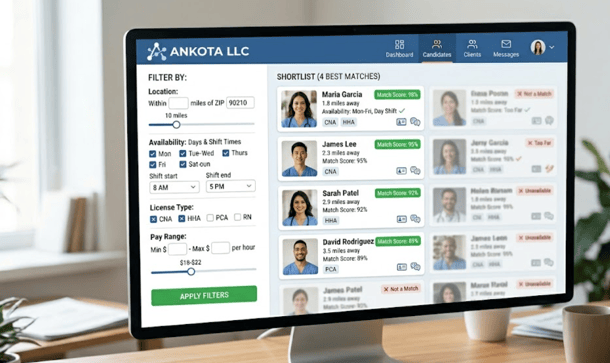
The fix: Use AI to scale small-agency wisdom. Instead of casting one giant net, use AI to auto-generate hyper-local job postings that specify the neighborhood, the shift pattern, and the pay.
[Ankota Perspective]: "The secret to fixing recruitment is hyper-localization. AI shouldn't just filter applicants - it should help you customize your outreach. If you're specific about the geography in the post, you respect the caregiver's time from second one. At Ankota, we believe technology should help large agencies act with the precision and 'neighborhood feel' of a small local provider."
The Augusta report highlights that roughly 70 percent of applicants are fundamentally a mismatch - wrong license, wrong hours, wrong geography, or a combination. Forcing human recruiters to manually sift through this noise leads to burnout and slows your response time for the qualified 30 percent.
The fix: Let technology handle the logistics math - license, location, and available hours - so your office staff can focus on building relationships with the candidates who can actually work the shifts you need to fill. This is one of the clearest examples of AI in home care moving past hype and into practical, daily use.
The Augusta report found a four-day cliff. If you don't interview a candidate within four days, the likelihood of actually hiring them drops sharply. In the time it takes you to "batch" resumes and review them Friday afternoon, that caregiver has already accepted a position with the agency that called them in four minutes.
This is why speed-to-interview matters more than almost any other single metric in recruiting. And it's also why recruiting and retention are the same conversation: the agency that moves fastest on day one tends to be the agency that invests most carefully in the first 100 days after hire. For more on that stage, see our guide to the first 100 days of caregiver retention.

The shift we need is to move away from "searching" for heroes and toward "matching" for lives. When we solve the logistics (the commute, the neighborhood, and the speed of the offer), we create the stability caregivers need. Only then can they show up and do the work they are truly passionate about: supporting care that keeps people home.
Ankota's caregiver retention and recruiting tools are built around the idea that recruiting is a logistics problem first. We help agencies filter applicants by geography and availability, generate hyper-local job postings, and shrink the gap between application and interview so you stop losing good caregivers to the four-day cliff. If you want to see how we do it, contact Ankota for a walkthrough.
Filtering for "the right heart" before filtering for logistics. Empathy matters, but if a candidate can't reach your client's home or can't work the hours you need, they aren't a hire. Filter for zip code, availability, and pay fit first, then evaluate for care quality.
Within four days at the outside, and ideally within hours. Data from the Augusta 2025 Caregiver Recruitment Benchmark Report shows a sharp drop-off in hire rates after the four-day mark. By the time most agencies review applications as a weekly batch, qualified candidates have already been hired elsewhere.
It helps when applied to the logistics layer. AI is strong at generating hyper-local job postings, screening applicants against license, location, and hours, and routing the qualified 30 percent to a human recruiter quickly. It is not a replacement for the relationship-building that experienced schedulers and recruiters do.
Because the recruiter and the scheduler are often the same person. They know which zip codes have open shifts, they know which caregivers live nearby, and they respond quickly. Large agencies can get the same effect by using technology to scale that precision instead of posting generic regional ads.
Agencies that move fastest on day one are usually the ones paying attention to the first 100 days after hire. Fast, specific, personal recruiting signals a well-run agency, and it sets the tone for the onboarding and scheduling experience that determines whether a caregiver stays.
Track time-to-first-contact, time-to-interview, percentage of applicants who meet your core logistics filter (license, location, hours), and first-90-day retention. Those four metrics together will tell you whether you are winning the right caregivers and keeping them long enough to matter.
Ankota's mission is to enable the Heroes who keep older and disabled people living at home to focus on care because we take care of the tech. If you need software for home care, EVV, I/DD Services, Self-Direction FMS, Adult Day Care centers, or Caregiver Recruiting, please Contact Ankota. And if you're ready to see how the most innovative agencies are using AI to empower their caregivers and automate the rest, meet your new companion at www.kota.care.

Ken is the founder and CEO of Ankota, a company that helps any organization that helps older or disabled people live independently in their home of choice. Having grown up with a disability and a passion for healthcare, this is Ken's mission
.png)
.png)




Trusted by home care agencies nationwide