
Adult Day Care Activity Ideas to Keep Clients Engaged
Adult day care centers provide a vital service, offering a ...
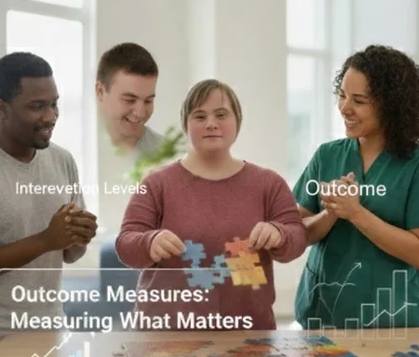
In disability services, we often ask ourselves: "Is this person making progress?" But progress toward what, exactly? And how do we know when someone has truly achieved independence in a skill or goal?
The answer lies in a deceptively simple principle: The best outcomes are achieved with the least intervention. When someone can accomplish a goal independently—without prompts, gestures, or physical assistance—that's when we know real progress has been made.
This article explores how outcome measures work in intellectual and developmental disability (I/DD) services, why they matter, and how the right approach to measurement can transform the way we support people toward greater independence.
Think about teaching a child to ride a bicycle. At first, you run alongside holding the seat. Then you let go for a few seconds. Eventually, they're riding on their own while you watch from the sidewalk. The goal isn't just to get the child from point A to point B—it's to get them there independently.
The same principle applies in disability services. True success isn't just about completing a task; it's about completing it with progressively less support until the person can do it on their own.
This is measured through two interconnected scales:
Intervention Levels (the amount of support provided):
Outcome Scores (the result achieved):
The magic happens when you track both together. A person who achieves "Goal Met" with "Independent" intervention has reached true mastery. Someone who achieves "Goal Met" but requires "Full Physical" assistance has accomplished the task, but isn't yet independent in performing it.
Outcome measures in disability services aren't just about internal tracking—they're increasingly tied to national benchmarks and regulatory compliance. Three major frameworks guide how agencies measure and report outcomes:
The National Core Indicators program is a collaborative effort involving 46+ state I/DD agencies that measures outcomes at the individual level. NCI tracks key indicators including:
Your goal tracking data feeds directly into these broader outcome measures, showing not just that someone is receiving services, but what impact those services are having on their independence and quality of life.
The 2014 Home and Community-Based Services (HCBS) Settings Rule fundamentally changed how we think about service delivery. The regulation requires that HCBS services support integration, independence, and individual choice—not just custodial care.
When you document that someone is progressing from "Full Physical" assistance to "Verbal Prompt" to "Independent," you're demonstrating compliance with the HCBS principle of promoting independence and community integration.
Person-centered planning puts the individual at the center of their own service plan. Outcome measures must reflect their goals, not just programmatic benchmarks.
This is where the flexibility to track diverse goals becomes critical. One person's goal might be competitive employment; another's might be maintaining their ability to make a sandwich as dementia progresses. Both are valid, person-centered outcomes that deserve measurement.
For more background on these and other key concepts, see our guide to disability services terminology.
Once you've collected data on interventions and outcomes, how do you calculate overall success? There are two primary approaches, each with distinct advantages.
The simplest approach treats outcomes as either successful or unsuccessful, with certain situations excluded from the calculation entirely.
Using our 0-5 scale: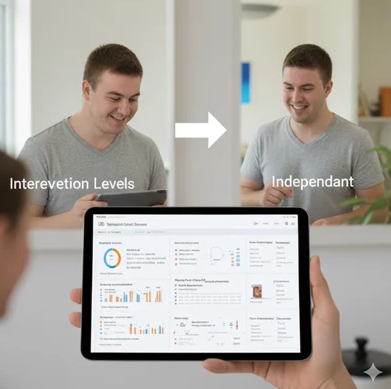
Example scenario: Michael worked on his medication self-administration goal throughout March with these results over 28 days:
Calculation:
This method provides a clear, unambiguous measure of complete goal achievement. It's particularly useful for compliance reporting and skills that truly require full mastery (like medication management or safety-related tasks).
The limitation? It doesn't give credit for meaningful progress that hasn't yet reached full goal completion.
This approach recognizes that meaningful forward movement—even when a goal isn't fully met—represents success worth measuring.
Using our 0-5 scale:
Example scenario: Sarah worked on her community navigation goal throughout April with these results over 30 days:
Calculation:
If we had used Method 1 (counting only Goal Met), Sarah's success rate would have been just 44% (12/27), which doesn't reflect the substantial progress she's making.
This method is particularly valuable for:
Many agencies use both methods for different purposes:
The key is consistency define your methodology clearly and apply it uniformly across your program.
To make those outcome metrics meaningful in everyday practice, it helps to have a clear process for setting and monitoring goals. Learn more about goal tracking and strategy management in disability services.
Here's where technology makes a real difference. Rather than hard-coding a single scoring methodology, modern I/DD software platforms should allow agencies to configure which codes count as "success" and which should be excluded from calculations.
Why does this matter? Because different states, funding sources, and service philosophies may have different definitions of success. One agency might count "Significant Progress" as success; another might require "Goal Met" only. Some programs exclude "Refused" from calculations; others include it as a data quality measure.
At Ankota, our I/DD software uses a configurable approach where agencies can define their own scoring parameters while maintaining the underlying 0-5 scale structure. This means you can align with your state's requirements or your agency's philosophy without requiring custom development.
As long as you're working within a consistent scale (0-5 for both interventions and outcomes), the system can calculate success rates, track progress over time, and generate reports that meet your specific compliance needs.
No discussion of outcome measures in disability services would be complete without mentioning Active Support—a evidence-based practice that perfectly embodies the principle of "best outcome with least intervention."
Active Support is a framework developed in the UK (with significant research by Julie Beadle-Brown at the University of Kent) that emphasizes graded assistance—providing just enough support for someone to successfully participate in an activity, then systematically reducing that support over time.
The Active Support approach aligns beautifully with outcome measurement because it:
When you're tracking both intervention levels and outcomes, you're essentially documenting Active Support in action. You can see when staff are appropriately fading prompts, when someone is ready for less support, and when additional intervention is needed.
For a deeper dive into this methodology, read our article on Active Support in disability services.
There's an uncomfortable reality we need to address in outcome measurement: sometimes the best outcome is simply maintaining current abilities.
For individuals with progressive conditions—whether due to aging, dementia, degenerative neurological conditions, or other health challenges—"no change" or even "slowed decline" may represent a significant victory.
Consider an 82-year-old man with early-stage dementia who has been preparing his own breakfast independently for decades. Six months ago, he needed no prompting. Today, he needs a verbal reminder to turn off the stove. In another six months, he might need gestural prompts to locate ingredients.
Traditional outcome measures might code this as "regressing" or "requiring increased intervention." But the real story is more nuanced: with appropriate support, this person is maintaining his independence in meal preparation far longer than he might otherwise. That's a win.
This is why outcome measurement systems need flexibility to recognize that:
In practical terms, this means:
The measure of good services isn't always upward trajectory—sometimes it's honoring someone's dignity and independence for as long as possible as they face inevitable changes.
If you're ready to implement or improve outcome measurement in your disability services program, here are the key steps:
1. Choose Your Scales Start with a simple, standard intervention hierarchy (Independent → Verbal → Gestural/Visual → Partial Physical → Full Physical) and outcome scale (Goal Met → Significant Progress → Minimal Progress → No Progress → Regressing).
2. Define Your Scoring Methodology Decide which codes count as "success" and which should be excluded from calculations. Document this clearly so everyone understands how success is measured.
3. Train Your Team Direct support professionals need to understand not just what to document, but why. Help them see that tracking intervention levels isn't bureaucracy—it's how we know when someone is ready for less support.
4. Use Technology Wisely Choose software that makes documentation easy and generates meaningful reports without creating burden. Look for configurable systems that can adapt to your needs rather than forcing you into a rigid framework.
5. Review and Adjust Outcome data should drive service planning. When someone consistently achieves goals with minimal intervention, it's time to reduce support levels. When someone shows no progress despite maximum intervention, it's time to re-evaluate the approach.
Choosing the Right Software for Disability Services
If your current tools make this kind of tracking painful, it may be time to choose the right software for disability services that puts goals and progress at the center.
Outcome measures in disability services are more than compliance requirements—they're the mechanism by which we demonstrate our commitment to independence, dignity, and person-centered support.
When we measure both the outcome (did they achieve the goal?) and the intervention (how much support did they need?), we capture the full story of progress. We can celebrate when someone moves from needing hand-over-hand assistance to just a verbal reminder. We can recognize when maintaining current abilities represents success in the face of decline. And we can demonstrate, with data, that our services are truly making a difference in people's lives.
The goal isn't to create paperwork—it's to clear the path for independence, one measured goal at a time.
Ready to implement comprehensive outcome tracking in your disability services program? Ankota's I/DD software includes configurable outcome measures, intervention tracking, and person-centered planning tools designed specifically for intellectual and developmental disability services. Our platform makes it easy to document progress, generate compliance reports, and focus on what matters most—supporting people toward greater independence. Learn more about Ankota's I/DD software or schedule a demo today.
Ankota's mission is to enable the Heroes who keep older and disabled people living at home to focus on care because we take care of the tech. If you need software for home care, EVV, I/DD Services, Self-Direction FMS, Adult Day Care centers, or Caregiver Recruiting, please Contact Ankota. If you're ready to accept that the homecare agencies of the future will deliver care with a combination of people and tech, visit www.kota.care.

Ken is the founder and CEO of Ankota, a company that helps any organization that helps older or disabled people live independently in their home of choice. Having grown up with a disability and a passion for healthcare, this is Ken's mission
.png)
.png)



Trusted by home care agencies nationwide