
Adult Day Care Activity Ideas to Keep Clients Engaged
Adult day care centers provide a vital service, offering a ...

California's Self-Determination Program (SDP) gives people real control over how services are delivered. But before any of that freedom becomes real, there's a very practical step that trips up a lot of families and facilitators: building a clear, compliant spending plan.
If you've ever stared at service codes, rates, and budget tables wondering whether you're doing it "right," you're not alone. The rules are specific, the terminology isn't intuitive, and most tools weren't designed with everyday users in mind.
This article breaks down how California SDP spending plans actually work, what commonly goes wrong, and how to build one more easily using a free SDP spending plan calculator.
In California's SDP, the individual budget and the spending plan are related, but they're not the same thing. The individual budget sets the total annual amount available. The spending plan shows how that budget will be used across specific services, rates, and providers.
Think of the individual budget as the ceiling, and the spending plan as the detailed map underneath it. The spending plan must:
When spending plans are unclear or inconsistent, approvals slow down and revisions pile up.
Managing a spending plan requires a trusted partner—explore the role of a fiscal intermediary in making participant-directed care work.
Before a spending plan can be built, California SDP requires an individual budget calculation based on real historical data. This isn't just looking at last year's total and copying it forward. The calculation is more nuanced than that.
The budget calculation typically starts with baseline spending from the prior 12 months of Regional Center services. But that baseline gets adjusted in several ways:
The official DDS budget calculation tool follows this logic closely, but it's formula-protected and not especially friendly for ongoing planning or scenario testing. That's where people often get stuck.
Not every helpful idea qualifies as an SDP service. Spending plans must be built using approved SDP service definitions and service codes, grouped into clear budget categories.
Most spending plans include services across areas like living arrangements and community living supports, employment and community participation, and health and safety supports. Each service must map to a specific SDP service code, such as Community Living Supports, Employment Supports, Technology, or Respite. The name alone isn't enough. The service has to match the official definition, purpose, and billing structure.
This is where many plans run into trouble. A service that sounds reasonable can still be denied or delayed if:
Clear alignment between goals, services, codes, and costs makes approvals smoother for everyone involved.
Self-Direction vs. Self-Determination
If you work in multiple states and are confused by California’s language, our article on self-direction vs. self-determination shows how SDP fits into the broader national picture.
After working with SDP participants, facilitators, and FMS providers, the same issues show up again and again. People often treat the spending plan like a rough estimate instead of a working budget. They mix individual budget math with spending plan details in ways that confuse rather than clarify. They use spreadsheets that only one person understands, which creates bottlenecks and errors when someone else needs to make changes. Services that are excluded from the SDP budget get accidentally included. And changes get made without anyone seeing how they affect the annual total until it's too late.
Most of these aren't policy mistakes. They're tooling and clarity problems.
To make this easier, we built a free California SDP spending plan calculator designed for real-world use. The calculator:
It's designed to support conversations, not replace them. Whether you're preparing for planning meetings or refining an approved plan, the goal is transparency and confidence. Press here to access the tool (or click on the image below)
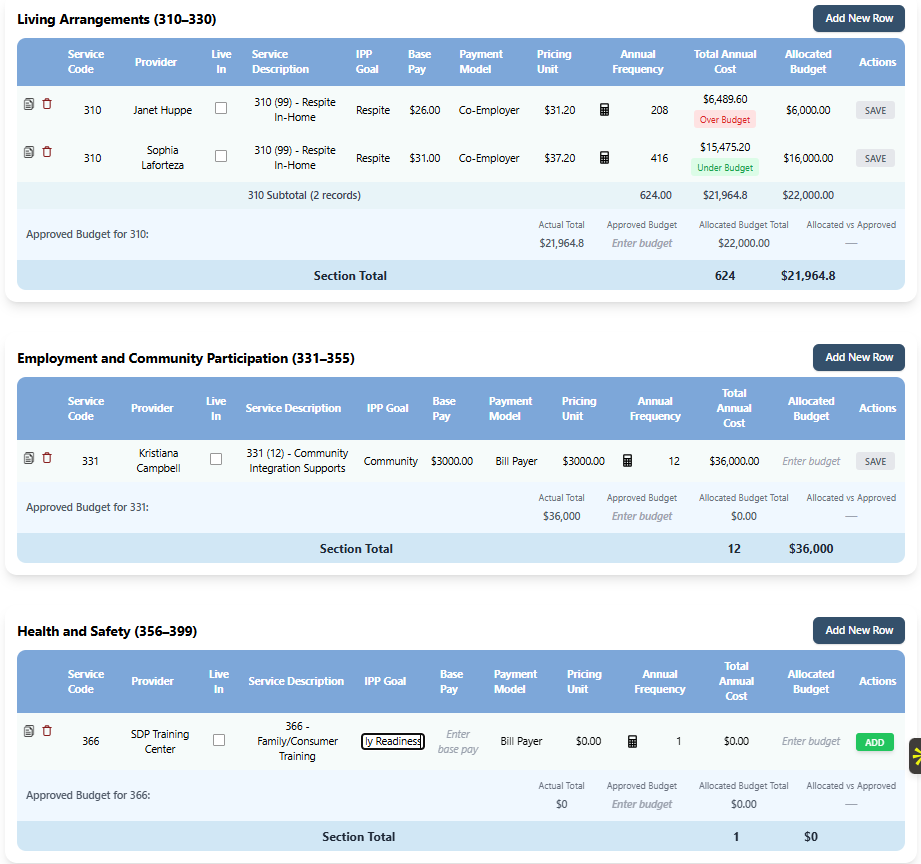
This tool is especially useful for:
The clearer the plan, the easier it is for everyone to do their part.
Keeping these budgets on track is much easier with the right technology; see which self-direction software is best for FMS agencies.
Self-determination is about choice, flexibility, and control. The spending plan shouldn't feel like a barrier to those goals.
When budgets are understandable, services are clearly mapped, and everyone can see where the money is going, the program works the way it was intended to. Good tools don't replace human judgment. They just make it easier to use.
Self-Determination in Action (Podcast)
If you’d like to hear what this looks like in real life, our self-determination in action podcast episode follows a California family as they move into SDP and start using their spending plan to build a better life.
Ankota provides software for Self-Determination Financial Management Service providers and self-determination programs in California and other states.
We focus on making SDP budgets and spending plans easier to understand, easier to manage, and easier for participants to engage with. That includes helping FMS providers offer more client-friendly visibility, so individuals and families can see and manage their budgets clearly alongside their FMS.
If you're exploring better tools for SDP budgeting, spending plans, or financial management, we'd be glad to help.

Ankota's mission is to enable the Heroes who keep older and disabled people living at home to focus on care because we take care of the tech. If you need software for home care, EVV, I/DD Services, Self-Direction FMS, Adult Day Care centers, or Caregiver Recruiting, please Contact Ankota. When you're ready to accept that the homecare agencies of the future will deliver care with a combination of people and tech, visit www.kota.care.

Ken is the founder and CEO of Ankota, a company that helps any organization that helps older or disabled people live independently in their home of choice. Having grown up with a disability and a passion for healthcare, this is Ken's mission
.png)
.png)


Trusted by home care agencies nationwide