
Adult Day Care Activity Ideas to Keep Clients Engaged
Adult day care centers provide a vital service, offering a ...
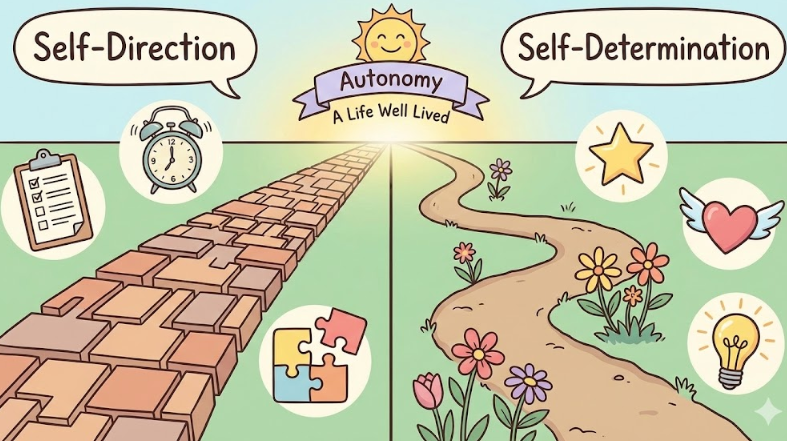
When California launched its Self-Determination Program in 2019, most disability advocates didn't bat an eye at the name. But if you work in this space across multiple states, you've probably noticed the split: California calls it self-determination. Nearly everyone else calls it self-direction.
Is this just California being California? A big state doing its own thing in parallel while the rest of the country moved forward together?
Not quite. The terminology gap reveals something more interesting: two different philosophical entry points that led to the same destination. And understanding the distinction matters—not just for historical curiosity, but for how we build technology, write spending plans, and talk to families about what these programs actually promise.
Most states landed on "self-direction" because the term emerged organically from federal Medicaid policy discussions in the 1990s and early 2000s.
The Centers for Medicare & Medicaid Services (CMS) began talking about self-directed services as a service delivery model. The framework was operational and practical. It answered administrative questions:
The emphasis was on direction—literally, who's steering the vehicle of service delivery. States adopted the language because it fit cleanly into Home and Community-Based Services (HCBS) waiver applications. It satisfied CMS requirements. It worked.
There's nothing wrong with this framing. It's precise, implementable, and crucially, it gave families real power over their supports. Self-direction transformed Medicaid from "we'll send you whoever's available on Tuesday" to "you choose who shows up, when they show up, and what they help you with."
That's revolutionary, even if the language sounds bureaucratic.
California came at the same destination from a completely different direction.
The state's Self-Determination Program didn't grow out of Medicaid operations meetings. It emerged from decades of disability rights advocacy and a deep cultural commitment to person-centered planning within California's Department of Developmental Services (DDS).
The philosophical backbone came from:
Self-determination answers a fundamentally different question than self-direction. It's not asking "who manages the supports?" It's asking: "Who decides what a good life looks like?"
That's a much bigger claim. It's about agency over your entire life, not just administrative control over your service budget. It positions the program as a tool for self-actualization, not just efficient service delivery.
California wasn't trying to be different. They were being intentional about the values they wanted to center.
Self-Directed Medicaid Home Care Services in 2026
To see how these models show up across different waivers and states, check out our overview of self-directed Medicaid home care services in 2026, which connects the terminology to real program designs.
This wasn't California rebelling against federal norms or reinventing the wheel out of stubborn independence. It was parallel evolution driven by different starting philosophies:
Most states: Medicaid-led, operations-first thinking → self-direction
California (and others influenced by rights-based models): Disability-led, values-first thinking → self-determination
Both paths led to remarkably similar programmatic structures:
Same mechanical house. Different front doors.
Think of it this way:
| Term | Primary Emphasis | Core Question |
|---|---|---|
| Self-Direction | Control of service delivery | "Who manages the supports?" |
| Self-Determination | Control of life decisions | "Who defines the outcomes?" |
The distinction isn't academic hairsplitting. It shapes how states market programs, how families think about eligibility, how planners approach spending plan development, and yes—how technology vendors position themselves.
The terminology split continues to influence program culture in subtle but meaningful ways.
Programs labeled "self-direction" tend to focus their messaging on budgets, compliance frameworks, and employer authority. The participant is positioned as a competent manager of services. Documentation emphasizes control, oversight, and accountability.
Programs labeled "self-determination" lean harder into choice, creativity, and non-traditional supports. The participant is positioned as the author of their own life story. Documentation emphasizes dreams, goals, and self-defined outcomes.
Both are valid. Both are necessary. And increasingly, providers operating across multiple states need to honor both mindsets simultaneously.
This is especially true as we see more innovation at the intersection of disability services and technology. AI in home care isn't about replacing human judgment—it's about clearing the path for better choices. Whether you call it self-direction or self-determination, the promise is the same: technology should expand autonomy, not constrain it.
Here's what you can say with absolute confidence: self-direction and self-determination are two lenses on the same promise.
One emphasizes how services are managed. The other emphasizes why they exist in the first place. Modern programs need both:
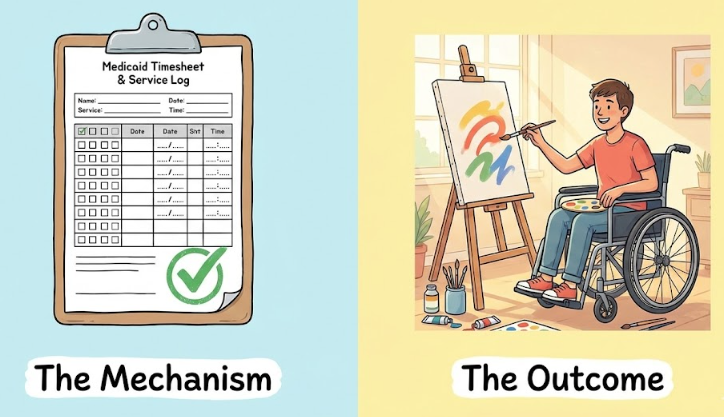
This is why comprehensive self-direction software can't just track budgets and timesheets. It needs to support the full spectrum of participant choice—from managing payroll for traditional caregivers to purchasing adaptive equipment, gym memberships, or cooking classes that build toward independence.
California's approach to spending plan flexibility, for example, has pushed other states to think more expansively about what "goods and services" can include. Meanwhile, the operational discipline that came from self-direction programs in other states has helped California maintain fiscal accountability as SDP scaled up.
The conversation flows both directions. Neither approach has a monopoly on wisdom.
If you're a provider, FMS agency, or state administrator, understanding this history helps you:
Ultimately, whether you call it self-direction or self-determination, the core commitment is identical: people with disabilities should have the same freedom to shape their own lives that everyone else takes for granted.
The path to that promise ran through Medicaid waiver policy in most states. In California, it ran through disability rights organizing. Both were necessary. Both were right.
And both require technology, policy, and provider practice that honors what participants actually need: not just budget management tools, but systems that make genuine autonomy possible at scale.
That's the real work. The terminology is just the history we carry with us while we do it.
Best Self-Direction Software for FMS Agencies
Once you’re clear on the terminology, the next step is making sure your tech supports both models—our guide to the best self-direction software for FMS agencies walks through what that looks like in practice.
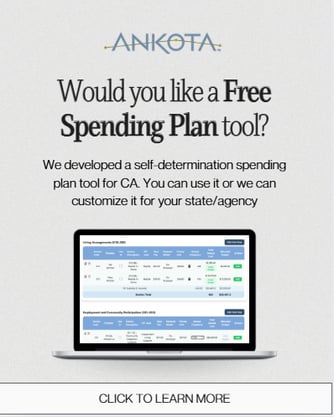
Ready to see how self-direction and self-determination come together in practice? Explore our comprehensive guide to self-direction programs, or see how our customizable spending plan tools adapt to California's unique requirements and beyond.
Ankota's mission is to enable the Heroes who keep older and disabled people living at home to focus on care because we take care of the tech. If you need software for home care, EVV, I/DD Services, Self-Direction FMS, Adult Day Care centers, or Caregiver Recruiting, please Contact Ankota. If you're ready to accept that the homecare agencies of the future will deliver care with a combination of people and tech, visit www.kota.care.

Ken is the founder and CEO of Ankota, a company that helps any organization that helps older or disabled people live independently in their home of choice. Having grown up with a disability and a passion for healthcare, this is Ken's mission
.png)
.png)



Trusted by home care agencies nationwide