Spotify
 Pandora
 Apple
 YouTube
 iHeartRadio
Solve Your Staffing Crisis: How Adult Day Services Let You Serve 50 Clients with Just 8 Staff
You're all worried about the skyrocketing demand for home ...
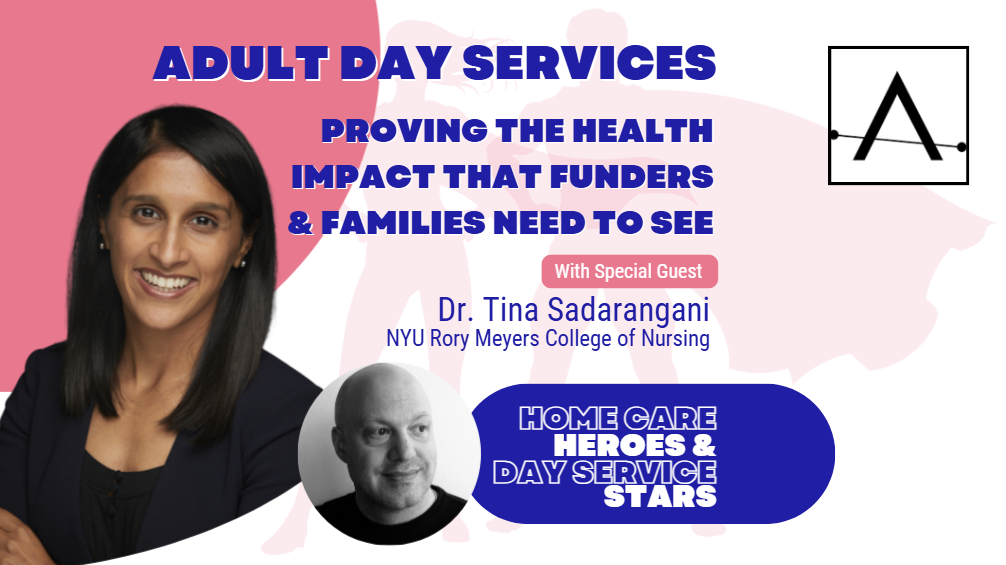
If funders, families, and even your own community think adult day is just a place to play bingo, the problem is not your program. It is that nobody has seen the data.
In this episode, host Ken Accardi talks with Dr. Tina Sadarangani, a board-certified adult and geriatric nurse practitioner, Fellow of the American Academy of Nursing, and one of the leading researchers on adult day services. Tina is also a family caregiver and a granddaughter whose grandmother attended an adult day center five days a week for 21 years. She makes the case that adult day is a highly effective platform for chronic disease management, that it is the most effective non-pharmacological intervention we have for dementia, and that the field has a PR problem it can fix with better data.
She also gets practical. She explains how any center can collect outcome measures every six months and benchmark against peers, why belonging and relief for the family caregiver matter more than a new menu, and how a free app is helping adult day centers and families stay on the same page.
Key Topics Covered:

Links & Resources:
Home Care Heroes and Day Service Stars is produced and sponsored by Ankota - If you provide services that enable older or disabled people to continue living at home, Ankota can provide you the software to successfully run your agency. Visit us at https://www.ankota.com
Adult Day Services: Proving the Health Impact That Funders and Families Need to See
Home Care Heroes and Day Service Stars
Guest: Dr. Tina Sadarangani, NYU Rory Meyers College of Nursing
Host: Kenneth Accardi (Ankota)
TRANSCRIPT
Intro Voiceover: You have got to meet Dr. Tina. Yes, she's a fancy academic researcher, but she's proving that adult day services don't just provide socialization, nutrition, and respite. They actually improve people's health. And best of all, she knows it's true from her own experience. Enjoy.
Podcast Intro Voiceover: Welcome to the Home Care Heroes and Day Service Stars podcast. If you provide services to keep older or disabled people living at home, then this podcast is for you. Now, here's your host, Ken Accardi.
Ken Accardi: Welcome to the next installment of Home Care Heroes and Day Service Stars. This is going to be a very Day Service Stars-oriented episode today. I have the pleasure of having as our guest Tina Sadarangani. I'm going to get the fancy titles out of the way first: she is an assistant professor at the NYU Rory Meyers College of Nursing. She's a board-certified adult and geriatric nurse practitioner and a fellow of the American Academy of Nursing. But Tina is super cool, and I keep seeing her at these conferences talking about the central thesis that I get from her, which is how adult day care extends lives, changes lives, and makes people healthier. That's what we're going to talk about today. With that, welcome, Tina. I'd love you to start by giving us your backstory and telling everybody who you are.
Dr. Tina Sadarangani: Thanks so much for having me. I appreciate all the recognition of the different long titles behind my name, but in addition to being a researcher and a clinician, I think the most important and most relevant credential I have is that I am a family caregiver myself. I was a caregiver for my father, who was seriously ill. I'm also a very lucky granddaughter. I had two grandmothers, one of whom is still alive at 104, and my other grandmother passed away recently, just shy of 101. That's a lot of the reason I'm so fascinated by the world of adult day services. So I'm really excited to chat with you today about my passion for the space, which comes from both the research and clinical practice lens, but also from a very personal one.
Ken Accardi: I love it. I think your grandmothers go by BG and Mummy, right? I remember you telling a story, and I might not have it quite right, but they were kind of your caregivers when your parents were out at work. So you grew up with them, and then you went off to college like people do, and I think one of them, or maybe both, started to decline, and adult day care turned the situation around. Could you tell us that story?
Dr. Tina Sadarangani: Yes. Mummy is 104 and she's the life of every party. But BG was really the one who came when I was born. I was the third kid, so my mom had to call in reinforcements. My parents were both physicians, and these grandmas came to take care of me and my siblings. So I have a very close kinship with my grandmother BG, who recently passed away. When I left for college, I was the third and last child in my family, so the house was empty. She had arthritis. She had depression. She didn't speak much English. She was an immigrant from India who never went to school and came to this country in her 60s. But she was a very devoted grandmother and a really passionate caregiver, and when I left for college, she had nothing to do with herself. She lost her job, as she said. And as you said, she started to decline. I think much of that decline was because of loneliness and social isolation. She couldn't drive to see her friends. She didn't know that many people. She really needed a purpose.
My mother had concerns about leaving her at home during the day, and that's when a neighbor came to my mom and said, "My mother attends this day center in Bergenfield. You might really want to try it for your mom." My mom met that with a host of questions, like, "Oh, yeah, people always say that. But how am I going to get her there?" My mother was a practicing physician, a solo-practice obstetrician. How was she going to get my grandmother to the center and back every day? My grandmother didn't really speak English, so how was she going to communicate with people there? She was a vegetarian. Were they even going to have anything for her to eat? What was she actually going to do in this place?
And the neighbor said, "No, no, you have no idea. There's a bus that comes and picks you up in the morning. Their meals are all vegetarian. She's going to meet a ton of other people who are also immigrants like her." It's a very diverse center, with a lot of immigrants from Korea, a lot of Jewish Americans, a lot of Indian immigrants. She'd feel right at home, and the staff are bilingual. Because my mother was a physician, she was so used to the barriers that healthcare creates that it was hard for her to believe there was a place that actually catered to the needs of these communities. But when my grandmother agreed to go, it was love at first sight. She attended five days a week for 21 years, and as she will always tell you, it became her second family.
Ken Accardi: I love it. So my mom is going to turn 90 in January. I'm going to go down to Florida and hang out with her, and I'm very, very excited about that. But about eight years ago, things started taking a turn for her. She would fall down and kind of face-plant. Obviously, when you cut yourself on your head, it looks horrible, and sometimes it's more superficial than it really is. She was also very resistant to having caregiving in the home. Finally, it was a similar thing to your grandmother: she went to the day center kicking and screaming, a little bit. But literally two weeks in, she said, "I'm going to camp." She just loved it. She met other people, she was eating better, she had to get out of bed, and her mobility got better. Not everybody's grandparents live to over 100 like yours, but when that decline started eight years ago, I might not have her now. I think adult day care, and being in day programs of various sorts since then, has been what turned it around. So I think we have similar backstories, mine not quite as dramatic as yours, but I'm drinking the Kool-Aid. I'm buying a ticket.
Dr. Tina Sadarangani: And from a geriatric standpoint, your mother's story is really remarkable, because repeated falls are not often associated with a favorable long-term outcome. The fact that she has likely gotten better, gotten stronger, and improved her balance, all as a consequence of attending, speaks volumes to what I wish we could measure. And I know we're going to talk about that.
Ken Accardi: Exactly. You always say that adult day centers are the best-kept secret, and that we really want to make that not the case. I think you've also said that adult day has a PR problem, or a branding issue. Talk a little bit more about that.
Dr. Tina Sadarangani: My fundamental thesis on adult day services is that we have a PR problem. So I'm grateful to you for doing this, and to everyone else who draws attention to the remarkable things these centers do. The issue is that much of society views adult day as dancing and dominoes. Most people couldn't even tell you the difference between adult day and a typical neighborhood senior center. I think that's unfortunate, because if you asked me what adult day services is, it's a highly effective platform for chronic disease management that integrates health and social care. It's a model for really excellent person-centered geriatric care when delivered well. The centers I work in, the centers that have participated in my research, my own grandmother's center, these are places that do an extraordinary job of giving meaningful days, activities, and purpose to people who otherwise wouldn't have that.
But as you said, it's the best-kept secret. I can tell you about small pilot studies, anecdotal studies, and qualitative studies that document the success of these programs, but we don't have a large-scale data set. I couldn't tell you with certainty that attending four days a week for three years, starting at 80, will make you healthier at 83. In my heart of hearts, I know that, and I think government funders should know that. But most of them have a fundamental lack of awareness of what these programs are and what they do.
The other piece that's lost on people is that, yes, maybe 20 or 30 years ago it was dancing, and people were fit enough to come in. But now, given how we've tightened eligibility criteria, most of the people in these centers are nursing-home-eligible clients with very high levels of acuity. The fact that they have really positive and favorable outcomes, and that very vulnerable older adults are kept in their homes, is a remarkable thing. We just haven't yet had the capacity or infrastructure to measure that, and that's why it's so hard for us as an industry to stand up against home health care or nursing homes, which have multiple forms of payment.
I also find it terribly ironic that my colleagues in research and in the clinical space all day lament that we have an epidemic of dementia in this country. AARP surveyed older adults, and 85 percent of them want to age in their home as long as possible. Policy makers are talking about how Medicaid cuts are coming and how great social services programs are on the chopping block. It's because we have a fundamental lack of understanding, grounded in data, about the power and potential of these programs to meet the needs of chronically ill people, particularly those with dementia, who make up 30 to 50 percent of those in adult day centers. We also have the ability to keep people who would otherwise be in a nursing home in their homes, where they want to be, at a potential cost savings to government payers. So the whole story is there. It's a really great solution to a number of problems we have in front of us, but people aren't making the link, and that has a lot to do with the lack of data to back up those claims.
Ken Accardi: Yeah, for sure. And if we look at social determinants of health, so many of them are met by going and getting a nutritious meal and having socialization with other people. To be honest, there's nothing wrong with dancing or dominoes.
Dr. Tina Sadarangani: No.
Ken Accardi: The fact that they're there and interacting with other people, as compared to trying to find just the right therapeutic for dementia care, is a big deal. We want to live in our own home. We don't want to be in a position where we're just in bed and maybe our family comes to visit every two weeks. I've been in a lot of nursing homes, and I always get depressed. We definitely don't want to be there. What better way to stay in your own home than to have that social component that also gives you the medical component?
Dr. Tina Sadarangani: Exactly. Where we've invested in dementia has been in therapeutics that in theory should slow the disease process, but those have had mixed success. If you asked a lot of healthcare providers whether they would prescribe some of the newest Alzheimer's therapeutics on the market to a family member, they would probably say no. The data associated with those medications is far from perfect, so there are risks and benefits. With adult day, there's very little risk and a very high benefit profile. I view it as the most effective non-pharmacological intervention we have for dementia. And yet the comparative investment in these programs, relative to therapeutics and Big Pharma, shows an enormous differential.
Most people who specialize in geriatrics or memory care understand that when you're treating an older adult, particularly one living with cognitive impairment, you need to assess their health and their functional status. You need to look at their entire social environment, as you said, the social determinants of health. And that's what adult day is so good at addressing comprehensively.
Ken Accardi: No, you're totally on the money. One rant I've been on, and it hasn't quite caught on, is this. I think we've all finally realized there's a shortage of caregivers, and when you talk to home care agencies, recruiting and retention is their biggest issue. I've always been on this bandwagon that every home care agency should open a day center. First of all, if you're trying to take care of 50 people at home, you need 50 caregivers in 50 homes. If you have a day center and you want to bring in 50 people, depending on what state you're in, that might be 12 or 15 staff. It's also a great place to train your new caregivers and get them used to being with older folks before they go into a home on their own. I just see so many positives in it for home care people. So let me take a step back. What's your thought on the fact that, finally, in 2026, the world is realizing that we have a shortage of caregivers?
Dr. Tina Sadarangani: Oh, yes. It's fascinating to me, because yes, we have a huge shortage, and a number of policies are contributing to it, including the decimation of the immigration pipeline that has furnished many of these workers in many places. But what I want to say is that even if you had enough sufficiently trained people to enter every home in America to provide home care, you would not achieve the benefit of adult day. It's a different benefit. Having somebody come to you for three hours a day to help you bathe, get out of bed, and eat something is not the same as having a reason to get up in the morning. On my grandmother's 100th birthday, we celebrated at her day center. Fifty people came to the door upon her arrival and said, "Where have you been? We have missed you so much." To have that experience at 100 years old, when your social network is largely shrinking, and to have people say "I've been missing you, where have you been?" is not something that allocating a single home health aide to every home could achieve, no matter how good or how talented they are.
That purpose and meaningful engagement is very hard to achieve. I'm a researcher, so my hypothesis is that one of the most powerful pathways by which adult day improves outcomes is the degree of person-centered care and social connection, the understanding of each person's unique needs, and the feeling that you can go into an environment that isn't your home and have some mastery and a sense of safety there. That's really motivating and powerful. I imagine that was the case for your mother and for my grandmother: "I can go to this place, I feel safe, the staff know my needs better than I do, my friends are there, I have something to look forward to, and I can come home and sleep in my own bed." What a great thing.
Ken Accardi: Perfect. One thing you mentioned, and I know you're passionate about it, is access to adult day. I know you did some research and published a paper this year on that. You also talked about immigrant communities, and maybe how it might be harder for immigrant folks to have access to adult day. What have you found there?
Dr. Tina Sadarangani: Actually, on the contrary. One of our key findings is that for older immigrants in particular, adult day centers are the most wonderful source of long-term care. What people don't realize about adult day is that it is the most racially and ethnically diverse sector of long-term care. Almost 60 percent of people in these centers, just under 58 percent, identify as racial and ethnic minorities. When I shared my grandmother's story about going to a place where people spoke her language and she could make friends, that's what we often see: adult day centers tend to become neighborhoods within neighborhoods, microcosms of the neighborhoods they exist in. That's really important, because it gives people who may face language barriers and access barriers to healthcare a space where their day-to-day health-related needs are met in the community, in a place that's culturally and linguistically congruent and familiar to them. That matters especially in older age, when people favor continuity. They like the predictable, familiar thing they're used to, and adult day can create that while also creating safe risks and new opportunities.
There was an article in the Associated Press two years ago that profiled just how effective adult day centers are, and how under-recognized they are for their role in immigrant communities. And to go back to the PR piece for a moment, when you look at the headlines around adult day, it's never "Adult day delivers person-centered care." Fortunately, the AP covered the great care they deliver to immigrant communities. But often you'll see that they're just centers for fraud, people getting a free lunch in Chinatown and riding their bike there. Every sector of healthcare and long-term care has fraudulent and bad actors in it, but it saddens me that those become the headlines, because the majority of centers deliver a very high level of person-centered care to very vulnerable and hard-to-reach diverse populations.
Ken Accardi: Yeah. Getting back to something I've heard you speak on two or three times at the National Adult Day Services Association conferences: how we can collect the right metrics. You've put together a way that non-medical people can do an assessment of the folks in their day center. I think it runs every six months, and you're trying to collect real, true outcome measures. Tell us a little bit about that, because the day centers listening to this might not know how to collect that data.
Dr. Tina Sadarangani: I've been doing research in adult day services for over a decade now. When I came to my first meeting of the National Association, there was no data infrastructure. The thought was that if we could collect the same measures as the minimum data set that nursing homes use, then we could say that, compared to them, we have better outcomes on key measures that are really important to payers. It was payer-focused outcome measures. So the National Association made a big push, and in 2020 it worked with a software vendor to create a free data entry portal. If you're a center that doesn't have your own EHR or billing software, or any existing system for data capture, the National Association took a series of evidence-based measures, identified not just by researchers but also by practitioners who work in adult day centers, and came up with a core set of outcome measures focused on the priorities of payers. Things like eventual nursing home placement, hospitalizations, depression scores, cognitive impairment, loneliness, nutrition, and falls. A lot of those were typical deficit-driven measures, and they were important as an initial starting point, because we needed to be able to say, "Look, we keep falls down. We keep people out of emergency departments, and out of nursing homes, versus home care, which also has to report these same measures."
I then came along and said that 30 to 50 percent of people in our centers have some form of dementia or cognitive impairment. We're measuring all these deficit-focused measures that cater to payers, and that makes sense, because CMS pays the bills. But you have to keep these people coming to your center. So what keeps them coming, and how do we measure that? Our team, funded by the Alzheimer's Association, did a study where we went to adult day centers across the country that served a wide range of people, from rural veterans in rural Tennessee, to Chinese Americans in San Francisco's Chinatown, to Spanish speakers in rural upstate New York. These were all people with some degree of cognitive impairment, in the earlier stages. We asked them, "Why do you keep coming here? What is it about this center that you love the most?" Based on that, we identified validated outcome measures that actually got to those pieces. Then we said to adult day practitioners, "You have no time and limited resources. Which of these measures would you actually collect? Which have clinical value that would inform and improve how you deliver care, and be a standard you want to be held against?" We came up with an additional five measures that are now embedded in that database, which centers can participate in. They can reach out to the National Association and be connected to the research initiative. They collect these measures every six months and receive benchmark reports on how their centers are doing. That also enables us to have a nationally representative sample. We need more centers to participate to make it more representative, because right now we're disproportionately representing five or six states. Getting more people into that data set would make an enormous difference, and we'd be able to demonstrate everything I've talked about, including the pathway by which we achieve better outcomes.
Ken Accardi: I love it. Going back to my rant from earlier, we make home care software, and we added day software because the state of Kentucky, of all states, basically said, "If you're going to do this attendant care and send people to the homes, you should have a day center as well." So we added the day center software. My question in all this is that I see a very strong complementary relationship between home care and day care. I'm wondering what your thoughts are on those two as a one-two punch, and how they fit together.
Dr. Tina Sadarangani: I think it's so important. First of all, there's so much power in being in one's home. I'm currently reading a book by a sociologist at NYU about the price of independence as we age. So much of what we associate with independence is the ability to remain at home as long as possible. Remaining at home and in the community represents savings for our government payers, which is great, and it represents the values of people, because nobody wants to end up in institutional care. But frankly, it also relies on the free labor of family caregivers, informal caregivers, friends, and neighbors who are helping these people "stay independent," but really are keeping them at home when they may have a high degree of functional dependence.
So I think home care plays a role in supplementing this care, and where possible, maybe it becomes more overnight or round-the-clock as people age. But giving someone a reason to get up, the functional piece, the cognitive piece, the stimulation, the productive engagement, is very hard for a home health aide to achieve, no matter how well trained. There's something about the power of human connection: multiple social relationships, a supportive environment, multiple people looking after you, and the feeling of a safety net all around you, besides this one person who might be a different person every other day depending on agency turnover, and who might only come for three hours a day depending on your benefit. That may be just enough to get you out of bed and into the shower, but what about the rest of the day? What about that human need to connect with others?
That's where adult day really shines, providing supervised care and serial observations throughout the day, for up to eight hours a day, seeing changes in a person, seeing them connect. People are very different at the center than they are at home. I know this from the family members I work with. A client in rural Tennessee will say, "Dad, when he comes home, is slumped over in front of the TV. But when he's at the center, I see pictures of him in a conga line, dancing and having a great time." So yes, maybe it is dancing, but dancing is the therapeutic intervention here. And that can't be delivered effectively throughout the day at home. It's just impossible.
Ken Accardi: Yeah, I got it. I'm a little myopic, because we make software for home care agencies and day centers, so when I think of a caregiver, I'm thinking of somebody who gets paid to be one. But when America thinks of caregivers, they think of those 60 million people, probably underestimated, who are coming home every day from work or taking care of older folks in their homes. I know that at one point you took something on. You said, "If the day center is providing respite, if nothing else, plus all these other therapeutic and social benefits, and you have this family caregiver in the middle, and the person sees their doctor maybe once, twice, or three times a year, how could we help with that?" And you came up with some technology for that. Could you talk to us about that?
Dr. Tina Sadarangani: Thank you. First of all, I really do believe those 60 million people are the fragile backbone of healthcare in this country. As I said earlier, I have lived the life of a family caregiver, caring for someone seriously ill at home and making it possible for them to "age in place." What we've realized in healthcare is that, in my perfect world, the adult day center is like an extended kinship network. They are the family's village. At the end of the day, though, it is rare for me to see a person who is functionally impaired or seriously chronically ill existing completely independently. Most of the time, their care is coordinated, managed, and supervised by one informal caregiver, whether that's a family member, neighbor, friend, spouse, or adult child.
Even though the adult day center is doing the best job of caring for this person for those eight hours, my research has shown that when they spot that something is wrong with Mr. Smith, and that's what adult day is good for, they spot problems early on and save healthcare systems a lot of money by promoting early intervention, their first reaction is to call the family caregiver. In my grandmother's case, she had shingles, and they called my mom and said, "You need to come pick her up and take her to the doctor." I've had countless people tell me about a participant who is acting out of character: "Mr. Smith is very agitated and very angry today. It's not like him. I see him every day. He's usually super pleasant. I know he has dementia, but something's off. I think he has a urinary tract infection." Then they call the caregiver, and the caregiver says, "Well, he's always agitated. He has dementia. What do you expect?" And then by the time they go to the doctor, a week has gone by, and this has become sepsis, or he has to be admitted for something that would otherwise have been highly treatable.
What I realized is that for adult day to maximize its potential in the current healthcare system, it needs to improve its communication with family caregivers. That relationship and communication needs to be bidirectional. When those two people have great communication, they can work with one another. The adult day center can be a supportive arm to the family, and when they spot things, the family member can proactively address them with the center behind them.
That was the impetus for creating my free app, CareMobi. My daughter was in daycare. I knew everything she ate, everything she did, and how her day went. My grandmother went to day care, and I couldn't tell you what happened. That becomes a problem when there's an issue like a UTI, a fall, a rash, something new or different. If a family caregiver can keep all the members of their care team on the same page, whether that's their sister in Chicago, the home health aide who comes three times a week, or the adult day center, about meds and how their loved one is feeling when something starts to change, all of that lives in one central spot. Then when they show up for that 15-minute primary care appointment and the doctor says, "How's he been eating? How's he been sleeping? What meds is he currently taking?", you're all on the same page, whoever is with them at that appointment. That information is transferred and explained more effectively. That communication and partnership is key to good outcomes.
The other thing the app creates is that when a caregiver invites their adult day center onto their care team, it creates transparency. Family caregivers can see what's going on at the center, and that gives them a deep sense of reassurance and creates retention, so you have less client turnover. Our research has shown that once they see, "Gosh, Dad's eating so well there, look how well Dad's day is going, oh, I see the nurse told me she was concerned about this, and I feel they're actually monitoring him," that matters. There's a lot of caregiver guilt, the sense of "I'm dumping them there." That is so not true, as you and I know, and the greatest centers know. Giving caregivers a lens into the person's day builds transparency, improves retention, and, most importantly, improves health outcomes. That's what CareMobi is all about.
Ken Accardi: I love that. I haven't checked it out myself, so I definitely will take you up on that.
Dr. Tina Sadarangani: It's really available, and it's sponsored by the National Institutes of Health, who I think believed in the ability of this project to improve health outcomes. We're grateful for that. It's a free tool for any family caregiver listening.
Ken Accardi: Perfect. All right, we're in the home stretch here. We have these centers that are contributing to the statistics, doing these measures, and benchmarking themselves. What would you tell a center director who's listening right now? Maybe they're going to start collecting that data and contributing. What are one or two things they should change in the next quarter if they want to improve retention and improve those numbers? What's coming out of that data that a center can use to improve?
Dr. Tina Sadarangani: I don't get this sense from a ton of directors I talk to, but I know there's sometimes a sense of "We want to create something bright and shiny. Let's invest in this space, or this hot technology, or this new thing for our center," or "Let's improve the menu." It's so fascinating when I talk to people. I'll never forget a woman in rural upstate New York who told me in Spanish, when I tried to get them to stop talking about friends and connection for two minutes and asked, "Is it the food? Is it the space?", she said to me, "Tina, food goes in one hole and out the other, but my friends here are forever."
So the key piece, and what our data are showing, is that getting people in the door is the hardest part, and getting them to foster those connections is really, really important. Their report of a sense of safety and belonging is a huge piece. Centers where people report high degrees of belonging tend to be associated with greater rates of retention over time.
The other piece that becomes the challenge is: what are you doing for the caregiver? That's something our data set doesn't yet fully measure. But I always say that the real outcome any program or senior service should be measured on is relief. How much relief do you provide for this family member? Is it just relief during the day from their duties, so they can go to work and do their groceries? Or is it a true sense that the weight on their chest has been lifted for a little while, because they know their loved one is safe, they feel they have a direct avenue to communication, and they know that this center is looking out for them? Caregivers are very savvy, and we hope we can eventually create a dashboard to help family caregivers identify the best centers in their area on these outcome measures. That would be a long-term goal for us. But creating that sense of trust and transparency is so fundamental to retention and to creating relief for caregivers, whether it's a space or outlet for them to talk about the issues they're having, or simply a lens into the day, knowing their loved one feels safe, feels they belong, and is meaningfully engaged. Those are all measures we're collecting, and they seem to be the most associated with positive participation and positive outcomes.
Ken Accardi: Yeah, I got it. You've touched on this a few times, and it never really occurred to me, but obviously it's big: you have a family caregiver who is actually feeling guilty about even considering sending Mom out to a center for the day. What would you say to them? I think it's not only taking pressure off them, it's enhancing the life of their loved one.
Dr. Tina Sadarangani: I hear you. But I've also lived the life of watching my mother, and a lot of caregivers out there, whose personal philosophy is "I'm going to care for this person until I can't." There are so many problems with that philosophy, because I tell caregivers all the time, you cannot pour from an empty cup. Yes, it's natural to experience resistance to change. Change is hard for anybody, especially an older adult who's in a part of the life course characterized by continuity. That's why older people are notoriously stubborn. But there are so many success stories out there, with patience and with time. And the more centers can cater to a person's personhood, the better. Who was this person before their illness? The best centers are the ones where, if Mr. Smith was a doctor before dementia forced him to retire, every day when he walks in, the director hands him a cup of coffee and says, "Good morning, Dr. Smith. It's nice to see you," because that's exactly how he would have been greeted in his office. That type of understanding of who this person is gets them in the door.
I tell family members that by keeping them at home, you are actually doing a disservice to them. The therapeutic intervention for dementia, for cognitive impairment, for frailty, for depression, is going out into the community. It is finding a source of productive engagement. It is being asked to reach your maximum potential in a safe environment where your needs are constantly being met. This is healthy for both of you. The longer you attempt to keep doing this for people and pour from that empty cup, the more your health is going to suffer, and ultimately the more their health is going to suffer. It is not a sustainable or healthy practice. Unfortunately, in our clinical world, it's very rare that when you ask a patient how they're doing, you bother asking the person who brought them to the appointment how they're doing. I think some of these interventions are just as effective for the older person as they are for the caregiver.
Ken Accardi: Love it. Okay, I think we're pretty much done with the questions. I always like to wrap up with connections. Where can someone who's listening to this learn more, be more connected, and be part of the adult day community? Where would you point them?
Dr. Tina Sadarangani: A couple of things. Definitely your state adult day services chapter and leadership organization, but also, so important, the National Adult Day Services Association. That's really the most organized research effort we have nationally, and we need more people to be part of that. Joining, coming to those meetings, and learning more about these initiatives is where the greatest momentum is. As we continue to build our footprint in adult day services, we're going to need all hands on deck. I also encourage people to visit my own personal website, drtinaphd.com. It has all the research we've done in the field of adult day services, and it talks a lot about these questions and about joining national research efforts in the space.
I know a lot of people listening are saying to themselves, "God, it's so hard for me to collect data. My staff is constantly turning over. Who can do this extra thing?" I think people don't realize that that extra thing is so important to documenting and demonstrating the impact they have on participants. Without it, we can't. And even the adult day centers that started using my app were so nervous. They said, "This is going to be an extra thing. It's going to take extra time. No one's going to go for it." And guess what? Their phone calls from families were cut in half, because the families now knew what was going on during the day. It actually saved them a ton of time, improved retention, and created transparency. So I encourage everybody listening to explore these resources, and to think about how entering into some of these projects can enhance and advance the field of adult day and change some of these headlines, so that we're not just dancing and dominoes, we're not a source of fraud, but we're highly effective platforms for chronic disease management and person-centered care.
Ken Accardi: Love it. Well, we're going to end on that. Thank you so much. Your website is drtinaphd.com, and just a quick thing, they can find out about CareMobi right there.
Dr. Tina Sadarangani: Yes. You can learn about CareMobi there, or you can go into your app store, on Apple or Android, wherever you download apps, and download the CareMobi app for free. It is completely HIPAA secure, and it's a great tool for centers. I'm also always happy for people to email me directly at trs233@nyu.edu.
Ken Accardi: Perfect. All right. Well, thank you, Dr. Tina, and have a great day. Thanks for being on Home Care Heroes and Day Service Stars. I'll talk to you soon.
Dr. Tina Sadarangani: Thank you.
Outro Voiceover: Thanks for joining us today on the Home Care Heroes and Day Service Stars podcast, produced by Ankota. You can listen to back episodes by visiting 4HomeCareHeroes.com. That's the number four, then the words homecareheroes.com.

Ken is the founder and CEO of Ankota, a company that helps any organization that helps older or disabled people live independently in their home of choice. Having grown up with a disability and a passion for healthcare, this is Ken's mission



Trusted by home care agencies nationwide