
 Spotify
  Pandora
  Apple
Apple  YouTube
  iHeartRadio
 Solve Your Staffing Crisis: How Adult Day Services Let You Serve 50 Clients with Just 8 Staff
You're all worried about the skyrocketing demand for home ...
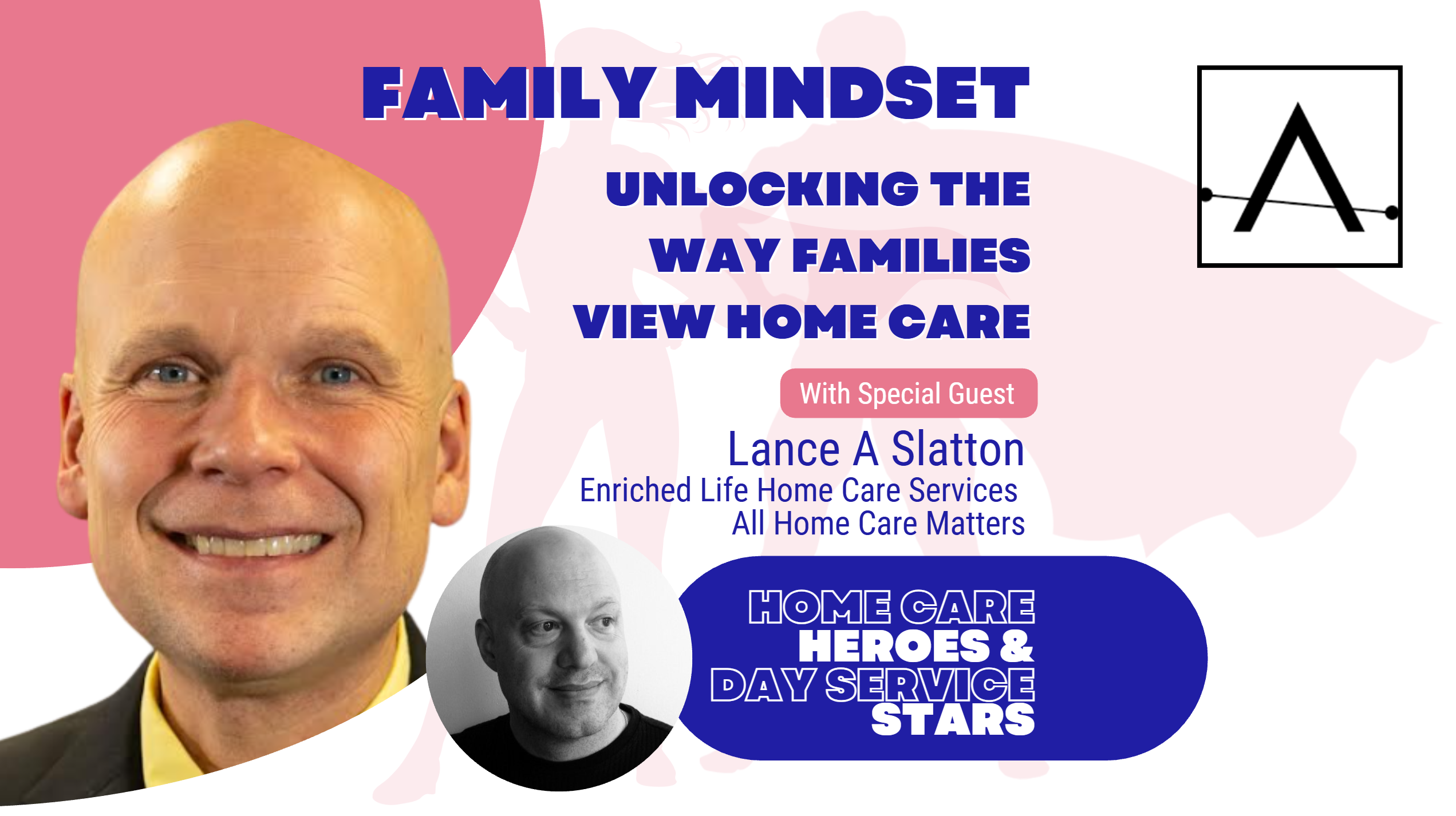
Based on his own experience caring for a parent and grandparent, Lance A. Slatton dedicated his life to home care, both as an agency leader and as arguably the top expert influencer in the Family Caregiving and Alzheimer's worlds.
Host: Kenneth Accardi (Ankota)
Guest: Lance A. Slatton, Senior Case Manager at Enriched Life Home Care Services & Host of All Home Care Matters
Episode Summary:
When a family reaches out to a home care agency, it is rarely a planned corporate transaction—it is almost always an emotionally charged crisis. What do agencies completely miss during that vital first phone call?
In this episode, host Ken Accardi sits down with Lance A. Slatton, a renowned family caregiving influencer, author, and host of the massive web show All Home Care Matters. Lance shares his perspective as both a senior case manager for Michigan's top-ranked home care agency and a former long-term family caregiver for his own father. Together, Ken and Lance tear down the wall between agency operations and the true emotional, physical, and financial reality that family caregivers face daily.
They dive deep into why intensive intake processes save cases, the severe risks of hiring un-vetted "under-the-table" care in non-licensed states, and a brilliant operational strategy involving employee "Appreciation Sheets" that has kept Lance's team ranked number one in Michigan for over five years.

Key Topics Covered:
Links & Resources:
Home Care Heroes and Day Service Stars is produced and sponsored by Ankota - If you provide services that enable older or disabled people to continue living at home , Ankota can provide you the software to successfully run your agency. Visit us at https://www.ankota.
Announcer: Lance A. Slatton not only runs the top home care agency in Michigan, but he's also a renowned influencer to family caregivers. Today on the podcast, we talk about the differences between the way families look at the world and the way agencies think they do. Enjoy. Welcome to the Home Care Heroes and Day Service Stars podcast. If you provide services to keep older or disabled people living at home, then this podcast is for you. Now, here's your host, Ken Accardi.
Ken Accardi: Hey, here we go. Well, welcome to Home Care Heroes and Day Service Stars. Today, my guest is Lance A. Slatton. And a lot of you may have seen Lance before because he's very well known in the industry and he has a great web show—and we'll talk more about that—called All Home Care Matters. One thing I love about Lance, and the reason I'm really excited about having him as a guest, is because he runs a very successful agency actually ranked number one in Livonia, Michigan, or in the state of Michigan, called Enriched Life Home Care Services. But also, he does so many things that are really geared toward families and their journey and everything that they're doing, and really helping to embody the mission of keeping people living in their chosen home. And that is, you know, at the core of our mission here at Ankota. And I love that. So, welcome, Lance. And why don't you start by just telling people who may not have heard of you—if that's even possible—a little bit about yourself.
Lance Slatton: Oh, well, thank you so much for inviting me, Ken. You know, well, as you said, my name is Lance Slatton and I am a senior case manager for our family home care company here in Michigan, Enriched Life Home Care Services. I'm the author of the official family caregiver's guide, as well as the host of All Home Care Matters, and now the president of AlzAuthors, the number one online digital resource for families and their loved ones who are facing dementia.
Ken Accardi: Incredible. So you have a lot of things going on and really all in service to families as well as home care agencies, and thanks for sharing today. So, what I really wanted to drill into today is to take a look at sort of the emotional journey that families are going through when they're choosing care. And I think that's a really interesting topic because coming from your perspective—where you've spoken to so many people and you've coached and advised people on family caregiving as well as agency caregiving—I bet that you have a lot to think about and a lot to say about how families might see the world differently than the way the agencies see the world. So I guess, you know, as a starting out question, I'm thinking like the moment that families call, it's oftentimes a crisis. So, you know, like for example, I'm here. My mom's in Florida. You know, mom fell. She's in the hospital. You know, I'm flying down. She's going to be discharged. You know, I'm panicked. I have to get back to my family. I have to get my kids in school or starting summer camp on Monday or whatever the case may be. And so, I guess, you know, the question in all that is, you know, what do agencies miss when they're dealing with that first phone call? And what could they do better when they're dealing with that, you know, very emotionally charged situation?
Lance Slatton: Yeah. Well, you know, I think this is a great topic, Ken, because, you know, I like to say, you know, every home care company is different. You know, from the values to the philosophy to, you know, operational. You know, are you, when you as a family, when you're reaching out, are you getting a call service who's just taking some basic generic information, or are you getting somebody directly tied into the company? And so I think we really got to start there in determining what the structure is of that home care company. For instance, with our company, our phones are answered 24/7 by somebody directly within the building working for the company. Some companies use a call service. I'm not saying what's right or wrong. That's an individual choice. But when a family calls us, we're getting as much history and detail as humanly possible because our goal, and the reason for them calling us, is to help them. And so we need to know as much as we can before we can truly help them in the most effective way.
Other families we've heard from would call a different company, and they're giving information, but that information is not reaching the right person. So, when a family calls us, they're getting a case manager—not answering the phone necessarily, but they're getting somebody in the building who will connect them to a case manager. And we're all trained and know what we're looking for and the information that we're trying to obtain. And often I think what companies are missing is that thoroughness and getting that extensive history. You know, it's much like when you go to a doctor, right? You're getting some information over the phone to make that appointment, but then ultimately you're either filling out a whole lot of paperwork before the doctor sees you, or you're doing an over-the-phone or online interview before the doctor sees you, because you're going in for a specific need and a targeted need that the doctor needs to help you with, and they need as much information as possible.
So, I think a lot of times companies miss the mark on really doing a thorough history and intake when they're initially going to help. You know, we had a family we just started helping not too long ago that actually hired a company where they went online, said the day and the time they needed the help, their mother's name, and that was it. And then the family had this caregiver show up at the house. Well, what that company missed was that lady had a dog in the home. The caregiver they sent is allergic to dogs, so that person had to leave. Then they had to go through this whole process of getting somebody back over there. They were a couple hours later, so the family missed this appointment, which is why they needed the help to begin with. So, it's for me, it's all about really finding out as much as you can before you ever start the process of providing that care, because you want it to be as beneficial as possible.
Ken Accardi: Yeah, I love that. Interestingly, I mean, as a tech person who's created a software company that sells home care software, sales is not my native place where I live. I'm a tech guy at heart, and what I found is that the best demos we ever give are the ones where the customers are doing a whole lot more of the talking than we are. If we're able to learn more and more about them and what makes their agency special and unique and, you know, what their values are and what their real pain points are, it's so much better for us. And I think that that lesson that, you know, I've learned over time really translates into home care as well.
But yeah, that's really interesting that I would imagine, first of all, that if the family opens up with you and, you know, they say, "Hey, here's the crisis. Can you help me?" and then you get into that conversation where you're really taking a step back and you're learning about their mom or their dad and everything that they've gone through and, you know, and some history as well. And I guess they're trained to know about the pets in the house and know about, you know, all those all those different types of things, and hey, what are you worried about that, you know, might be falling through the cracks that, you know, mom's taking care of, and all those things. That's really, really wonderful.
I guess, you know, kind of a similar twist on the same question is that, you know, families are shopping for an agency probably differently than owners think they are. So, what do you think really, you know, kind of gets to that point where the family trusts you, you know, where they say, "Okay, yeah, I am, you know, totally comfortable with this guy." I'll just share that, you know, when my aunt Emma in Queens had care—you know, like she passed unfortunately, but you know, when she found caregiving, there was, you know, this guy, and he was this, you know, Irish guy from the neighborhood, and he had been in home care for a real long time. And, you know, he came to the house and he spoke to her, and I don't think it was about price. I don't think it was about anything else. It was just like she connected with this guy. You know, they probably shared stories about growing up in Bayside, Queens, and, you know, picking up cookies at the same cookie shop or things like that. And I think that that's what did it for her. But I guess, you know, in general, I guess people are coming at it from different ways, and it might not always be that common background. What are your thoughts on that?
Lance Slatton: Yeah. So, well, here in Michigan where we're at, Ken, we're actually a non-licensed state, but most people don't know that. You know, family caregivers and families aren't really preparing, planning, and positioning themselves to be as educated and really aware of what home care is, or even long-term care in general, often until there's a crisis and they need to know, and then they're making sometimes rash decisions under the gun. And so we like to educate, kind of like you said, a great segue to this question. We like to educate families and make them aware. Okay, you might be hiring Mr. Jones and his caregiving company down the road that your mom or a friend or a relative saw on the wall at the local grocery store. But are they licensed? Are they insured? Are their staff direct hires or are they temp employees? Are they secured, bonded, and background checked, and do they have liability insurance and workers' comp?
You know, those are things that we really try to educate families about because whether you choose to entrust us with the care or someone else, we want these families to kind of know these things going into it because we've been in business almost 15 years and served thousands of families. And often, when a family calls us and we're not the first choice, they have had a bad experience. That's why they're calling us. And so some of these bad experiences are: "Oh, mom hired this lady for dad that a friend of hers at church has a niece," you know, that sort of thing. And they had a home care company, but they weren't a company in the sense that you or I are a company. They were a company in the sense of you're paying them for services. And in this situation, the caregiver got hurt taking care of their father, and now they're suing the family saying, "I'm not able to work because of the care I provided to your father. How are you going to make me whole? How are you going to compensate me?" And the family said, "Well, you're a company." No, they weren't a company. They were cash under the table.
And the unfortunate part, Michigan being a non-licensed state, you're allowed to do that. I mean, tax-wise and all that you're not allowed to, but in the sense of you can provide home care services without any sort of government oversight or regulations or requirements, and that's something we're big proponents of because we want to protect these families that don't know what they don't know, whether they hire us or maybe they hire someone else, whatever the case may be, because we're trying to avoid a crisis for the family and take injuries and theft out of the equation. If you hire somebody and they're not a true company, like with us, right? We have a whole roster of employees. They're all direct hires, been with us for years, great people. They're qualified, trained, credentialed, the whole nine yards. And if one of them takes vacation or maternity leave or whatever the case is, we have other staff that we're going to train and prepare to cover those days that that person's off.
If you hire somebody privately, so to speak, they may not have any other people to help provide that backup. So, if they get sick or they get hurt or let's say they just quit, you're still left needing help for your mom or your dad or your loved one. And so, you know, there's a lot of risk associated when you're not going through a legitimate, established business. And so, we prepare families for that and explain those things to them. And 99 out of a hundred, Ken, they have no idea. You know, I tell people, I don't blame you or fault you for not knowing that. When you say you're hiring a company, you think you're hiring a company and they're in operation, so they must be doing all the legalities and all their requirements appropriately. But how many times have you gone into your doctor or dentist and asked to see their medical or dental license? You know, it's just an assumption that's taken for granted. If you're open and you're operating, you must be in good standing and you're allowed to be here.
And so with home care, we're just kind of a rare breed in Michigan where there really isn't that oversight or those requirements to provide home care. And it's unfortunate. So, I think families often aren't aware of that, and so they miss that situation and they proceed because, again, they're wanting what's best for their loved one, and usually the person they're meeting with is telling them they're going to get the best. But unfortunately, even with established companies, that doesn't always happen. And so I think they need to look at reviews online, look at years of operation, and don't just say yes to the first company you meet with, whether it's us or anyone else. Do your due diligence, and hopefully you have the luxury of being able to do that. Often you don't, but when you do, you know, ask those tough questions. You know, are you bonded? Are you insured? Can I see a copy of your insurance? What is the process for when you hire somebody? Are they direct hires? Are they a temp employee? Do they go through background screenings, drug screenings? We do motor vehicle checks as well through the state of Michigan. Do they have valid auto insurance? You know, a lot of things that really aren't going to be at the forefront of your mind. And you know, I don't blame them for not being there, but just make yourself a little aware of some of the things that you should be checking on before you entrust the care of someone that's probably very precious to you into the care of someone else.
Ken Accardi: Yeah. Fantastic. I really appreciate all those thoughts. I think just making another analogy to what I go through in doing sales for software, I think that people don't really understand, but I will just kind of say that when we get into a great conversation and I'm learning more about their agency, that's usually a good situation. When the first question is, "What does it cost?" that's usually not a good situation, and a lot of times the trigger goes off in my mind that if they're just trying to figure out who has the lowest dollars per client per month or whatever the case may be, they're probably not really thinking about the service and the relationship and the depth that they're getting. And I guess that ties exactly the same way to working with a home care agency. So, yeah, great, great answer.
Let me shift gears on you a little bit. So, just a little bit more about my mom. She's actually now 89. She has pretty severe Alzheimer's disease, and she actually has, for the last couple of years, shifted her primary home to being in a care facility. So she went through the home care phase, and actually even in the facility, my sister—who started as her sole family caregiver—still checks in on her and has actually moved her. We've been in the situation where different private equity companies buy the facility and they change a whole bunch of things around, and the quality of care, we've seen, drops and all those types of things. But even inside of the care facility, we have a caregiver who spends time with my mom to make sure she gets personal attention because, for example, she has extreme hearing loss and she has trouble collaborating with others as a result of not being able to be in the conversation.
But I've really learned a lot about family caregiving through my sister's experience. And you know, I think it's always good to walk a mile in another person's shoes. And I'm really looking forward to reading about your guide for family caregiving and things like that. So, I guess just off the top of your head, like what would be a few things that you think would really surprise agency owners or people like myself who are more tied into the home care agency side of the world than the family caregiving side of the world? What do you think some of the big shockers or things that they're really going to have their eyes opened about will be for the families—or rather, for the agency owners who are learning about family caregivers?
Lance Slatton: Oh, that family caregivers are carrying a lot more responsibility than they probably will voluntarily provide. Because like for myself, Ken, the book that I wrote, the All Home Care Matters Official Family Caregiver's Guide, that wasn't written for any notoriety or sales or anything like that. It was written out of my own experience many, many years ago when I first became a family caregiver, though I never identified or recognized myself as one. I was pursuing medical school. And then my father—unbeknownst to my wife and I, we were newlyweds at the time... and I just want to preface this by saying he was in the Marine Corps in the '60s, which is dramatically and drastically different than the Marine Corps we have today, though they are amazing men and women, it was just a different environment. And so fast forward, my father retires. Great, great health, very active. He had slipped and fallen on some black ice because, of course, we're in Michigan, so we like ice and snow 10 months out of the year, I say. And he had landed on his tailbone. Well, that developed into a very, very bad bruise. Well, just like you and I right now, we're sitting on our tailbones. And so 99% of the day, most people are, and that bruise never had a chance to properly heal.
And so, as a result of that not healing and the tissue not healing, it turned into an abscess now, rather than just a bruise. Well, it burst on my father. The infection got into his bloodstream. Ultimately, it got into his bone, developing osteomyelitis, an infection of the bone. And the home health care nurse called us and said, "Hey, just checking in. You know, we've been visiting your father for the past two weeks since he got home from the hospital." We said, "Well, wait, pause right there. We didn't know he was in the hospital. What is going on?" And so she explained it and she said, "And you know, my biggest concern is that he's not able to properly cleanse and dress the wound—but nor could you or I, right? And so could he come stay with your wife and you for a couple of weeks? Or I could just have him go to rehab for a couple of weeks." Well, I'm not going to let my dad go to rehab when I can easily have him come stay with my wife and I. It's only a couple of weeks.
And so we did that. And that couple of weeks turned into almost three years. Well, during that three years, I never heard—and I'm pursuing medical school, I'm working at the university and the labs and all this stuff—no one ever said, "Oh, we didn't know you were a caregiver for your father." I'm just a son dutifully helping my dad through a time he needed help, right? And so, around that two-and-a-half, three-year mark, I actually called my wife and I said, "You know, we really need to start a company or do something to help people like us, because no one is giving us any support. My dad doesn't really have much support other than his discharge instructions and things like that." I said there's got to be millions of people like us. And so, we started our company based on that, and it changed the entire trajectory of my career.
And so I think most home care companies don't necessarily—and I don't want to say most, I'll say a lot—don't realize what family caregivers truly go through day in and day out. And that's something I feel is a very beneficial asset for me because I can look at a family, whether they come to our offices or we meet with them at their home, and I can say, I absolutely get it. I know what you're going through. I know what it's like to try to juggle all of your professional or academic responsibilities, your job, but also you have to get your loved one to that follow-up appointment or pick up their prescriptions or whatever the case may be. And we didn't hear the word caregiver or home care ever. And you know, he had seven major surgeries while living with us. So, we had a lot of face time with social work, discharge planners, surgeons, nurses, rehab specialists, you name it—pretty much every discipline.
And so from that experience was born the idea of helping others this way rather than through becoming a physician. And you know, I don't even look back and don't regret it for a minute because I feel like we're having a lot more profound benefit for families and for healthcare professionals than if I had taken that other route that I had originally chosen. But I think that's what it is. I don't think a lot of business owners of home care companies necessarily understand it unless they have lived it and walked it themselves, because like I tell people, it's an experience unlike any other. You know, I always tell people when you're expecting your first child, you're reading the books, you're going to appointments, you're doing all this stuff leading up to the delivery date, and then you get all that support after the delivery date. And there's books and all these things, but nobody plans to be a caregiver. And there's no classes, so to speak, preparing you for it. There's stuff once you become the caregiver, but usually by that point, you might not necessarily even have the time to do classes or trainings because now all of your focus and energy is committed to your loved one. And so I think just having a better appreciation and understanding of the emotional toll, the physical toll, and even the financial toll that family caregivers experience when they're caring for a loved one is unlike anything else out there.
Ken Accardi: Yeah. Great thought. And just another thing, my sister recently... we have a caregiver rewards, caregiver support app, and we've been talking about how do we make this more useful for family caregivers as well. And some very simple things that just never occurred to me, she said, "You know, there's just... I had never been a homeowner before, and now I'm kind of managing my mom's home, and I just never knew about things like shutting off the water in the fall or things like this." And so she said that, first of all, there's just some things that us other siblings who are distant and wishing we could help more could be helping with. And she also said, "You know, and sometimes, for example, I'll need to get like a new hose and a new sprayer for the hose and that type of thing. And you know, I mean, yes, I'm here in Florida, but if you were going to get it for yourself, you probably ordered it on Amazon.com and you probably know which one's a good one or whatever." So, she came up with some really interesting ideas of how, even though we're not there, that we could be more supportive remotely. But, you know, just again interjecting my silly personal stories in there.
But, kind of going back, you said in the first thing that your agency is really trained on getting as much information as possible, and then you talked more and more about understanding what folks are going through emotionally. So if somebody listened through maybe just the first five minutes and they come away with, "Oh yeah, you know, like we should ask a whole lot more questions. I'm going to get my agency to start doing that," they're probably thinking more about facts. You know, they're thinking about, oh, you know, the dog was there, and I don't want to send the caregiver who's allergic to dogs, or you know, like the lactose intolerance issue or the, hey, there's a lot of house plants, those kinds of things. But how do you get at and incorporate into what you're learning about them—how do you get into those emotional things that the family's going through and carrying? And if agencies thought more about that emotional strife that they're going through, how might they show up differently when starting to provide support and planning for support for that family and their loved one?
Lance Slatton: Well, and I think that, yeah, I'm going to give you a couple of answers, but it'll answer the one question. You know, kind of like we were talking about a few moments ago, Ken, where some of the home care business owners don't understand it because they haven't walked through it. So, that's not going to necessarily be top of mind. They're looking at how many hours you need and how many days and, you know, what are some of the basic care needs. And so, I think like with us, not all of our case managers have been family caregivers either, so they don't have that firsthand experience. They're getting that experience... you know, maybe they worked at the hospital or a doctor's office. So, you know, they have at least some reference point to what families can go through.
But we go through, and when we're meeting with them, more times than not, a lot of that's being voluntarily shared with us. You know, when you sit down with... I'm going to, if it's okay, Ken, I'm going to pick on you and your sister. Let's say we were meeting with you and your sister and we're asking, "Is mom DNR? What's her medical history? Does she use any assistive devices?" you know, things like that. And then we start talking about the care needs and things around the home. You know, you or your sister might say, "Well yeah, and it's really, really been hard on us. I'm in Florida, my sister's in New York," or what have you. That's our opening to talk about different ways that we can help alleviate. We're not going to remove it. We're not going to cure it, but we can help support alleviating some of that and start to take some of that off of you.
And when we meet with our caregivers, you know, we have a hard requirement. I could hire you, Ken, right now and send you into a home here in Michigan. I'm going to assume you have only a software background. Maybe you don't, but I'm going to assume that for this purpose. It doesn't mean I should send you into a home, though. You know what I mean? If they needed help with their computer, I'm calling you. But if they needed help with memory care or bathing or toileting or exercises, I'm probably not going to call you—even though I could. So, we implemented our own policy where people have to have at least two years of professional experience, being a credentialed CNA, home health aide, medical assistant, all the alphabet stuff.
But we do make exceptions, and the exceptions are: we have a person who took care of their disabled son for 28 years. They have the heart. They have the passion and the soul. I can teach you tasks. I can't teach you heart and soul. And that for us is more valuable than you having a few initials after your name, because we want people that have that heart and passion. You know, if you're going to be in more institutional care, you may not need the heart and passion as much. I still want you to have it, but if you're going to be working in someone's home caring for their mother, I want to know that you know what that family's going through. And I want to know that you can relate to them on a level that's personal, but much different than just professionally, you know?
And so that's the stuff we look for. And the families usually are wanting to talk with us. Right when COVID hit—and that's kind of how All Home Care Matters was created—we were facilitating seven caregiver support groups throughout Michigan. Not all in the same city, not all in the same county, but throughout Michigan. They were monthly, sometimes bimonthly meetings that we would host and facilitate. We did very little at those meetings. We would kind of set up the topic, start the conversation, but all the people in the room, they were hungry and thirsting for somebody to hear what they were going through, but they were even more hungry for someone to understand what they were going through.
So once you kind of get that conversation starter going, they were off and running. And we would, if it wasn't me, whoever else was facilitating it, we would sit back and unless they had a specific direct question—maybe about a DME or maybe about something more technical—they were taking care of it themselves. And that's really what caregiver support groups are all about. It's about not finding support through us; we're just creating the space. It's finding support through all those other people there that you can build that relationship with, that can understand—maybe not identically, but they can at least relate to it on a much deeper scale than maybe a lot of your peers or whoever else is going, maybe even a sibling. And that is so beneficial and that's very therapeutic.
Ken Accardi: I love it. Yeah, one thing I picked up on... I mean, you said so many great things here, but I actually had on the podcast a woman named Jen Waldron, and she works for a caregiver recruiting software company. She was talking about that, and you know, interestingly she said that one of the issues that home care agencies face, especially with the shortage of caregivers, is that everybody's looking for a CNA with this many years of experience. And you know, there's so many organizations where, first of all, they are great caregivers who haven't done any licensing like a CNA, and also haven't worked in an agency. But one thing they do in their best-practice application process is they do ask about family caregiving experience. And I think that, you know, my sister, having taken care of my mom for a number of years, would be... you know, she's learned so many lessons, even though she's never been paid as a professional caregiver. So, that one did resonate with me, as did everything else in your answer.
Um, you know, interestingly, this next question I had for you was something that you've kind of covered before, which is that, you know, to somebody calling for home care for the first time, all these agencies look interchangeable, and what makes them different? So, you talked about the licensing and the processes and how you hire, and are your employees actually employees, and are they trained, and all those types of things. And I listened to one of my favorite podcasts in the industry, the Homecare Strategy Lab that's run by Miriam Allred. I can't remember the name of her guest that was on a few weeks ago, but they really spoke about having a very high-end agency and how, you know, their agency should be hired as a partner and as a problem solver, because that's what you're looking for—somebody that can deal with and understand your journey and things like that. So I guess, just any other thoughts on underrated ways, let's say, that an owner can think about how they could genuinely stand apart other than just their price and the availability of a caregiver.
Lance Slatton: Yeah. Well, I don't know if this would qualify as availability, but I know one of the things that, at least in our state and in our areas that we serve—we service the bottom half of Michigan—one of the things that families, if we aren't the first destination and maybe we're the second, sometimes even the third, that they just so greatly appreciate, but not only the family but also our staff, is we keep consistent schedules. We do continuity of care.
We had a family last year or maybe the year before, and this always has stuck out because I could just imagine the scene at their house, if you will. It was for a midnight shift, and I think it was 8:00 PM to 8:00 AM. The daughter called because she said, "You know, my mom and dad called and they were all upset." The mom had heart issues, dad had early-onset dementia, and she said, "You know, I just can't have that going on, plus the neighbors..." What happened was—we had not met with them, they found us after—they had hired this company, and I won't name the name, but it's a known company name. And they had sent seven caregivers to that house for that one shift. And when the company was questioned about that, Ken, their explanation and reasoning was, "Well, we wanted to ensure that your parents had a caregiver tonight."
Now, I think that is just a horrible explanation and horrible management, because if you know what you're hiring and who you're hiring, you shouldn't have to send seven people. The one person you send, you should have confidence they're going to show up. And so what ended up happening... most of them all left and then two stayed, and they were both arguing and saying, "Hey, I need this, I got bills, I got groceries," you know, whatever. And you know what the family ended up doing? They told them both to leave, and they fired the company the next day. That was their first day with this company—or, you know, the first day that care was to begin.
And when they're sitting there telling us this, we don't do that. What we do is, when we hire somebody, first and foremost, we hire only when we have an opening. I know a lot of companies hire regularly and they build up a pool of candidates because, being in this industry yourself from the software side, you don't get to pick and choose when your next client is going to need care. You don't know when that family's going to call and say, "Hey, we need to hire you." So, unless you have staff sitting around waiting for work, you're going to have to get busy really quick. And so, some companies feel like this is a cheat code: "We'll just hire a bunch of people, and then when we do get that call, we'll just go right through the tree until somebody says, 'Oh, yeah, I'm excited to start.'"
Do you know how many people we have hired over the years who will say, "Oh, I'm working at ABC Company," and we'll say, "Well, then what's the reason you're looking to leave?" "Well, I haven't gotten any work yet." "Well, did they hire... are you full-time, part-time?" "I was hired full-time." "Well, how many hours a week are you working?" "Well, I haven't started yet." "Well, when were you hired?" "Three weeks ago, four weeks ago," you know? And I just think it does a great disservice to the professionals wanting to be in this industry, but also to this industry as a whole because we're seeing how some companies are treating the staff as almost a commodity, right?
And our staff, we tell them, you know, you're the top of the totem pole here. We are going to treat you with reverence and respect because you're the face of that company. Yeah, we spend a lot of time with the family before we ever start providing the actual care, and we don't disappear once the care is started. Our case managers do drop-in visits—some are surprises, some are planned—and we don't just disappear after you hire us. We're with you through to the end. And families appreciate that. So they know we're not just here to get your business and, you know, okay, we signed you up, now we disappear. This really is about the care and the quality of care first and foremost.
And we want to support that family as well, because they still need support even on the days we're not scheduled to be there. If it's not a 24/7 client—maybe the sister is saying, "Well, I'll do the weekends if we could have the help Monday through Friday"—she's still going to have a rough go of it, and we're in constant communication. And our staff know—and this is what I am probably the most proud of—what we say is what we do. And we're not just telling you what you want to hear to get you to work with us; we're going to show you, you know? And I think that's a big differentiator because... if I could share this quick story because I know we're coming up on time.
We had interviewed a lady, and I'll probably never forget this. It was about a year ago, and this was an amazing candidate. So, let me back up. Our candidate process: we post jobs, we do have recruiters that also help, and again, we only hire when we actually have a position that we need to fill. We're not just hiring to hire; our time is too valuable and limited, and we don't want to waste anybody else's time. So, they apply. We have a database—you know, we've been in business about 15 years, many thousands of names of candidates over the years. And we save all this information because, you know, we're not outside of Michigan, so we want to say, okay, did this person apply to us before? What was the reason we didn't hire them? Or maybe we hired them before—what's the reason they are no longer employed with us? So, we have a reference point and everything checks out there.
Then our office will call and do a pre-screening, and we have an actual pre-screening form. We're going to make sure things line up based on what you filled out and said on your application on the pre-screening form. You know, you said you had a CNA license, and then when we ask you, "Do you have any credentials, licensing, or certifications?" and they say no... then we're going to say, "Well, you know, on your resume..." So, we're doing a good audit, if you will. And then we're checking to see what is their availability, when can they work, and what do they want to work, because we know the opening and what's going to be required. So, if you can't work Monday through Friday and this position is Tuesday through Friday, we'll just say, "You know what, this looks great, but unfortunately right now what we're looking for does not lend itself to your availability."
Let's say everything checks out; then we schedule an in-person interview. So, this lady was amazing. And she is amazing because she does work with us to this very day. And she came in, and then at the end of the first interview, we always ask the candidate, "Do you have any questions for us? You know, we've taken a lot of your time, we're asking you a whole round of questioning. Do you have anything you want to know from us?" And she said, "Well, yeah, you know, I just want some clarification and clarity here. The last company I worked for, they told me all this great stuff also, like you guys have shared with me." She goes, "And then once I got in there, none of it was as they told me it was going to be."
And I said, "That's very fair." And that's another thing that really frustrates me is, you know, companies sometimes are not very upfront and honest, and are very disingenuous. And I was actually in on this interview, and I said to her, I said, "You know, but I do want to say this. We interviewed a candidate, and I think it was like a week or two earlier, and she looked great, and we hired her, and everything she told us was amazing. She came in to do her background check and to start her shadowing and orientation, and all of a sudden everything she told us started falling apart. And then we said, 'Well, we can't change what the needs are. You know, we hired you because of all these great things and also your availability is a key component,' and well, 'I can't work those days anymore.'" She said she was available Monday through Friday, but now she could only work on Saturday and nothing else. That sort of thing, right?
I said, "So, you know, she decided to withdraw and resign, even though she didn't really technically start." I said, "But I'm not going to hold what she said against you because you're you." I said, "So, we just ask, give us a fair opportunity. Don't hold a past employer or a bad experience with another company against us because we're us, no more than I would hold what that candidate did against you." And she's like, "You know, that's actually a great point. I didn't ever look at it that way." And I said all we ask is, you know, let us show you and let our actions speak for everything we've said to you. And she's been here ever since and is just an amazing person, you know?
And so you got to combat that. Also, you have to show and earn a lot of trust because some employees have been taken advantage of, have been lied to. I know some that never even got their paycheck, and you know, they're not able to go fight it in court and all this stuff. And you know, so I think that's what's earned us that designation for the last five, six years of being the number one company in Michigan for home care because, you know, we're not looking at this as a business-first approach. We're looking at this as we definitely and truly want to help these families, and we want our employees to feel proud and excited and look forward to going to work for us.
And we remind them all the time. We do a lot of great things and initiatives for our employees—some are scheduled, planned events, and then others are just, hey, we drop off... Like, we have a—and I recommend this to any home care company that's listening or any company in general—when they're doing their hiring process, we give them a sheet and they're like, "Well, what's this all about?" And we say, "Just fill it out and then we'll explain it to you." We go through all... it's like 20 different things, all their favorite stuff, their likes and everything. And we say it's because we like to do little things every now and again to show our appreciation. So, it's like, you know, favorite food, favorite restaurant, favorite store, and then we'll get them a nice package, put it sometimes in a nice little wrapped box, maybe a gift bag, and then a case manager will just surprise them randomly at the place they're working at. And, you know, that goes a long way because a lot of them haven't experienced that kind of appreciation, but they know we have their back and we know that they'll have ours. And I think that's what it's all about.
Ken Accardi: I love that. Well, I think that was a great place to end, and this has been really... I've learned a lot, and I think every listener will. Um, let's kind of grow on that a little bit. So, you do have a book, and it's about really family caregivers. So, if somebody wants to read and walk in someone else's shoes, they could get access to that book. And then you have a lot of other resources and your podcast and other things. Could you just give us a little rundown on how people could get more Lance into their life?
Lance Slatton: Sure. Well, you can go to allhomecarematters.com. There's a plethora of resources, like you shared, Ken. We've done over 500 episodes between All Home Care Matters and our other media shows that we produce. AlzAuthors—if you're caring for a loved one with dementia, alzauthors.com is the number one international digital resource platform for family caregivers and their loved ones with dementia. We have a full digital library. We do not sell the book there; we give you information and our stamp of approval of it earning that designation as being an AlzAuthors approved book, so you know you're getting accurate, factual, good information. It's memoirs, it's non-fiction, it's resource guides, it's free handouts, it's also fiction, and a lot of good information there. Or you can just go to my website, lanceslatton.com. I write articles for several well-known online news publications, and it's always a very timely topic, like one was just published yesterday and it's about when knowing memory care is the right decision for your loved one, because that's something people struggle with all the time, you know? And we're just here to help how we can and where we can.
Ken Accardi: Fantastic. Well, with that, thank you again for being on Home Care Heroes and Day Service Stars, and we look forward to keeping in touch in the future. Thanks.
Lance Slatton: Likewise, and thank you for having me.
Announcer: Thanks for joining us today on the Home Care Heroes and Day Service Stars podcast produced by Ankota. You can listen to back episodes by visiting forhomecareheroes.com. That's the number 4, then the words homecareheroes.com.

Ken is the founder and CEO of Ankota, a company that helps any organization that helps older or disabled people live independently in their home of choice. Having grown up with a disability and a passion for healthcare, this is Ken's mission
![What Every Home Care Leader Should Know About AI! [with Ankota Founder Ken Accardi]](https://www.ankota.com/hubfs/What%20Home%20Care%20Leaders%20need%20to%20know%20about%20AI.png)


Trusted by home care agencies nationwide