
Adult Day Care Activity Ideas to Keep Clients Engaged
Adult day care centers provide a vital service, offering a ...
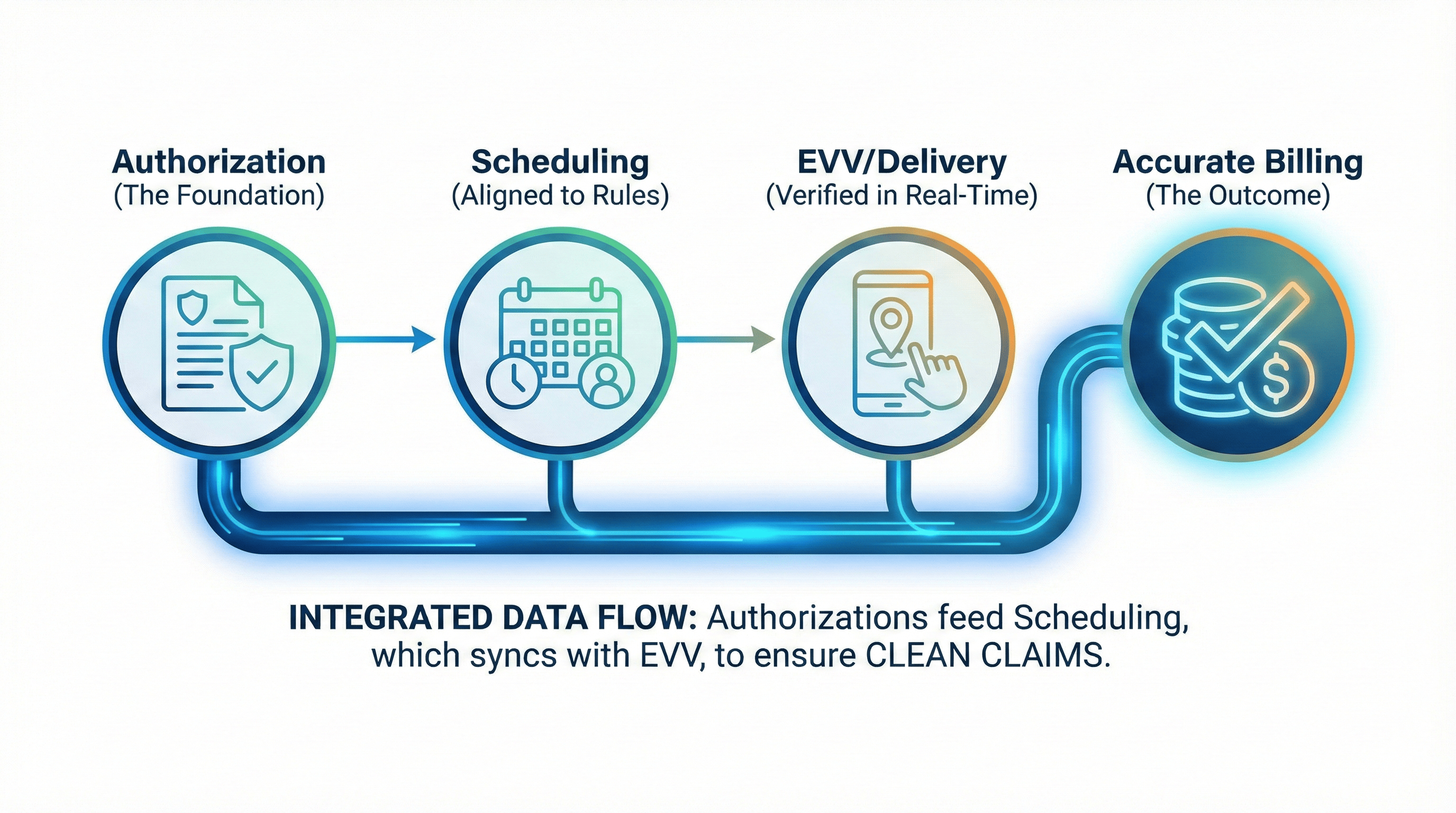
Medicaid waiver billing breaks down when scheduling, authorizations, documentation, and EVV operate as separate systems. Most claim denials are caused upstream, long before a claim is submitted. This article explains why waiver billing is structurally different from traditional healthcare billing and what capabilities matter most in software designed for HCBS. Solutions explored include integrated operational platforms, including systems like Ankota, that align service delivery with state-specific billing rules. The goal is not faster claims, but fewer corrections, fewer denials, and sustainable growth.
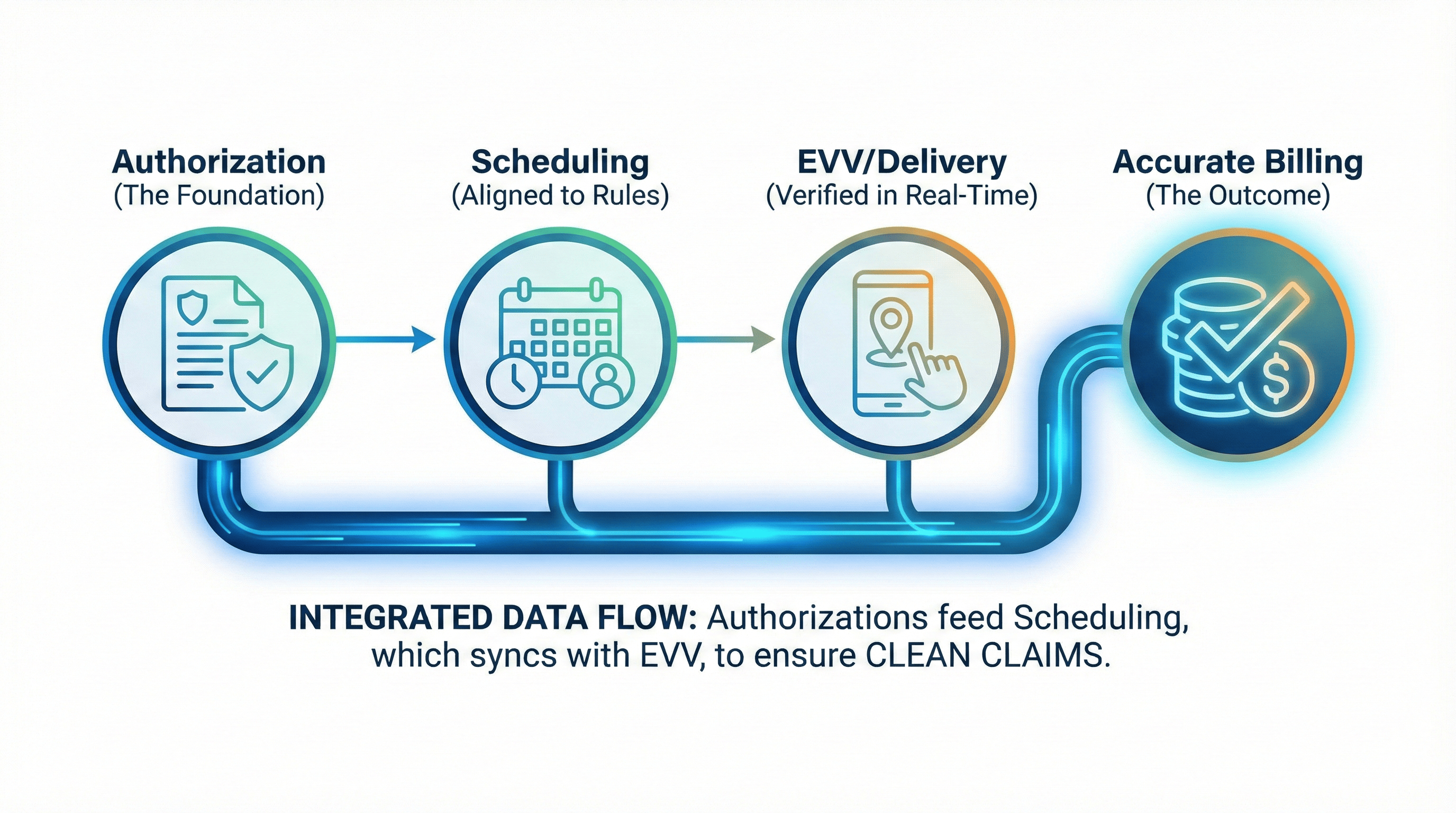
Billing in Medicaid waiver programs is rarely just a billing problem. It is the visible symptom of disconnected operational systems trying to stay in sync under state-specific rules that change often.
Unlike fee-for-service healthcare, waiver programs layer authorizations, service models, participant choice, and workforce constraints on top of billing. When any of those inputs drift out of alignment, billing teams inherit the cleanup work.
For a practical, visual walkthrough of how waiver programs actually function and why billing complexity is structural, not accidental, this short explainer video is useful background:
That framing helps clarify why waiver billing so often becomes the scaling limit for HCBS organizations, not staffing demand or referral volume.
Waiver programs are intentionally flexible. States define services, units, and provider roles differently across populations such as IDD, aging services, and self-directed care.
That variability is not an edge case. It is the core design of waivers, and it means billing logic cannot be uniform across programs or states.
Systems built for traditional medical billing often force staff into manual workarounds because they cannot represent this variability cleanly.
A common misconception is that billing problems happen at submission. In practice, most denials originate earlier, when:
Once those mismatches exist, no amount of claim scrubbing can fully fix them.
High-performing organizations do not treat billing as a downstream task. They treat it as the natural output of aligned operations.
When scheduling respects authorizations, documentation reflects actual services, and visit data flows cleanly, billing becomes predictable rather than reactive.
This is why Medicaid waiver billing software works best as operational infrastructure, not as a standalone billing module.
Effective systems treat authorizations as living constraints that evolve over time. They account for:
This prevents staff from creating work that will later have to be unwound.
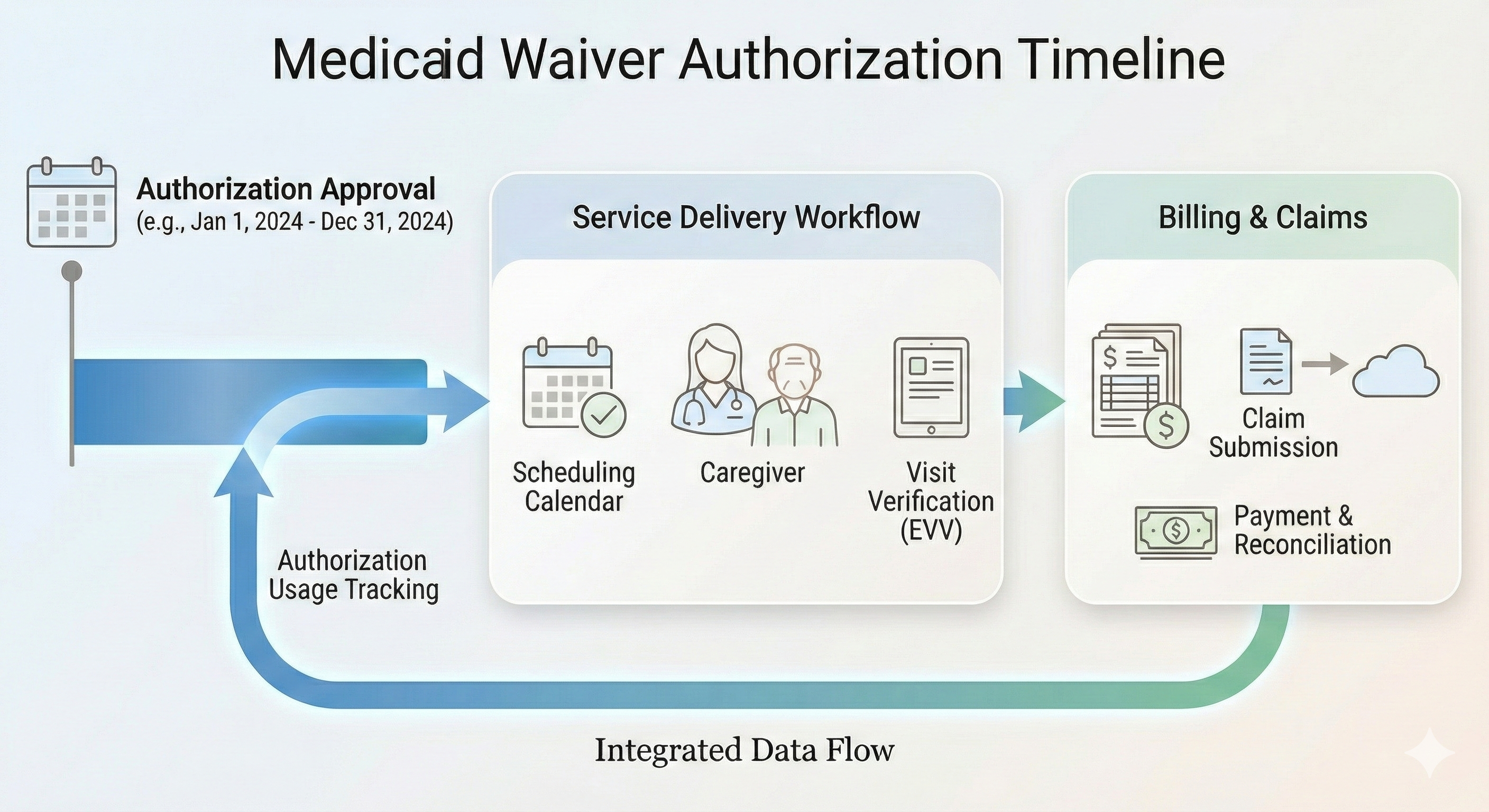
Re-keying visit data is one of the most common sources of billing errors. Systems that link service delivery records directly to billing logic reduce both mistakes and staff fatigue.
When adjustments happen upstream, they should automatically propagate downstream.
Self-direction adds complexity by design. Caregivers change, schedules shift, and fiscal rules still apply.
Software that does not explicitly support these models pushes the complexity back onto people. Systems designed for self-direction absorb that variability without breaking financial controls.
EVV is often treated as the centerpiece of waiver billing discussions. In reality, EVV is only valuable when it is connected.
Its real role is to serve as a verified data source that confirms when services occurred and feeds that information into scheduling, payroll, and billing.
Disconnected EVV tools frequently increase reconciliation work instead of reducing it. For providers evaluating EVV options, this comparison of the best EVV software solutions for 2026 helps clarify which platforms are designed to integrate cleanly versus operate as standalone compliance tools. Here's the link.
When providers search for Medicaid waiver billing software, they are usually trying to relieve deeper operational pressure, including:
These are not effort problems. They are systems problems.
In integrated environments, billing accuracy emerges naturally because:
Billing teams shift from constant correction to oversight and validation.
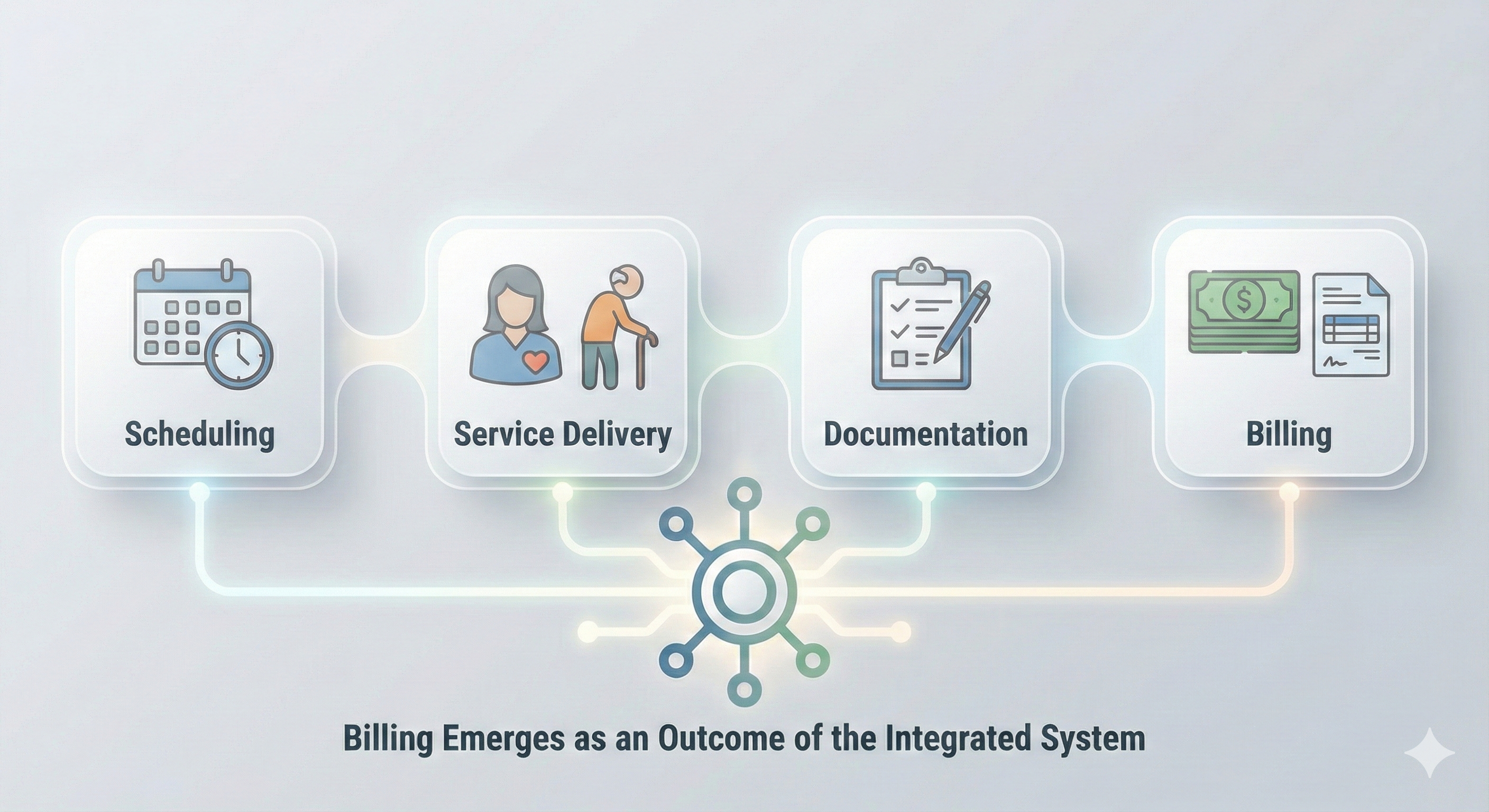
As HCBS demand increases, administrative capacity often becomes the bottleneck. Integrated platforms allow service volume to grow without linear growth in billing staff.
This is where AI begins to matter in a practical sense, not as automation theater, but as pattern recognition that surfaces anomalies and operational drift early. A deeper look at how AI is already being applied in home care operations is outlined here
Ankota was built specifically for HCBS and Medicaid waiver environments where billing accuracy depends on upstream alignment. Its design ties scheduling, service delivery, EVV, and billing logic together so that claims reflect verified activity rather than reconstructed data.
This approach treats billing as the final step in a continuous operational cycle, not as a separate function layered on top of care delivery.
| Operational Area | Fragmented Systems | Integrated Platforms |
|---|---|---|
| Data Entry | Re-entered across multiple tools | Entered once, reused everywhere |
| Claim Accuracy | High correction volume | Driven by verified service data |
| Audit Preparation | Manual document gathering | Audit-ready by default |
| Staff Experience | Frequent pay and billing disputes | Predictable, trusted workflows |
Providers that move away from disconnected tools often report that billing stabilizes not because staff work harder, but because the system stops creating avoidable exceptions.
Get a boots-on-the-ground perspective with these hard-won lessons from a veteran Missouri home care biller.
Instead of asking which billing features are included, stronger evaluation questions include:
These questions reveal long-term operational fit, not surface-level functionality.
As HCBS programs expand and workforce constraints tighten, organizations will increasingly succeed or struggle based on their internal systems.
Medicaid waiver billing software is no longer just about getting paid. It is about visibility, predictability, and operational resilience.
When billing logic is aligned with how care is actually delivered, accuracy becomes the default rather than the exception.

Ankota's mission is to enable the Heroes who keep older and disabled people living at home to focus on care because we take care of the tech. If you need software for home care, EVV, I/DD Services, Self-Direction FMS, Adult Day Care centers, or Caregiver Recruiting, please Contact Ankota. If you're ready to accept that the homecare agencies of the future will deliver care with a combination of people and tech, visit www.kota.care.

Ken is the founder and CEO of Ankota, a company that helps any organization that helps older or disabled people live independently in their home of choice. Having grown up with a disability and a passion for healthcare, this is Ken's mission
.png)
.png)



Trusted by home care agencies nationwide