
Adult Day Care Activity Ideas to Keep Clients Engaged
Adult day care centers provide a vital service, offering a ...
Hawaii has two completely different daytime care programs for kupuna and adults with disabilities, and confusing them can cost families months of wasted planning and cost providers their operating license.
For newbies: Adult Day Care (ADC) is a social model program: supervision, activities, meals, and companionship. Whereas, Adult Day Health (ADH) is a medical model program: everything ADC offers, plus skilled nurses, therapists, and clinical oversight on site.
Only ADH qualifies for Med-QUEST reimbursement under Hawaii's QUEST Integration program, and only for people who meet nursing home level of care criteria. Once you dive deeper into this article, these terminologies will make more sense to you. I will explain both programs in plain language, walk through Med-QUEST eligibility, and tell providers exactly what they need to operate compliantly in Hawaii in 2026.
Adult Day Care vs. Adult Day Health in Hawaii: The Difference That Actually MattersThere's a question that comes up over and over from families on Oahu, Maui, the Big Island, and every neighbor island in between: is my loved one going to a day care center or a day health center? And does it matter for what Med-QUEST will cover?
The short answer is yes, the difference matters ENORMOUSLY. The longer answer is what this whole article is about.
Hawaii's long-term care system is genuinely unlike anywhere else in the country. The islands have a deep cultural tradition of family caregiving that runs through Hawaiian, Filipino, Japanese, Samoan, and Pacific Islander communities. Caring for elders is not a burden here; it's a value. And the state's Medicaid program, Med-QUEST, works differently from the standard Medicaid model that most guides and online resources are written around. If you've been trying to apply mainland advice to a Hawaii situation, that's probably part of why you're still confused.
This guide is written specifically for Hawaii. For families trying to navigate real options. For providers trying to open, run, or grow a program that actually survives a licensing inspection. Let's start with the basics and build from there.
“Across home and community-based care, I’ve seen that families are rarely looking to hand off responsibility for someone they love. They’re looking for enough support to keep caring for that person at home. A good adult day program can provide the structure, engagement and care someone needs during the day while making it possible for them to return to their family and their chosen home each evening. What I enjoyed most about researching what makes day services special in Hawaii's many cultures bring their traditions to bear in organizing and delivering care.”
— Ken Accardi, CEO of Ankota
Before going deep, here's the comparison that answers most of the questions people are searching for.
Note: This is also the section worth bookmarking or screenshot for your next conversation with a care coordinator.
| Adult Day Care (ADC) | Adult Day Health (ADH) | |
|---|---|---|
| Model | Social | Medical |
| Primary Purpose | Supervision, social engagement, meals, activities | Therapeutic, social, and health services with nursing oversight |
| Licensed Under | HAR Title 17, Chapter 1424 (Dept. of Human Services) | HAR Title 11, Chapter 96 (Dept. of Health) |
| Licensing Body | DHS (via Community Ties of America) | DOH Office of Health Care Assurance |
| Clinical Staff Required | Not required | Yes, nursing oversight required |
| Med-QUEST Coverage | Limited (varies by plan) | Yes, under QUEST Integration for qualifying participants |
| Level of Care Required | Lower, social and functional needs | Higher, nursing home level of care |
| Services Provided | Meals, activities, supervision, personal care assistance | All of ADC, plus skilled nursing, PT/OT/ST, health monitoring |
| CON Required? | No | Potentially yes, check with SHPDA first |
P.S. PT/OT/ST stands for Physical Therapy, Occupational Therapy, and Speech Therapy. These are delivered by licensed therapists and are very different from an activity coordinator leading morning exercises. CON stands for Certificate of Need, which is a state government approval that a new healthcare facility is actually needed in your area before you can open. SHPDA is the State Health Planning and Development Agency, the Hawaii office you call to find out if you need one. More on both of these below.
Now let's go deeper on each program, because the nuance really does matter when you're making a real decision.
Adult Day Care is the more accessible of the two programs, and it's the one most families encounter first when they start searching for daytime care options for a kupuna. (for those of you who are thinking what kapuna means: it's a term broadly used across Hawaii to refer to older adults with a sense of deep respect)
In Hawaii, Adult Day Care centers are regulated under Hawaii Administrative Rules Title 17, Chapter 1424, administered by the Department of Human Services. Licensing is delegated to Community Ties of America (CTA), which operates under the Office of Health Care Assurance.
If you want to open an ADC or check on a center's license status, CTA is your first call at (808) 234-5380.
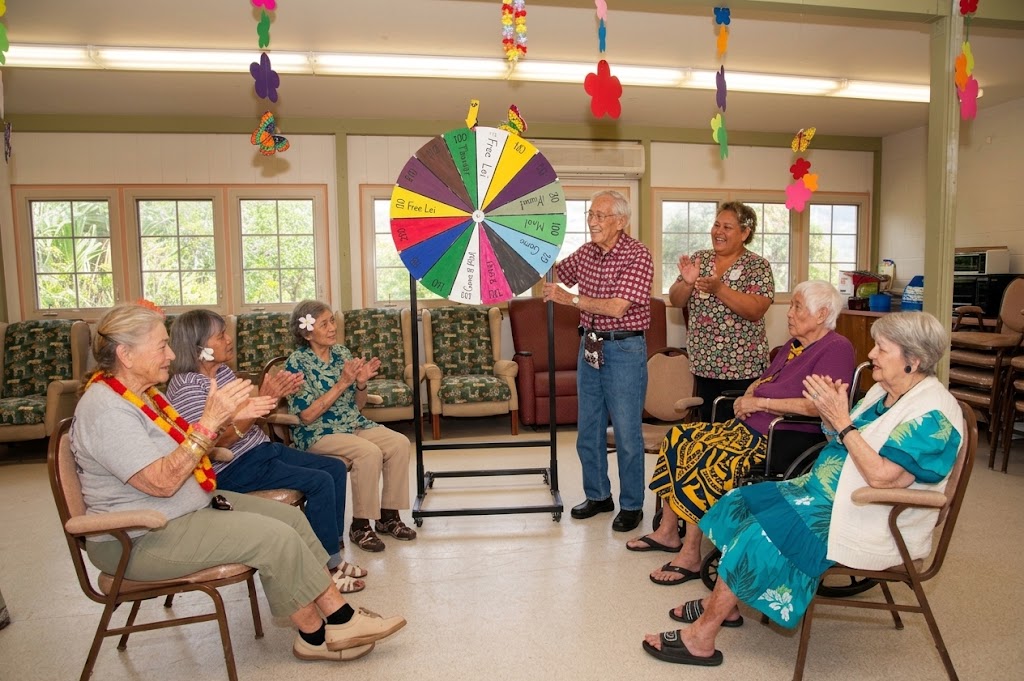
The social model is designed for adults who need structured daytime supervision and support, but whose medical needs don't require a nurse on site. A participant might have physical or cognitive limitations that make it unsafe to be home alone, but they don't need clinical care during the day. Their doctor manages their health at medical appointments. The day center provides everything else: engagement, meals, safety, and relief for family caregivers.
Under Hawaii's definition, an Adult Day Care participant is someone who needs services to maintain their current level of social, emotional, or physical functioning; has a physical or mental disability verified by a medical or psychological report; and can benefit from structured group programming without needing clinical intervention during center hours.
What Adult Day Care does not include: skilled nursing services, physical or occupational therapy delivered as a clinical service, or nursing oversight of ongoing medical conditions. If your kupuna needs medication management during the day, wound care, therapist-supervised exercises, or ongoing nursing assessment of a chronic condition, Adult Day Care alone is not the right fit. They need Adult Day Health.
The practical test: if your family member's medical needs are stable and their doctor visits are routine checkups rather than active management of a complex condition, Adult Day Care is likely appropriate. If their health requires ongoing clinical eyes during the day, they might need the medical model. And this is not at all a medical advice from me!!!
“In my heart, I believe that Adult Day Services can be the savior for caring for older Americans. Unlike home care, where one care provider goes to one home and cares for one person, a day center can care for many people with a small staff [note that each state has different staffing ratio requirements] and that by coming to a day center, participants get movement, socialization and nutrition. I'm hoping and expecting to see a lot of growth in this service.”
— Ken Accardi, CEO of Ankota
Adult Day Health is a fundamentally different type of program operating under a completely different regulatory framework. The name sounds similar, but the differences are substantial.
Under Hawaii Administrative Rules Chapter 96 (Title 11), anyone operating a freestanding Adult Day Health center in Hawaii must be licensed by the Hawaii State Department of Health through the Office of Health Care Assurance. This is not the same license as Adult Day Care.
It comes from a different agency, involves different inspections, requires different staffing, and carries different consequences if you operate without it.
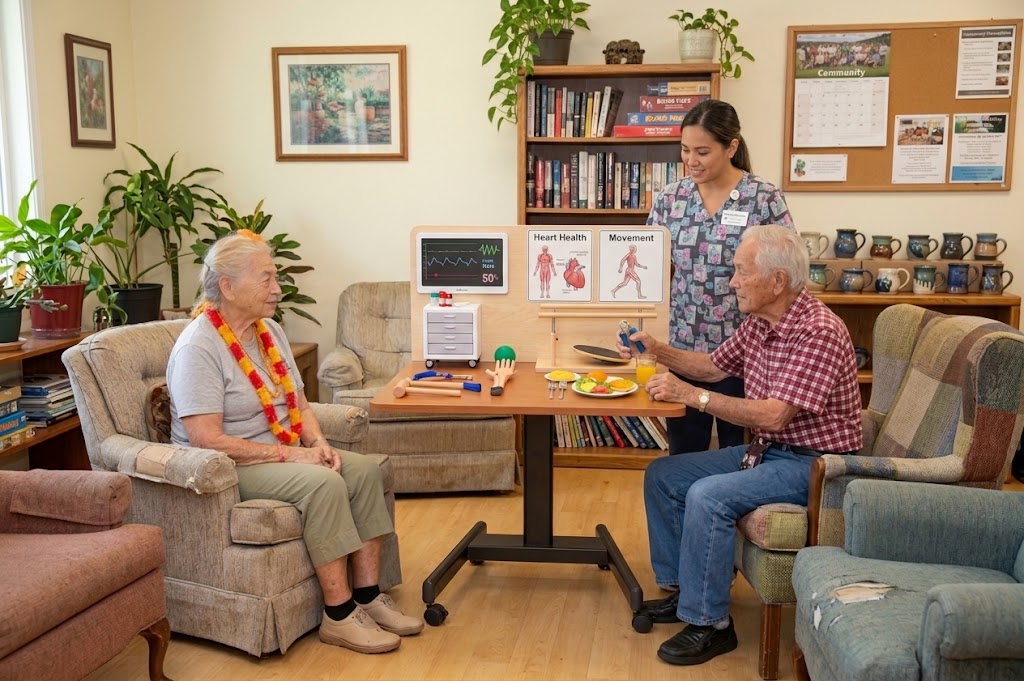
Hawaii's legal definition of Adult Day Health Care is worth reading in full because every word is deliberate: it is "an organized day program of therapeutic, social, and health services provided to adults with physical or mental impairments, or both, which require nursing oversight or care, for the purpose of restoring or maintaining, to the fullest extent possible, their capacity for independence in the community."
Simply put, an Adult Day Health program includes everything an Adult Day Care center offers, and on top of that:
skilled nursing assessment and care planning updated regularly
medication management by nursing staff at the center during the day
physical, occupational, and speech therapy delivered by licensed therapists as part of a care plan
health monitoring for chronic conditions including blood pressure tracking, blood sugar checks, wound care observation
coordination between the center's clinical staff and the participant's physicians and specialists
the capacity to serve people who qualify for nursing home care but are choosing to stay in the community instead.
That last point is important enough to say again: Adult Day Health exists precisely to serve people who need nursing-home-level care but want to remain living at home or in the community.
I think it is one of Hawaii's most valuable tools for honoring the cultural preference of kupuna and their families to stay connected to home, neighborhood, and family rather than moving into a facility. 👨👩👧👦
If you are a provider planning to open an Adult Day Health center, there is a step many people miss that can derail your timeline by months: before applying for your DOH license, you must contact the State Health Planning and Development Agency (SHPDA) to find out whether you need a Certificate of Need.
P.S. A Certificate of Need (CON) is a state government document that says a new healthcare facility is actually needed in the area where you plan to open. The idea behind it is to prevent a situation where three adult day health centers open in the same neighborhood and two of them fail because there aren't enough clients to support all three. Not every ADH center needs a CON, but you have to ask SHPDA to find out. Do this before you sign a lease or hire staff. Finding out you need a CON after you've already made commitments is an expensive and stressful discovery.
The DOH application for ADH licensure requires a copy of SHPDA's response before it will be considered.
Remember to contact the Office of Health Care Assurance once you have your SHPDA determination in hand.
Let's get to the part that most families in Hawaii really need to understand, because it directly affects what they can afford and what help they can access.
Med-QUEST is Hawaii's version of Medicaid, administered by the Med-QUEST Division under the Department of Human Services. Hawaii's approach is different from most mainland states: instead of paying providers directly, the state runs Med-QUEST through managed care plans, meaning you enroll in one of the participating health insurance plans and that plan then manages your coverage and pays your providers.
P.S. "Managed care" just means your care is coordinated through an insurance plan rather than going directly to the state for every service. Think of it like having a health insurance plan that happens to be funded by Medicaid. The plan manages what gets approved, which providers you can use, and how claims get paid. In Hawaii, Med-QUEST is run entirely through these plans rather than through a traditional fee-for-service system where providers bill the state directly.

For long-term care services including adult day programs, the relevant program within Med-QUEST is QUEST Integration (QI), Hawaii's managed care program for Medicaid-eligible seniors and adults with disabilities.
The five QI plans available in 2026 are:
AlohaCare
HMSA
Kaiser Permanente
Ohana Health Plan
UnitedHealthcare Community Plan
Availability varies by island and not all plans operate on every island, which matters if you're on Molokai, Lanai, or the more rural parts of the neighbor islands.
Hawaii's QUEST Integration program funds personal care, home health, adult day health, homemaker services, and case management to help kupuna age in place rather than move into nursing facilities. This is the funding stream that makes Adult Day Health affordable for people who qualify.
To access Med-QUEST coverage for Adult Day Health, a person must meet two separate eligibility tests: financial and functional. Both matter, and you can fail one while passing the other.
On the financial side, as of February 2026, a single individual applying for QUEST Integration long-term care services must have income below approximately $1,530 per month and assets under $2,000.
For married couples where only one spouse is applying, the rules are more complex: the applicant spouse can keep up to $2,000 in assets, and the at-home spouse is protected up to $162,660 in assets under spousal impoverishment rules.
P.S. "Spousal impoverishment rules" exist because without them, applying one spouse for Medicaid could leave the other spouse with almost nothing. These federal rules set a minimum that the at-home spouse gets to keep regardless of what the rules would otherwise require. In Hawaii in 2026, that protected amount for the at-home spouse is $162,660.
Hawaii's home equity limit is $1,130,000 in 2026, which is among the highest in the nation and reflects the reality of Hawaii's housing market. A kupuna who owns a home in Hawaii, even a very valuable one, is generally not disqualified from Med-QUEST coverage on the basis of that home equity while they are alive. The home is generally protected as long as the applicant or their spouse is living in it or has expressed intent to return.
P.S. "Home equity" is the current value of the home minus anything still owed on the mortgage. Hawaii's high limit here is significant because real estate values across the islands are high, and families elsewhere in the US often lose Medicaid eligibility because their home is worth too much. Hawaii's $1.13 million limit is designed to account for this.
Income limits update in February each year. Verify current figures directly at medquest.hawaii.gov or by calling Med-QUEST at 1-800-316-8005.
Passing the financial eligibility test alone is not enough to access Med-QUEST reimbursement for Adult Day Health. The person must also pass a functional level of care assessment that establishes they qualify for nursing-home-level services.
P.S. A "level of care assessment" is a formal evaluation, usually done by a nurse or social worker, that looks at how much help a person needs with everyday activities like bathing, dressing, eating, getting around, and managing medications, as well as how much supervision they need for safety. The result determines whether someone qualifies for the most intensive Medicaid long-term care programs or whether their needs can be met through less intensive services.
This assessment is the clinical gateway that separates who qualifies for ADH and Med-QUEST reimbursement from who may be better served by Adult Day Care without Med-QUEST funding. It looks at functional limitations in activities of daily living, cognitive status and dementia severity, medical complexity, fall risk, and the level of supervision required to keep the person safe.
In November 2025, Hawaii published a rate methodology for a new service initiative called Kau Ai Pono within QUEST Integration. The name means "thriving and sustaining" in Hawaiian, and the program addresses social determinants of health like food insecurity, housing instability, transportation barriers, and safety concerns as part of the Medicaid benefit package.
P.S. "Social determinants of health" is a formal term for all the non-medical things that affect whether someone stays healthy: things like being able to afford food, having stable housing, having transportation to medical appointments, and feeling safe at home. Researchers have long known these factors affect health outcomes as much as medical care does, and Medicaid programs across the country are starting to cover some of them. Hawaii's Kau Ai Pono initiative is their version of this.
Eligible QI enrollees may receive services including medically tailored meals, food pantry coordination, housing navigation, and transportation resources beginning in 2026. This initiative is still being implemented and may expand in scope.

If a participant's needs include these social support gaps alongside their adult day services, it's worth asking their QI managed care plan what Kau Ai Pono services may be available to them.
If you've been searching for adult day care or adult day health in Hawaii, you've probably encountered the acronyms ARCH and ICF and wondered where they fit. These are residential programs, not day programs, but they share the same regulatory ecosystem and the same population, which is why they come up in the same searches.
An ARCH is where someone lives, not where they go during the day. The resident calls it home. ARCHs are licensed under Hawaii Administrative Rules Chapter 100.1 by the Hawaii Department of Health Office of Health Care Assurance. They provide 24-hour residential care in a home-like setting, usually in an actual house in a residential neighborhood rather than a clinical building.
There are two types. Type I ARCHs serve up to five residents. Type II ARCHs serve six or more. Both types can have a special designation called Expanded Care, which is important to understand if your family member's needs might increase over time.
I will write another separate guide to cover this, because now we are getting off-track.
Intermediate Care Facilities provide a higher level of 24-hour institutional care than an ARCH. They sit between a basic residential care home and a full skilled nursing facility in terms of the intensity of care they provide.
ICF/IID facilities are specifically certified for individuals with Intellectual and Developmental Disabilities. They are federally certified by Medicare and provide structured residential care alongside active treatment programming designed to help residents develop and maintain skills. In Hawaii, the most well-known ICF/IID provider is The Arc in Hawaii, which operates multiple small group homes and apartment settings on Oahu.
For a complete list of all licensed facility types in Hawaii with their applicable administrative rules, the OHCA's facility type reference page is the authoritative source.
This section is for people running or planning to run an adult day program in Hawaii. Families who are evaluating programs can skip to the next section, though reading this might give you useful questions to ask any center you're considering.
This sounds obvious, but it's worth stating plainly because the consequences are serious. Operating an Adult Day Health center without a valid DOH Chapter 96 license can result in civil money penalties and imprisonment under Hawaii state law. The DOH takes unlicensed operation seriously. If you are providing services that meet the definition of Adult Day Health, you need that license, full stop.
For ADC providers, the situation is the same: operating without a valid Chapter 1424 license from DHS is not a gray area. If you are running a program and are unsure whether your current activities require a license, contact Community Ties of America at (808) 234-5380 before continuing.
Both ADC and ADH centers are required to maintain accurate records of attendance, services, meals, incidents, and care plans. The difference is in how detailed those records need to be and what they need to show.
For ADC centers under Chapter 1424, the core records include attendance, meal service logs, activity participation, incident documentation, and care plans for each participant. These need to be organized well enough that a licensing inspector can review them efficiently and a new staff member can understand what's been happening with a participant.
For ADH centers billing Med-QUEST, the documentation bar is significantly higher. Nursing assessments, therapy notes, medication administration records, physician orders, care plans with measurable goals, daily service notes, and quarterly progress reviews all need to be maintained in a format that can withstand a Med-QUEST audit. An auditor will look at a chart and ask: was this service authorized? Was it delivered? Was it documented? Was the documentation completed by a qualified person in the required timeframe? The answer to all four questions needs to be demonstrably yes.
Providers who are managing this documentation on paper or in spreadsheets will almost always find that their documentation is missing something a Med-QUEST auditor is looking for. Not because the care wasn't delivered, but because the record keeping system isn't designed to capture everything that's required.
Adult day services compliance software built around the specific documentation requirements of Hawaii programs is not a luxury for growing centers; it's the infrastructure that makes the documentation manageable in the first place.
The case for why Excel spreadsheets fall short in managing adult day care is particularly strong in Hawaii, where Med-QUEST's managed care billing layer adds documentation complexity that generic spreadsheets weren't designed to handle.
For both ADC and ADH programs, structured activity programming and care plan documentation are not optional. They are what the license requires you to demonstrate. When a DOH surveyor or a Med-QUEST auditor visits, they are looking at whether the activities you planned for each participant actually happened, and whether the care plan goals are being worked toward in a measurable way.
Activity tracking software that links participation records to individual care plans gives providers the documentation trail that shows services delivered match services planned. Without that linkage, a surveyor finds activity logs in one binder and care plans in another and has to manually connect them, which is exactly the kind of inefficiency that creates problematic survey findings even when the care itself was good.
Transportation is a bigger operational component for Hawaii adult day programs than for most mainland programs, for reasons that are obvious once you think about Hawaii's geography. The islands are not flat grids. Neighborhoods are separated by mountains, one-lane roads, and sometimes an ocean. On neighbor islands, distances are significant and traffic is unpredictable. Providers serving clients across different communities, or operating on islands with limited transportation infrastructure, need reliable documentation of every transportation trip.
Transportation tracking for elder day centers that records pickup and dropoff times, routes, and any incidents creates both the operational visibility and the compliance record that licensors and payers expect. If something goes wrong during transport and you don't have a record of what happened, when, and how it was resolved, you are in a difficult position with both the family and the licensing agency.
This section doesn't appear in any mainland guide to adult day programs. It should, so I will be the first one to write this:
Hawaii has one of the most genuinely multicultural elder care cultures in the United States. In Hawaiian, Filipino, Japanese, Samoan, Tongan, Marshallese, and many other communities across the islands, caring for elders within the family is not a burden. It's an expression of love and obligation that runs deep and is spoken about with pride. When a family in Hawaii starts looking at adult day care options, the conversation is almost never "we need to find somewhere for Dad." It's "how do we make sure Dad is well cared for while we are at work, and how do we make sure he comes home to us at the end of the day."
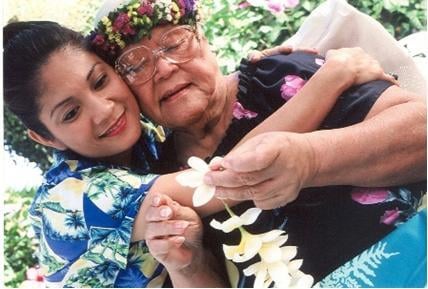
That cultural context shapes what adult day programs in Hawaii need to be. Culturally responsive programming means different things across the islands' communities, but some elements are consistent: language matters, and many kupuna in Hawaii are more comfortable in Tagalog, Ilocano, Japanese, Chinese, Korean, Hawaiian, Marshallese, or Chuukese than in English.
Hawaii's Med-QUEST program offers free language services in all of these languages for a reason. A center where the staff can speak to a participant in their first language is not a nice-to-have feature. For many families, it's the deciding factor.
Food matters. Activities matter. Whether the center feels like a place someone would actually want to spend time, or whether it feels institutional and impersonal, matters enormously to families who are making this decision with real emotional weight behind it.
The business case for adult day programs in Hawaii is also shaped by this cultural reality. Demand for community-based care alternatives to nursing facilities is both culturally strong and demographically growing. Adding adult day services alongside home care creates business synergies and margins that are particularly compelling in this market, where the population of kupuna is growing and the preference to stay in the community rather than enter a facility is strong and consistent across virtually every cultural group.
If you're a family trying to figure out which type of program is right for your kupuna, here's the framework that actually works. It has five steps, and the order matters.
Step 1: Start with the medical need, not the funding. Does your family member need nursing oversight during the day? Medication given or managed by nursing staff? Wound care? Therapist-supervised exercises? Monitoring of a complex condition like congestive heart failure, late-stage diabetes, or moderate-to-severe dementia? If yes to any of these, they need Adult Day Health. If their medical needs are stable and managed by their regular doctor at scheduled appointments, Adult Day Care may be the right fit.
Step 2: Ask about Med-QUEST eligibility. Is your family member enrolled in QUEST Integration, or do they potentially qualify? Do they meet the financial limits (income under approximately $1,530 per month, assets under $2,000 in 2026)? And do they meet the functional level of care assessment for nursing-home-level need? If yes to all three, and they need ADH-level services, Med-QUEST should cover a significant portion of the cost. If they don't meet the functional criteria, they may still qualify for ADC through a different benefit.
Step 3: Verify the program's license before you commit. Don't assume. Ask directly: are you licensed under DOH Chapter 96 as an Adult Day Health center, or under DHS Chapter 1424 as an Adult Day Care center? This is a simple question. Any legitimate program will answer it immediately. The license type determines what services they can legally provide and what Med-QUEST will pay for. A center that can't clearly tell you which license they operate under is a red flag.
Step 4: Think about geography and transportation. On Oahu you have more options. On Maui, the Big Island, Kauai, Molokai, and Lanai, the options are fewer and transportation to the center is a bigger part of the decision. Factor it in from the beginning. A wonderful program that your kupuna can't reliably get to is not actually a solution.
Step 5: Ask about language and cultural fit. Hawaii's population is genuinely diverse. The right program is one where your family member can communicate comfortably, participate in activities that feel meaningful to them, eat food they actually enjoy, and feel at home rather than just adequately cared for. Don't underestimate how much this matters for engagement, dignity, and wellbeing.
For providers operating or building adult day programs in Hawaii, the operational challenge is real: managing the documentation, billing, activity tracking, care planning, and transportation records of a licensed program while also actually delivering high-quality, culturally responsive care to participants. These things pull in different directions if your administrative infrastructure isn't solid.
Ankota's adult day care software handles the full operational picture: participant records and care plans, attendance and activity tracking, medication administration records for ADH centers, transportation documentation, and billing that connects to Med-QUEST managed care plans. For programs growing beyond what spreadsheets can manage, or preparing for their first DOH survey or Med-QUEST audit, the adult day care software vendor comparison and adult day care software pricing guide are the right starting points for understanding what a modern platform costs and what it actually delivers.
Hawaii's community-based care network works best when the organizations in it operate as an interconnected system, and the software should reflect that reality. Our article on how to differentiate your adult day care center covers how operational quality and documentation discipline become real competitive advantages in a market where families have meaningful choices.
Want to talk through how Ankota supports Adult Day Care and Adult Day Health providers in Hawaii, including Med-QUEST billing and DOH compliance documentation? Talk to our team. We'll walk through your specific program type, participant population, and billing requirements without a lengthy demo process that assumes you're a mainland provider.
Adult Day Care (ADC) is a social model program providing supervision, meals, activities, and personal care assistance, licensed under Hawaii Administrative Rules Chapter 1424 by the Department of Human Services. Adult Day Health (ADH) is a medical model program that adds skilled nursing, physical and occupational therapy, and clinical health monitoring, licensed under HAR Chapter 96 by the Department of Health. The core distinction is whether nursing oversight is required: ADH participants have medical needs requiring a nurse's ongoing involvement in their care during the day, while ADC participants have social and functional needs that don't require clinical staff on site.
Yes. Adult Day Health services are covered under Hawaii's QUEST Integration managed care program for participants who meet both financial and functional eligibility. In 2026, income must be below approximately $1,530 per month for a single individual and assets under $2,000. Functional eligibility requires a level of care assessment establishing nursing-home-level need. Coverage flows through the five QI managed care plans: AlohaCare, HMSA, Kaiser Permanente, Ohana Health Plan, and UnitedHealthcare Community Plan. Adult Day Care does not automatically qualify for Med-QUEST reimbursement in the same way. Verify with your plan what social ADC benefits may be available separately.
Adult Day Care Centers are licensed under Hawaii Administrative Rules Title 17, Chapter 1424, administered by the Department of Human Services. The Office of Health Care Assurance has designated Community Ties of America (CTA) to perform the actual licensing and certification activities. Contact CTA at (808) 234-5380. Adult Day Health centers are licensed separately by the DOH Office of Health Care Assurance directly under Chapter 96, and may require a Certificate of Need from SHPDA before applying for that license.
An Adult Residential Care Home is where a person lives, not a daytime program. Type I ARCHs serve up to five residents; Type II serve six or more. An Expanded Care ARCH can retain residents who develop needs typically associated with a nursing facility. A person can live in an ARCH and separately attend an Adult Day Care or Adult Day Health program during the day. The two services operate in parallel and address different hours of the day and different types of need. ARCHs are licensed under Chapter 100.1 by the Hawaii DOH Office of Health Care Assurance.
An Intermediate Care Facility for Individuals with Intellectual Disabilities is a federally certified residential facility providing 24-hour structured care and active treatment programming for people with intellectual and developmental disabilities. In Hawaii, The Arc in Hawaii operates ICF/IID settings on Oahu. Some individuals who live in ICF/IID settings also participate in community-based adult day programs during daytime hours as part of their active treatment and community integration plan. The facility type is the residential setting; the day program is structured daytime programming outside of it. They are separate, complementary services.
ADH centers billing Med-QUEST need software that handles participant care plans and daily service documentation, nursing assessment records, medication administration logs, activity and attendance tracking, prior authorization tracking by plan, and electronic billing submission to Hawaii's QI managed care plans. The documentation requirements for a Med-QUEST audit are significantly more rigorous than for a state licensing survey, and programs running on paper or spreadsheets typically struggle to respond quickly when audit requests arrive. Adult day services compliance software built for this documentation infrastructure is what keeps Hawaii ADH providers audit-ready without burying staff in manual record-keeping.
Yes, and this combination is common in Hawaii. Many kupuna live in an ARCH and attend a day program during weekday hours, then return to the ARCH in the evening. The ARCH provides the residential setting and overnight supervision. The day program provides structured activities, meals, and for ADH participants, clinical services. Med-QUEST coverage for the day program is separate from any funding arrangements for the residential ARCH placement and runs through the participant's QI managed care plan.
Ankota's mission is to enable the Heroes who keep older and disabled people living at home to focus on care because we take care of the tech. If you need software for home care, EVV, I/DD Services, Self-Direction FMS, Adult Day Care centers, or Caregiver Recruiting, please Contact Ankota. And if you're ready to see how the most innovative agencies are using AI to empower their caregivers and automate the rest, meet your new companion at www.kota.care.

Ken is the founder and CEO of Ankota, a company that helps any organization that helps older or disabled people live independently in their home of choice. Having grown up with a disability and a passion for healthcare, this is Ken's mission
.png)
.png)




Trusted by home care agencies nationwide