Ankota offers end-to-end solutions for managing care delivery for older or disabled people in their homes and in day facilities. Additionally, some of Ankota's solutions can be unbundled modular components for companies that have home-grown or best of breed components but need additional add on capabilities.
Home Care, Day Services and Disability Services will continue to be among the most important industries worldwide for the next 2 to 3 decades. The resources provided here are designed to help you learn and grow. Thanks for being home care heroes and day service stars
Ankota creates software for organizations that keep older and disabled people living at home. Our primary products are software for Home Care, Electronic Visit Verification, Adult Day Services, and Long Term Supports and Services (LTSS) for people with Intellectual and Developmental Disabilities. We also support other players in this ecosystem like PACE programs, Area Agencies on Aging (AAAs), Centers for Independent Living (CILs) and more
EVV Beyond Home Care: The STOP Medicaid Fraud Act and What's Next
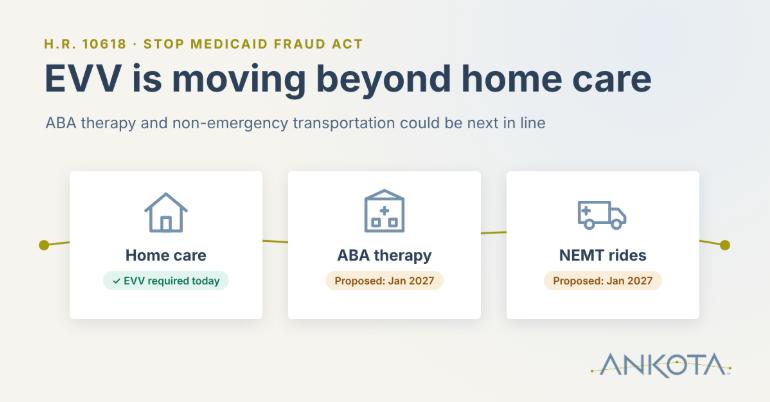
A bill introduced in the House on September 28, 2026, H.R. 10618, would require Electronic Visit Verification (EVV) for Medicaid applied behavior analysis (ABA) therapy, including sessions in clinics, and for non-emergency medical transportation (NEMT) starting January 1, 2027. It is part of a 14-bill anti-fraud package, and it may not move before this Congress ends. The direction is still clear: EVV is becoming the default proof of service across Medicaid, not just a home care rule. Ankota has spent the decade since the 21st Century Cures Act helping personal care, home health, I/DD, and adult day providers live with visit verification, and this article shares what that experience says about the services next in line.
What Is the STOP Medicaid Fraud Act (H.R. 10618)?
The Strengthening Tools for Oversight to Prevent Medicaid Fraud Act of 2026, or STOP Medicaid Fraud Act, is a House bill that would make states require electronic verification for two Medicaid services that federal EVV law does not cover today: applied behavior analysis and non-emergency medical transportation. Rep. Gabe Evans of Colorado introduced it on September 28, 2026, and it was referred to the House Energy and Commerce Committee. The next day, Committee Republicans folded it into a 14-bill package aimed at Medicaid fraud and improper payments.
Mechanically, the bill borrows almost everything from the EVV law home care agencies already know. It adds a new subsection to Section 1903 of the Social Security Act that points back to the existing EVV rules for personal care and home health, then applies them to these two new services. If you have run a home care agency through EVV, you will recognize nearly every line of it. You can read thefull bill text on GovInfo.
Which Services Would Need EVV Under H.R. 10618, and When?
H.R. 10618 would require EVV for Medicaid ABA services and NEMT furnished on or after January 1, 2027, under a state plan or waiver. The bill does not limit the requirement to services delivered in the home, so ABA sessions in clinics, schools, and community settings would appear to be covered, along with in-home sessions. That is the biggest departure from current federal EVV law, which applies to personal care and home health visits that happen in the home.
Each verified session or trip would need the same six data elements the Cures Act requires for home care:
The type of service performed
The individual receiving the service
The date of the service
The location of service delivery
The individual providing the service
The time the service begins and ends
States would also have to follow the same implementation rules that apply to home care EVV today, which include consulting with providers, families, and other stakeholders and keeping the system minimally burdensome. States that already require electronic verification for these services when the bill becomes law would be exempt as long as they keep their systems in place. A state that falls short would get a notice from HHS, then 90 days to submit a corrective action plan, then one year from the notice to comply.
One notable gap: unlike the home care EVV law, which can reduce a state's federal Medicaid match, this bill does not spell out a financial penalty for states that do not comply.
Will the STOP Medicaid Fraud Act Actually Pass?
Probably not in its current form, and probably not this year. The current Congress ends on January 3, 2027, and in an October 2 review, the law firm Alston & Bird wrote that the package's bills are"unlikely to advance before the end of the current Congress"because of the limited calendar left after the November elections. A January 1, 2027 effective date, written into a bill introduced in late September, is also more of a statement of intent than a realistic rollout plan. Home care's own EVV deadlines slipped by a year for most states, and those had four years of lead time.
So why write about it? Because bills like this rarely disappear. They get reintroduced, attached to bigger packages, or adopted state by state while Congress debates. The question for ABA and NEMT providers is not whether this particular bill passes. It is whether electronic verification is coming to their services, and on that question the evidence is pointing one way.
Why Is EVV Spreading Beyond Home Care?
EVV is spreading because it has become Medicaid's default answer to a simple question: how do we know this service happened? When spending on a service grows quickly, regulators reach for the tool that already worked somewhere else, and for in-person Medicaid services that tool is EVV. Home care went first because the 21st Century Cures Act, signed in December 2016, required it for personal care and home health. Nearly ten years later, policymakers are treating it as a template.
The pressure is clearest in ABA. According to the committee's staff report, as reported by Breaking News ABA, Medicaid ABA spending rose from about $2 billion in 2021 to more than $10 billion in 2025. In August 2026, CMS released a State Medicaid and CHIP ABA Toolkit that lists fraud warning signs such as providers billing maximum hours for most of their patients and overlapping claims and schedules. The same staff report reportedly named ABA alongside NEMT, home- and community-based services (HCBS), adult day care, and substance use treatment as Medicaid programs with elevated fraud risk.
Fast spending growth is not the same thing as fraud. ABA recipients grew sharply over the same period too, and some of that growth is more children getting a service they needed. As we wrote inhow data helps honest providers answer fraud headlines, the best defense for a legitimate provider is proof that the service happened. But in our experience, regulators do not wait for that distinction to be settled before asking providers to prove each session took place. States are already moving on their own. Colorado has required EVV for in-home and community pediatric behavioral therapy for several years, and Minnesota has passed a law adding NEMT to its EVV requirements starting in 2027.
What Has 10 Years of Home Care EVV Taught Providers?
The biggest lesson from a decade of personal care EVV is that the six data points are the easy part. The hard part is everything that happens when a visit does not go as scheduled: the missed clock-out, the phone with no signal, the manual correction, and the approval chain behind each one. Agencies that planned for the exceptions got paid. Agencies that planned only for the happy path spent months reworking denials. Here is what we have watched play out across the states where Ankota customers operate.
Grace periods end, and the bar keeps rising
Almost every state started EVV in a "soft launch" where incomplete visits still paid, then moved to hard edits where they did not. Missouri is a good example: its EVV program went live in November 2023, ran a grace period through March 2026, and on April 1, 2026 started denying any visit not properly registered with its aggregator. We wrote aboutwhat changed in Missouri and how agencies kept getting paid. ABA and NEMT providers should assume the same arc: connect first, then get measured, then get denied.
"I would expect that EVV will be expanded to more and more health care services. There's a lot of attention on social services and Medicaid cost reductions, because there are bad actors. One of the most recent pieces of evidence here is that there was an investigation of day care centers in Minnesota that found centers that were fraudulently charging the government, and it made big headlines. This was only a small percentage of "bad actors" but it has tainted the entire industry and Medicaid in general." Ken Accardi - Ankota CEO
The aggregator becomes the source of truth
Early on, many agencies treated EVV as a side system that ran next to billing. Over time, states started paying claims based on what the EVV aggregator recorded, not what the claim said. When the two disagree, the claim loses. For an ABA practice, that means the session start and end times in your EVV data will eventually need to match your billed units to the minute.
Caution
The most common shortcut we see is using a "forgot to clock out" reason code, filling in the scheduled end time, and moving on. It gets the visit accepted, but it creates a pattern of manual edits that is exactly what auditors look for. Fix the cause of missed clock-outs instead of papering over them.
A separate EVV app creates double work
Providers that bolted a standalone EVV app onto their existing scheduling and billing system ended up entering the same visit twice and reconciling the differences by hand. Providers whose EVV, scheduling, and billing lived in one system caught errors before submission. The ABA world has the same choice ahead, and practice management systems that do not treat verification as part of the session record will push that reconciliation onto office staff.
Families need to be part of the design
Home care EVV drew real pushback from families and self-directed participants, especially around GPS and live-in caregivers. Federal guidance eventually made clear that GPS tracking is not required and that states have flexibility in how they capture location. The bill's requirement to consult families is not a formality. Parents of children receiving ABA will have strong feelings about how sessions in their homes are tracked, and providers who explain the process early will have fewer problems later.
"When the first states turned on EVV, I assumed the hard part would be getting caregivers to clock in. It wasn’t. The visits that got denied were the ones where someone forgot to clock out, the office fixed it, and nobody picked a reason code. Then we’d see the opposite: an aggregator rejecting a perfectly good visit because it carried a reason code it didn’t need. Every exception has to be handled exactly the way that state wants it, and the rules aren’t the same from one state to the next.” Ken Accardi - CEO Ankota
How Is EVV in an ABA Clinic or a NEMT Van Different From a Home Visit?
EVV in a clinic or a vehicle is different because the location check, which is the simplest part of a home visit, becomes the most complicated. In a home visit, the address is fixed and one caregiver serves one client. In an ABA clinic, many technicians may be working with many children in the same building at once, with a supervising BCBA moving between sessions. In NEMT, the "location" is a pickup point, a drop-off point, and everything in between.
This is where Ankota's work outside of home care becomes relevant. Clinic-based ABA looks less like a home care visit and more like an adult day center or an I/DD day habilitation program, where one site serves many participants and the question is attendance: who was here, for how long, and with which staff member. Ankota has built attendance and service tracking for adult day and day program operators for years, and the lesson from that world is that group settings need a check-in model built for the building, not a home visit model stretched to fit it. If regulators apply home-visit EVV logic to a clinic without adjusting for that, providers will see a wave of false exceptions. Those who understand both models will be better prepared to push back during the state consultation period the bill requires.
NEMT has its own twist. Many state NEMT programs and brokers already require GPS trip logs, signatures, and odometer readings that go beyond the six EVV data elements. For those providers, EVV may add less new data and more new reconciliation, since a trip record and an EVV record will both need to agree with the claim.
What Should ABA and NEMT Providers Do Now?
ABA and NEMT providers should treat EVV as a when, not an if, and use the time before any mandate to get their session and trip data ready. Nothing in H.R. 10618 takes effect unless it passes, but the providers who did best with home care EVV were the ones who started capturing clean, verifiable data before their state required it.
In practical terms, that means checking whether your current software records the six EVV data elements for every session or trip, and whether those records tie directly to your billed units. It means learning your state's direction now: whether your Medicaid agency already requires EVV for your service, is piloting it, or has mentioned it in program integrity plans. And it means paying attention to state stakeholder sessions, because the consultation period is where providers have the most influence over how location, group settings, and exceptions get handled.
Tip
Ask your software vendor one direct question: "If our state turned on EVV for our service next year, what would change in our workflow, and which aggregators do you already connect to?" A vendor that has integrated with Sandata, HHAeXchange, and other state aggregators for home care will have a much shorter path than one starting from scratch.
Where Ankota Fits
Ankota has been on the front lines of EVV since the Cures Act mandate began, connecting personal care, home health, I/DD, and self-direction providers to state aggregators and helping them work through each state's shift from grace period to hard denials. We built ourEVV softwareso scheduling, verification, and billing share a single record, which is what keeps exceptions from turning into denials. OurEVV pillar guidecovers the federal requirements and how states implement them. If your organization provides Medicaid services that may be next in line for EVV,contact Ankota, and we will walk you through what verification looks like in practice before it becomes a requirement.
Not under current federal law, which requires Electronic Visit Verification only for Medicaid personal care and home health services. Some states, including Colorado, already require EVV for certain behavioral therapy services. H.R. 10618 would make EVV a federal requirement for Medicaid ABA services furnished on or after January 1, 2027, if it passes.
Would EVV apply to ABA sessions in a clinic, not just at home?
As written, H.R. 10618 does not limit the requirement to in-home services, so clinic, school, and community-based ABA sessions would appear to be covered. That is a significant change from home care EVV, which focuses on visits in the home. Group settings like clinics will need a verification approach designed for many sessions happening in one building at the same time.
Is EVV required for non-emergency medical transportation (NEMT)?
The federal Cures Act EVV requirement does not cover NEMT today. Many states and brokers already require trip verification such as GPS logs and rider signatures, and Minnesota has passed a law adding NEMT to its EVV program starting in 2027. H.R. 10618 would require electronic verification of Medicaid NEMT trips nationwide if enacted.
When would the STOP Medicaid Fraud Act take effect?
The bill sets January 1, 2027 as the start date for services furnished under a state plan or waiver. However, it was introduced in late September 2026, and analysts expect the 14-bill package it belongs to will not advance before the current Congress ends on January 3, 2027. A future version could carry a different date.
What data does Electronic Visit Verification capture?
EVV captures six elements: the type of service, the person receiving it, the date, the location, the person providing it, and the start and end times. H.R. 10618 would apply those same six elements to ABA sessions and NEMT trips. Federal guidance does not require GPS tracking specifically, and states have flexibility in how location is verified.
What happens if a state already requires EVV for ABA or NEMT?
States that already require electronic verification for these services when the bill becomes law would be exempt, as long as they keep the requirement in place. Whether a particular state's existing program qualifies may depend on its scope, such as whether it covers clinic-based sessions or only in-home ones.
How should ABA providers prepare for EVV?
Start by confirming your practice management software records the six EVV data elements for every session and ties them to billed units. Then learn whether your state Medicaid agency is planning EVV for ABA and take part in any stakeholder sessions. Providers that move early avoid the scramble that many home care agencies went through when their state grace periods ended.
Ankota's mission is to enable the Heroes who keep older and disabled people living at home to focus on care because we take care of the tech. If you need software for home care, EVV, I/DD Services, Self-Direction FMS, Adult Day Care centers, or Caregiver Recruiting, pleaseContact Ankota. And if you're ready to see how the most innovative agencies are using AI to empower their caregivers and automate the rest, meet your new companion atwww.kota.care.
Share This Article
Kirstin White
Oct 29, 2026
Kirstin started her career as a caregiver in home care and progressed through positions of increasing prominence in home care before joining Ankota.