
Adult Day Care Activity Ideas to Keep Clients Engaged
Adult day care centers provide a vital service, offering a ...
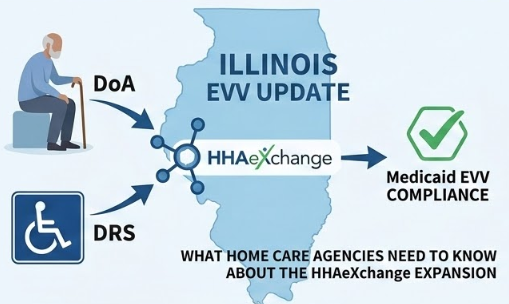
Illinois is expanding its Electronic Visit Verification requirements to cover the Community Care Program and the Home Services Program - two of the largest sources of home care volume in the state. If your agency serves older adults through the Illinois Department on Aging or the Division of Rehabilitation Services, you need a working connection to HHAeXchange, the state's EVV aggregator. At Ankota, we've helped agencies across multiple states navigate exactly this kind of EVV transition, and the agencies that prepared early almost always came out ahead.
Here's something that's been causing unnecessary panic across Illinois. A number of home care agencies recently received a memo from HHAeXchange informing them that they've been out of EVV compliance. Understandably, that got people's attention. But many of those agencies had nothing to worry about.
The first EVV compliance requirement in Illinois, which has been in place since 2023, only affected a specific set of programs: Division of Developmental Disabilities services, Personal Support Worker (PSW) services, Home Health services billed to Illinois Medicaid Healthcare and Family Services (HFS) and the Managed Care Organizations (MCOs), the Division of Developmental Disabilities, and the Division of Specialized Care for Children. Most home care agencies whose primary focus is care for older individuals were NOT part of that early group. If you got the letter and you're mainly serving seniors through DOA programs, don't panic - but do pay attention, because this next wave does include you. Details confirming which programs were in that first phase are available from HHAeXchange directly. - Ken Accardi, Ankota CEO
That said, even if you weren't affected by the first wave, the expansion currently underway is a different story. The state is bringing EVV requirements to the Community Care Program (administered by the Department on Aging) and the Home Services Program (administered by the Division of Rehabilitation Services). These two programs represent a huge share of home care volume for agencies that serve older and disabled adults in Illinois. If that's your agency, now is the time to confirm you're ready.
The 21st Century Cures Act requires every state to verify certain Medicaid-funded home care services electronically. Illinois, like most states, rolled out EVV in phases. The early phases targeted specific Medicaid programs and populations. Now the state is catching up with the broader mandate by extending EVV to DOA and DRS programs.
This is a pattern we've seen play out in state after state. Missouri went through a similar phased expansion, and the agencies that treated it as a "we'll deal with it later" problem ended up scrambling. The ones that got ahead of it - confirming their integrations, training their caregivers, testing their data submissions - had a much smoother transition.
For anyone unfamiliar with what EVV actually captures, it confirms the basics of every home visit: which caregiver provided the service, which client received it, when the visit started and ended, where it took place, and what service was delivered. The goal is straightforward accountability, but the technical implementation is where agencies run into trouble.
Illinois uses HHAeXchange as its statewide EVV aggregator. If you're not familiar with the term, an aggregator is the central system that collects visit verification data from all the different software platforms that providers use, then transmits that data to the state. Think of it as the translation layer between your agency's software and the state's compliance system.
As a provider, you generally have two paths. You can use HHAeXchange's own platform directly to record and submit visits. Or you can use your own EVV-capable software - like Ankota - and have it integrate with HHAeXchange to transmit the data automatically.
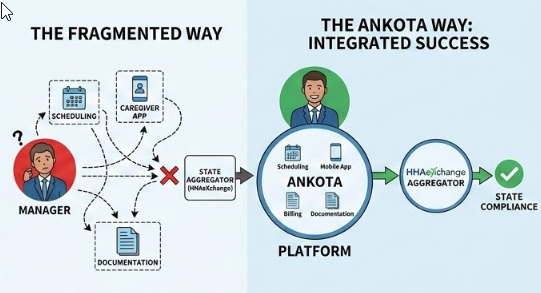
Most agencies that are growing or managing any real volume choose the second path, and for good reason. When your scheduling, caregiver mobile app, visit verification, documentation, and billing all live in one system, you're not re-keying data across platforms. You're not chasing discrepancies between what your scheduling system says and what the aggregator received. Everything flows from a single source of truth. We've written in more detail about why third-party EVV software tends to outperform aggregator-only approaches and about what to look for in EVV software that's compatible with HHAeXchange.
If you operate a home care agency in Illinois and you serve clients through DOA or DRS programs, the window to get ahead of problems is now. Not after you get a compliance notice. Not after a claim gets rejected.
Review the services you deliver and determine whether they fall under the Community Care Program, the DRS Home Services Program, or other Medicaid waiver programs that are now subject to EVV. Many agencies are discovering that more of their service lines are affected than they initially assumed. If you're unsure, the HHAeXchange Illinois info hub is a good starting point.
This is where agencies get tripped up most often. Having EVV capability in your software is not the same as having a tested, working integration with the state's aggregator. You need to confirm that your system supports HHAeXchange data submission, transmits all required visit fields, and has passed aggregator compliance testing. Not every EVV system handles this properly, and discovering that gap during a billing cycle is a painful way to learn. If you're evaluating options, the EVV pillar guide on our site walks through what to look for.
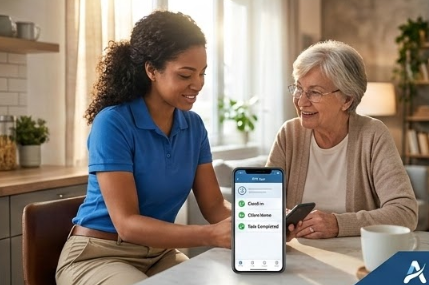
The caregiver experience is where EVV compliance lives or dies in practice. If your caregivers find the app confusing, slow, or unreliable, you'll end up with missing visit data, exception reports piling up, and compliance problems that no amount of office staff effort can fully fix. Your mobile EVV app needs to make clock-in and clock-out simple, capture GPS or location verification reliably, work offline when connectivity is spotty (which happens constantly in home care), and make service documentation quick and intuitive.
EVV isn't just a caregiver tool - it changes workflows for your office staff too. Someone needs to monitor visit exceptions daily, correct missing or incomplete EVV data before it hits billing, review compliance dashboards, and ensure visits are clean before claims go out. In our experience, agencies that built these workflows before the mandate kicked in avoided the worst of the transition pain. The ones that didn't tend to discover problems at the worst possible time: when revenue is on the line.
Confirm that visits are transmitting successfully to HHAeXchange. Verify that the data appears correctly in the aggregator system. Make sure exceptions are visible and manageable. If you haven't run a full test with real visit data, do it now - before billing depends on it.
Here's something we see over and over, and it's one of those cross-industry patterns that being in this business for years gives you visibility into. When a state expands its EVV mandate, it forces agencies to take a hard look at their technology. And many of them realize that their current setup - maybe a patchwork of standalone scheduling software, a separate EVV tool, paper-based documentation, and manual billing processes - just isn't going to hold up.
Instead of bolting on yet another point solution, the most forward-thinking agencies use the EVV mandate as the catalyst to move to an integrated platform that handles scheduling, Electronic Visit Verification, documentation, billing, and payroll connections in one place. The math is simple: fewer systems means fewer places for data to fall through the cracks, less time spent on duplicate data entry, and a much cleaner path to compliance. This is exactly what Ankota's EVV platform is designed to do - give agencies one system where scheduling, verification, documentation, and billing all connect.
EVV is an inconvenience, but it exists because it helps ensure that clients are receiving the care they need and that our industry as a whole is not committing fraud. Every hour of care that you deliver makes someone's life brighter. They get the help that they need, plus the added value of companionship.
If your agency serves clients through Illinois DOA or DRS programs, the time to address any gaps is now - before your first rejected claim. Ankota's EVV software is built for exactly this: reliable HHAeXchange integration, caregiver-friendly mobile apps, and the kind of all-in-one platform that eliminates the patchwork. To see how other Illinois agencies are handling the transition, schedule a demo.
Yes. The Community Care Program administered by the Illinois Department on Aging is one of the primary programs now being brought under EVV requirements. If your agency provides home care services to seniors through DOA programs, you will need a working EVV system that integrates with HHAeXchange, the state's aggregator platform.
HHAeXchange is the EVV aggregator platform that Illinois has selected to collect and transmit Electronic Visit Verification data to the state. You don't have to use HHAeXchange as your day-to-day software - many agencies prefer to use their own EVV-capable platform (like Ankota) and integrate with HHAeXchange behind the scenes. But your visit data does need to flow through HHAeXchange one way or another.
Not necessarily. The first wave of Illinois EVV compliance, in place since 2023, only applied to specific programs including Division of Developmental Disabilities services, PSW services, and Home Health services billed to Medicaid (HFS) and managed care organizations. If your agency primarily serves older adults through DOA programs, you likely weren't part of that initial group. However, the current expansion does affect you, so use this as motivation to confirm your systems are ready.
Absolutely. Most growing agencies choose to use third-party EVV software that integrates with HHAeXchange rather than using the aggregator platform directly. This approach lets you manage scheduling, caregiver apps, visit verification, clinical documentation, and billing all in one system instead of juggling multiple platforms and re-entering data.
Non-compliance typically leads to rejected claims, delayed reimbursements, and potential audit scrutiny. In other states that have gone through similar EVV expansions, agencies that weren't ready experienced cash flow disruptions that took weeks or months to resolve. The best protection is acting now: confirm your integration, train your staff, and test your data submissions.
Timeline varies depending on your current technology setup. If you're already using an EVV-capable platform with HHAeXchange integration built in, the process can be relatively quick - mainly configuration and testing. If you're starting from scratch or switching platforms now, move quickly - you want issues resolved before they affect billing.
Ankota's mission is to enable the Heroes who keep older and disabled people living at home to focus on care because we take care of the tech. If you need software for home care, EVV, I/DD Services, Self-Direction FMS, Adult Day Care centers, or Caregiver Recruiting, please Contact Ankota.
And if you're ready to see how the most innovative agencies are using AI to empower their caregivers and automate the rest, meet your new companion at www.kota.care.

Ken is the founder and CEO of Ankota, a company that helps any organization that helps older or disabled people live independently in their home of choice. Having grown up with a disability and a passion for healthcare, this is Ken's mission
.png)
.png)



Trusted by home care agencies nationwide