Adult Day Care Activity Ideas to Keep Clients Engaged
Adult day care centers provide a vital service, offering a ...

Most agency owners assume caregivers quit over pay, but when caregivers are asked directly, poor communication and unreliable hours rank ahead of the paycheck. Turnover in home care has hovered between roughly 75 and 80 percent for years, and most of it happens early, before a new caregiver ever feels like part of the team. The agencies that keep people fix the office experience, protect hours and consistency, and set up the first client match with care. At Ankota, we see this pattern across home care, adult day, and I/DD services, and we build our scheduling, recruiting, and Caregiver Rewards tools around the moments when people decide whether to stay.
Here is a finding that surprises most agency owners: pay is not the number one reason caregivers quit. When Home Care Pulse interviewed more than 40,000 caregivers, the top answer was poor communication, followed by hours and scheduling. Pay and benefits came in third. Pay matters, and we will get to it, but if your whole retention strategy is a fifty-cent raise, you are treating the third problem and ignoring the first two.
Caregivers quit home care agencies mostly because of how the job feels from week to week, not because of a single big grievance. In Home Care Pulse's study of more than 40,000 caregiver interviews, the top ten reasons were poor communication, hours and scheduling, pay and benefits, little or no training, lack of recognition, unclear expectations with the first client, poor client compatibility, rude office staff, lack of openness to feedback, and commute or travel. Seven of those ten are things the agency controls directly.
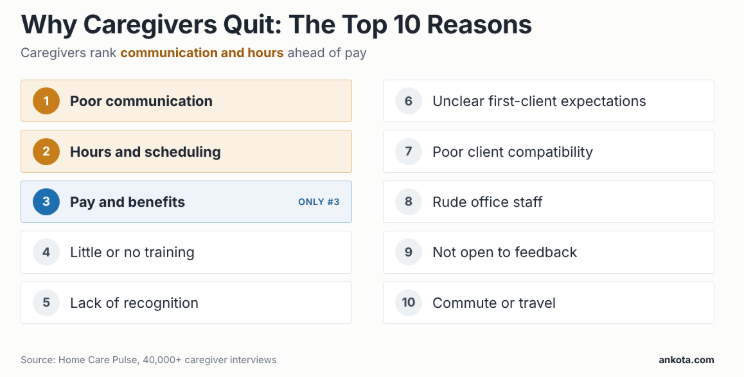
That list was presented at the Home Care Association of America conference and reported by Home Health Care News, and in our experience it has aged remarkably well. The tools have changed and wages have moved up, but when we talk with agency owners today, the stories they tell about why someone walked away still land on the same handful of causes.
Look at the list again and notice how many items are really about the office, not the client's home. Communication, scheduling, training, recognition, rude office staff, openness to feedback. Caregivers rarely quit because the work is hard. They signed up for hard work. They quit because the organization behind the work made it harder than it needed to be.
Pay is a real reason caregivers leave, but it is rarely the only one, and it is often the reason that gets written down because it is the easiest one to say. According to PHI's 2025 key facts on the direct care workforce, median annual earnings for direct care workers were just under $26,000. That is a hard number to raise a family on, and an agency paying well below its local market will lose people no matter how good its culture is.
But here is the part that gets missed. For a caregiver, pay is the hourly rate multiplied by the hours you actually give them. A caregiver earning a dollar more per hour at an agency that can only offer twenty hours a week is taking home less than one earning a dollar less with a steady thirty-five. When caregivers say "pay," they often mean "I couldn't count on enough hours." That is a scheduling problem dressed up as a compensation problem.
Industry advice has long been to aim for pay in the top quarter of your local market, and we agree that being competitive is the price of admission. Once you are there, though, the next dollar of retention almost always comes from hours, consistency, and respect, not another raise.
"What is it that they really want? Maybe they just feel like a number and they feel unappreciated. Maybe money is a factor, but usually that's not one of the bigger aspects of why they got into this business. The number one reason that caregivers got into the business is the desire to help people."
- Nick Bonitatibus, The Digital Champs, on Creating an Irresistible Offer for Caregiver Recruiting, Home Care Heroes with Ken Accardi
Most caregivers who quit do it early because the first few weeks are when expectations meet reality, and many agencies leave that collision to chance. A new caregiver walks into a stranger's home, often with a few hours of orientation and a care plan they saw for the first time that morning. If the first client is a poor match, or the job looks nothing like what was described in the interview, they are gone before the agency ever learned their name well.
Two items from the Home Care Pulse list, "lack of expectations with first client" and "lack of client compatibility," sit right in this window. So does training. That same research found that agencies providing five or more hours of orientation had meaningfully lower turnover than their peers. None of this is expensive. It is just easy to skip when you have three open shifts and a new hire who can start tomorrow.
We wrote a full framework for this stretch in the first 100 days of caregiver retention, and the short version is this: treat the first client assignment as part of onboarding, not as the end of it. Pick an easier first match on purpose, have someone check in after the first shift, and make sure the new caregiver knows exactly who to call when something feels off.
Poor communication drives caregiver turnover because it makes caregivers feel invisible, and people do not stay where they feel invisible. It shows up as schedule changes sent by text late at night, calls to the office that go unanswered, a coordinator who sounds annoyed when a caregiver reports a problem, or the sense that ideas and concerns disappear into a void. "Rude office staff" made the top ten on its own, which should give every agency owner pause.
Think of it like a restaurant. The diners are your clients, but the cooks and servers are your caregivers, and if the kitchen manager yells at them every shift, it does not matter how good the menu is. Your caregivers are out in the field alone most of the time. The office is the only part of the organization they experience directly, and every interaction with it either builds loyalty or drains it.
The fix is mostly behavioral. Set a standard for how fast caregiver calls and messages get answered. Give schedule changes as much notice as you possibly can, and explain why when you cannot. Ask for feedback and then visibly act on some of it. And make sure the people who answer the phone understand that caregivers are their customers too.
Tip
Don't wait for the exit interview. Run short "stay interviews" at 30, 60, and 90 days and ask one question that gets an honest answer: "What almost made you quit this month?" It surfaces the communication and scheduling problems while you can still fix them.
Caregiver turnover costs a home care agency far more than the price of a replacement hire, because it also costs hours you can't staff, clients you can't accept, and continuity that clients and families notice. The 2024 Activated Insights Benchmarking Report put median home care caregiver turnover at 79.2 percent for 2023, according to the Home Care Association of America. The 2025 report showed improvement to about 75 percent, which was the lowest level in five years and still means most agencies replace three out of four caregivers every year.
Run the math for a mid-sized agency. If you employ 100 caregivers and turn over 75 percent, you need to recruit, screen, onboard, and train 75 new people a year just to stay even, before you grow at all. Every one of those departures also means a client who has to meet someone new, and inconsistency is one of the fastest ways to lose a private pay client. We have written about how scheduling software can reduce missed visits and caregiver burnout, and turnover is the hidden engine behind most missed visits.
The flip side is encouraging. Because so many of the causes are controllable, small improvements in retention have an outsized return. Keeping ten more caregivers a year means ten fewer recruiting cycles and a lot more continuity for the people you serve.
The agencies that keep caregivers do a few unglamorous things consistently: they answer caregivers quickly and respectfully, they protect steady hours and consistent client matches, they make the first assignment a soft landing, and they recognize good work in ways caregivers actually value. None of these replaces competitive pay. All of them make competitive pay go further. At Ankota, we see the same handful of practices separate high-retention organizations from the rest across every segment we serve.
Recognition deserves special mention because it is the cheapest item on the list and the one agencies most often get wrong. A pizza party once a quarter is nice. A specific thank-you from a supervisor, points toward rewards that caregivers can use for things they need, and public credit for a tough shift covered are what people remember. We dug into this on the podcast in our episode on caregiver rewards that make an impact, and it is a big part of why we built Caregiver Rewards.

Here is something we see because we work across home care, adult day services, I/DD programs, and self-direction, where siloed vendors usually see only one. In self-directed programs, participants often hire someone they already know and trust, and the relationship comes first while the job grows around it. Agencies cannot copy that exactly, but they can borrow the principle: when a caregiver feels matched to a person rather than assigned to a shift, they stay longer.
The second cross-industry lesson comes from adult day care. If you run an adult day center alongside your home care agency, it becomes a training ground where new caregivers learn the work with coworkers and supervisors in the room, instead of alone in a stranger's living room on day one. That eases the transition into home care and takes some of the sting out of the first 90 days, which is exactly where most turnover happens.
"One of my all-time favorite things to do is sending a personal video message to someone telling them how much you appreciate them. Send it to a caregiver when they've done an excellent job, or on their birthday. Because almost nobody receives personal video messages, doing this makes you stand out completely from other agencies competing for that caregiver."
- Nick Bonitatibus, The Digital Champs, on Attracting Clients and Caregivers with Video, Home Care Heroes with Ken Accardi
If you want a longer list of tactics to try, our guide to 12 ways to retain caregivers longer in home care goes deeper, and what agencies get wrong about recruiting covers the hiring side, because the best retention strategy starts with hiring people whose location and availability fit the work.
Ankota helps agencies reduce caregiver turnover by taking friction out of the parts of the job that drive people away: scheduling, communication, and recognition. Our scheduling tools help coordinators build steadier hours and more consistent client matches, our caregiver mobile app gives field staff one place to see their schedule and visit details, and Caregiver Rewards gives agencies a structured way to recognize the behaviors they want more of, like showing up on time, picking up open shifts, and staying past the first 90 days.
Technology does not fix a rude office or a broken culture. What it does well is make the good habits easier to keep and the bad patterns easier to see, so you can spot the caregiver whose hours keep getting cut, or the client match that has already burned through three people, before it turns into another resignation.
If caregiver turnover is costing your agency hours, clients, and sleep, start with the controllable causes: communication, hours, the first client match, and recognition. When you are ready to see how software can support that work, take a look at Ankota's caregiver retention and rewards solutions or contact us to talk with our team about what is driving turnover at your agency.
In Home Care Pulse's study of more than 40,000 caregiver interviews, poor communication was the top reason caregivers left their agencies, followed by hours and scheduling and then pay and benefits. That ranking surprises many agency owners, who assume pay comes first. It is good news, because communication is something an agency can improve without a budget increase.
Median home care caregiver turnover was 79.2 percent in 2023, according to the Activated Insights 2024 Benchmarking Report, and improved to about 75 percent in the 2025 report. Even at that improved level, a typical agency replaces about three out of every four caregivers each year. Rates vary widely between agencies, which shows how much of turnover is within an agency's control.
New caregivers often quit in the first 90 days because the job does not match what they expected, the first client is a difficult match, or they feel unsupported with little training. Agencies can reduce early turnover by choosing an easier first client on purpose, checking in after the first shift, and providing solid orientation. Treating the first assignment as part of onboarding makes a measurable difference.
Competitive pay is necessary, but it rarely fixes retention on its own. Caregivers also leave over unreliable hours, poor communication, and lack of recognition, and a raise does not address any of those. Once your rates are competitive in your local market, steady hours and a respectful office usually do more for retention than the next increase.
A stay interview is a short, informal check-in with a current caregiver, usually at 30, 60, and 90 days, to learn what is working and what might make them leave. Unlike an exit interview, it happens while you can still fix the problem. A simple question like "What almost made you quit this month?" tends to get more honest answers than a long survey.
Caregiver rewards programs reduce turnover by recognizing specific behaviors, such as on-time visits, covering open shifts, and reaching tenure milestones, in a way caregivers can see and use. Recognition was one of the top reasons caregivers gave for leaving, and it is one of the least expensive to address. Ankota's Caregiver Rewards gives agencies a structured way to do this consistently instead of relying on occasional gestures.
Ankota's mission is to enable the Heroes who keep older and disabled people living at home to focus on care because we take care of the tech. If you need software for home care, EVV, I/DD Services, Self-Direction FMS, Adult Day Care centers, or Caregiver Recruiting, please Contact Ankota. And if you're ready to see how the most innovative agencies are using AI to empower their caregivers and automate the rest, meet your new companion at www.kota.care.

Kirstin started her career as a caregiver in home care and progressed through positions of increasing prominence in home care before joining Ankota.






Trusted by home care agencies nationwide