Adult Day Care Activity Ideas to Keep Clients Engaged
Adult day care centers provide a vital service, offering a ...

TL;DR: New York State, working with federal partners including the FBI, is investigating more than 100 social adult day care programs for Medicaid fraud and is weighing whether to reform or phase out a benefit that serves about 45,000 people. The bad actors deserve every bit of that scrutiny. But the right lesson is to verify adult day, not to abandon it, because the research, led by people like NYU's Dr. Tina Sadarangani, keeps showing that a good day center is one of the most effective tools we have for keeping frail older adults, especially people living with dementia, healthy and at home. At Ankota, we build software for both home care and adult day centers, and we think honest centers can win this argument with two kinds of proof: proof that every participant was there, and proof that being there made a difference.
Let's start with the part nobody in our industry should argue with. If someone is billing Medicaid for seniors who are dead, out of the country, or never walked through the door, they should be caught, and we're glad they're being caught. Fraud steals from taxpayers, and it steals from every honest day center director who now has to explain to their own families and referral sources that they're "not like those places."
But there's a second story inside the New York headlines, and it's the one we're worried will get lost. In October 2026, Governor Hochul directed the Department of Health to review the social adult day care benefit and "consider all options," including phasing it out entirely, with recommendations due by December 31. That would be a decision about tens of thousands of frail older New Yorkers, many of them immigrants and many of them living with dementia, made in the shadow of the worst actors in the field.
I recently sat down with Dr. Tina Sadarangani of NYU's Rory Meyers College of Nursing for an episode of the Home Care Heroes and Day Service Stars podcast, and she put her finger on the problem before any of this broke. In her words, much of society "views adult day as dancing and dominoes." She sees something very different: "a really highly effective platform for chronic disease management that integrates health and social care." You can watch the full conversation on our podcast page or listen on your favorite podcast player, including Apple Podcasts.
New York is investigating more than 100 of its 400-plus social adult day care (SADC) programs for potential fraud, according to the Governor's October 20 announcement. The effort involves the Department of Health, the Office of the Medicaid Inspector General, the Attorney General's Medicaid Fraud Control Unit, HHS-OIG, the FBI and more than a dozen other partners. The benefit runs through 35 Medicaid managed long-term care (MLTC) plans, serves about 45,000 members and costs an estimated $500 million a year.
The alleged schemes are the kind that make a reader angry, and they should. Officials have described kickbacks, cash and gift cards paid to recruit enrollees, money laundering, and billing for services that were never provided. On Staten Island, prosecutors arrested an owner and program director who allegedly billed for at least 32 seniors who were dead or out of the country. And in February, the State Comptroller's audit of SADC oversight found $285 million in questionable payments, including one Flushing program with a legal capacity of 323 that billed for 530 people in a single day.
It helps to know what "social adult day care" means in New York. SADC programs are social-model centers paid through MLTC plans, and they are not licensed the way New York's medical-model adult day health care (ADHC) programs are. ADHC programs are approved by the Department of Health, operate under a nursing home's certificate and must have a registered nurse on site. That distinction matters, because when the headline just says "adult day care," every center in the state, and frankly every center in the country, wears it.
Even New York's Attorney General, who is helping lead the enforcement, made the point in the same announcement: "Social adult daycare centers play valuable roles serving New Yorkers in need in their communities."
Ending the benefit would punish tens of thousands of participants for crimes committed by a minority of providers, when the proven fix for this kind of fraud is verification, not elimination. We know this because home care already lived through it.
Ankota started in home care, and we've watched this movie before. For years, personal care was where Medicaid fraud lived. KFF reports that before Electronic Visit Verification (EVV) was widely in place, personal care attendant cases averaged more than 400 convictions a year and made up about 43% of all Medicaid fraud convictions. Congress didn't respond by abolishing personal care. It passed the 21st Century Cures Act and required EVV, so that every visit records who, what, where and when. Fraud didn't disappear, but the most common scheme, billing for visits that never happened, got a lot harder.
Look at the Flushing example again. A program licensed for 323 people billed for 530 in a day. That isn't a sophisticated crime. It's the kind of thing a connected attendance system would flag before the claim ever left the building, if anyone required one. The problem wasn't that adult day was a bad idea. The problem was that nobody was checking.
Caution
If you operate an adult day center in any state, assume the New York questions are coming to you. A paper sign-in sheet answers "who was here today?" badly, and it doesn't answer "how do you know?" at all.
For the people it serves, adult day care is a daytime health and social care setting that keeps nursing-home-eligible adults living at home, and it addresses mobility, mood, nutrition, cognition and isolation all at once. Dr. Sadarangani notes that 30% to 50% of adult day participants are living with Alzheimer's disease or another dementia, and that tighter eligibility rules mean most participants today are nursing home eligible with high acuity. This isn't a senior center with a lunch program.

She also made a comparison that stuck with me. Billions of dollars have gone into dementia drugs with mixed results and real side effects. "I think with adult day, it's one of these things where there's very little risk and only a very high benefit profile," she said. "I really view it as the most effective non-pharmacological intervention we have out there for dementia."
Then there's the population. Dr. Sadarangani points out that adult day is the most racially and ethnically diverse sector of long-term care in the country, with about 58% of participants identifying as racial or ethnic minorities. Many centers become what she calls "neighborhoods within neighborhoods," with bilingual staff, culturally familiar meals and transportation. Her own grandmother, an immigrant from India who spoke little English and was a vegetarian, attended a New Jersey center five days a week for 21 years and called it her second family. When she turned 100, fifty people met her at the door asking, "Where have you been? We have missed you so much."
And the economics aren't close. The CareScout 2025 Cost of Care Survey puts the national median for adult day health care at $95 a day, compared with $315 a day for a semi-private nursing home room.
I'll admit I'm not neutral here. I've seen it in my own family.
"My mom turns 90 in January. About eight years ago, things started taking a turn. She'd fall and face-plant, and she was very resistant to having anyone come help her at home. She went to the day center more or less kicking and screaming, and literally two weeks in she was telling people, 'I'm going to camp.' She met people, she was eating better, she had a reason to get out of bed, and her mobility got better. When that decline started, I wasn't sure I'd still have her now."
- Ken Accardi, CEO, Ankota
So why is adult day still the "best kept secret"? Because, as Dr. Sadarangani is candid enough to say, the field has small studies and strong stories but not yet the large data set that settles the question. Her work is about getting the data to match what the people closest to adult day already see.
Home care can't replace adult day because it delivers a different benefit. A home health aide who comes for three hours to help someone bathe and eat is essential, but it isn't a reason to get up in the morning, a room full of friends, or eight hours of trained eyes watching for changes. Dr. Sadarangani put it plainly: even if we had enough trained caregivers to send one into every home in America, "you would not achieve the benefit of adult day."
That "eight hours of eyes" point is underrated. Staff who see a participant every day notice when a usually pleasant man with dementia is suddenly agitated, which is often the first sign of a urinary tract infection, days before anyone else would. Catching that early is the difference between an antibiotic and a hospital admission.
This is also where we have a slightly different view than most of the industry, because we make software for both sides. We don't see home care and adult day as competitors for the same Medicaid dollar. We see them as a one-two punch: home care for the morning and evening routines, and the day center for everything in between.
"I've been on this bandwagon for years: every home care agency should open a day center. If you're trying to take care of 50 people at home, you need 50 caregivers in 50 homes. Bring those same 50 people to a day center and, depending on your state, you might need 12 or 15 staff. And it's a great place to train new caregivers and get them used to working with older folks before they go into a home on their own."
- Ken Accardi, CEO, Ankota
In a caregiver shortage, a policy that removes adult day from the menu doesn't move those 45,000 New Yorkers into home care. There aren't enough aides to do that. It moves many of them toward isolation at home, or toward a nursing home that costs Medicaid far more.
Honest adult day centers can prove their value with two layers of evidence: proof of presence, showing every participant was actually there, and proof of benefit, showing that attending made their lives better. We wrote about these two layers across all care programs in Fraud Headlines Hurt Honest Providers. Here's How Data Fights Back. New York makes the case for adult day specifically.
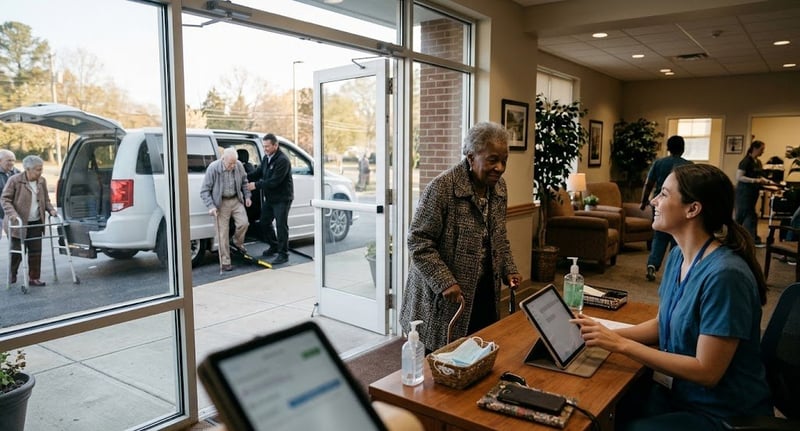
Proof of presence means attendance you can defend. That includes actual arrival and departure times for each participant (not a schedule copied forward), transportation records that line up with those times, attendance that never exceeds licensed capacity, and daily notes and activity participation tied to the person. When those records live in one connected system instead of a binder and a spreadsheet, an auditor's question takes minutes, not a week.
Proof of benefit is where Dr. Sadarangani's work comes in. The National Adult Day Services Association (NADSA) offers a free data portal where centers can record a core set of outcome measures every six months and receive benchmark reports. The original measures focus on what payers care about, like falls, hospitalizations, depression and nursing home placement. Her team, with funding from the Alzheimer's Association, added person-centered measures of belonging, purpose and friendship, because those are what keep participants coming back. Centers where participants report a strong sense of belonging tend to have better retention over time.
One participant in rural upstate New York summed up why those measures matter. When Dr. Sadarangani kept pressing her about the food and the space, she answered in Spanish: "Tina, food goes in one hole and out the other, but my friends here are forever."
Tip
Join the NADSA outcomes data initiative and start measuring every six months now, before your state asks. Right now the national data set leans heavily on five or six states. The more centers contribute, the harder the case for adult day becomes to dismiss.
Families are the third audience, and they matter more than most centers realize. Dr. Sadarangani built a free, NIH-supported app called CareMobi so that day center staff, family caregivers and physicians can share what's happening with a participant. Centers worried it would add work, and instead their phone calls from families were cut in half. Transparency helps with the guilt many family caregivers feel about "dropping Mom off," and it keeps enrollment steady.
"[Adult day services are] the best-kept secret. I can tell you about small pilot studies, anecdotal studies, and qualitative studies that document the success of these programs, but we don't have a large-scale data set. I couldn't tell you with certainty that attending four days a week for three years, starting at 80, will make you healthier at 83. In my heart of hearts, I know that, and I think government funders should know that. But most of them have a fundamental lack of awareness of what these programs are and what they do."
- Dr. Tina Sadarangani, NYU Rory Meyers College of Nursing
We built our adult day care software because a state asked us to. Kentucky told the home care agencies we served that if they were sending attendants into homes, they should run day centers too, and our customers needed one system for both. Today it tracks participant arrival and departure times, centers, schedules and transportation, and its center activity plans let staff describe an activity once for the whole group, then individualize it for each participant who needed extra support. Billing covers both Medicaid claims and private pay, so the record of who was there is the same record that drives the claim.
None of that is a substitute for the heart of a good center, and it won't make a dishonest operator honest. What it does is make an honest center provable. If you want the bigger picture of how adult day is regulated and paid for, our adult day care services and reference guide is a good start, and our article on the compliance curve explains why adult day should learn from home care's EVV journey before it has to.
The New York investigation will run its course, and the people who stole should answer for it. Our hope is that when the recommendations land on December 31, the conversation is about how to verify adult day, not whether to keep it. If you'd like to talk about getting your center's attendance and outcome records audit-ready, contact Ankota.
Not as of early November 2026. Governor Hochul directed the Department of Health to review the social adult day care benefit and consider all options, including phasing it out and moving participants to other services, with recommendations due by December 31, 2026. In the meantime, MLTC plans must review SADC claims before paying them, and a moratorium on new SADC providers has been in place since July 2026.
In New York, social adult day care (SADC) is a social-model program, typically paid through Medicaid managed long-term care plans, that provides supervision, meals, activities and socialization. Adult day health care (ADHC) is a medical-model program approved by the Department of Health that operates under a nursing home's certificate and requires a registered nurse on site. Other states use different names, but most draw a similar line between social and medical models.
A growing body of research says yes, though the field still needs larger data sets to prove it at scale. Dr. Tina Sadarangani of NYU calls adult day "the most effective non-pharmacological intervention we have out there for dementia," and adult day centers address mobility, nutrition, mood, isolation and early detection of illness in one setting. NADSA's outcome data initiative is building the national benchmark data the field needs.
Keep actual arrival and departure times for every participant, transportation records that match them, daily notes and activity participation, and an attendance count that never exceeds licensed capacity. Those records are far easier to defend when they live in one connected adult day system rather than paper sign-in sheets and spreadsheets.
Start with the payer-focused measures in NADSA's free data portal, such as falls, hospitalizations, emergency visits, depression and nursing home placement. Then add person-centered measures of belonging, purpose and friendship, which Dr. Sadarangani's Alzheimer's Association-funded research identified as most meaningful to participants with cognitive impairment. Collect them every six months to build a trend line.
Adult day and home care are complementary, not competing. A day center lets an agency serve far more clients with fewer staff, adds a revenue stream, and gives new caregivers a supervised place to train before working alone in a client's home. For clients, home care covers morning and evening routines while the day center provides engagement, meals and supervision in between.
Ankota's mission is to enable the Heroes who keep older and disabled people living at home to focus on care because we take care of the tech. If you need software for home care, EVV, I/DD Services, Self-Direction FMS, Adult Day Care centers, or Caregiver Recruiting, please Contact Ankota. And if you're ready to see how the most innovative agencies are using AI to empower their caregivers and automate the rest, meet your new companion at www.kota.care.

Ken is the founder and CEO of Ankota, a company that helps any organization that helps older or disabled people live independently in their home of choice. Having grown up with a disability and a passion for healthcare, this is Ken's mission





Trusted by home care agencies nationwide