
Adult Day Care Activity Ideas to Keep Clients Engaged
Adult day care centers provide a vital service, offering a ...
Fraud stories about hospices, child care centers and home care billing are shaping how the public, legislators and regulators see every program that cares for people at home, including the honest ones that are doing the work right.
For newbies: think of it as two separate questions. Fraud enforcement asks about proof of presence: did the right person show up, in the right place, at the right time, and deliver the service that got billed? Reputation asks about proof of benefit: did that service actually make someone's life better? Most providers have spent years building an answer to the first question. Very few can answer the second with real data.
Only clean, verifiable presence records protect a program in an audit, and only outcome data protects a program's funding when legislators are deciding what to cut. Once you dive deeper into this article, these two layers will make more sense to you. I will walk through what's driving the current wave of scrutiny, explain both layers in plain language, and tell providers in self-direction, Medicaid home care, I/DD services, adult day and private duty exactly what they need to be capturing in 2026.
Proof of Presence vs. Proof of Benefit: The Difference That Protects Your Home Care Program in 2026Here's an uncomfortable truth for anyone in this industry. When a news story breaks about a fake hospice or a phantom caregiver, the damage doesn't stay with the people who did it. It lands on every agency owner, every day center director and every family caregiver who is doing the work right. The public doesn't read the court filings. They remember the headline.
And there have been a lot of headlines. In June 2026, the Department of Justice announced its 2026 National Health Care Fraud Takedown, charging 455 defendants in schemes tied to $6.5 billion in alleged false claims. One of the cases described a personal care attendant who billed Medicaid for helping a client with health and hygiene while that client was in the hospital. In May, CMS put a six-month nationwide moratorium on new Medicare hospice and home health enrollments after suspending roughly 800 providers in Los Angeles alone. Home care attorney Elizabeth Hogue, a longtime friend of the industry, recently wrote in The Rowan Report that private duty companies should expect "a tsunami of regulation," and that owners and managers will be held responsible for what their employees and contractors do.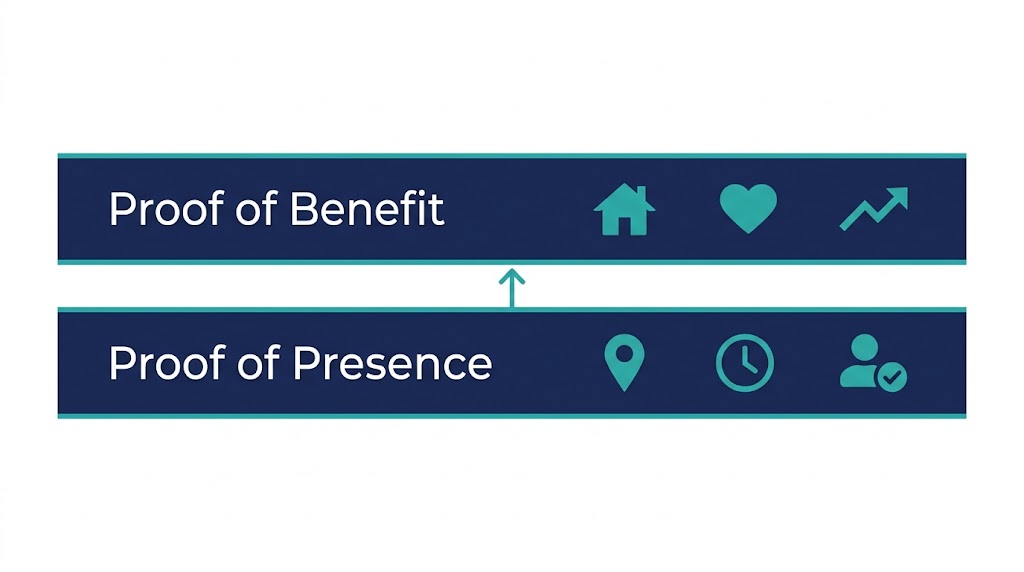
This article isn't about politics, and it isn't about who is to blame. Enforcement numbers like these move quickly, so verify current figures directly at justice.gov or cms.gov before citing them in a board meeting. What this article is about is what honest providers can do about it.
The short answer is that providers need two kinds of proof, not one. The longer answer is what this whole article is about.
This guide is written for providers across the home and community-based care landscape: agencies delivering Medicaid personal care and home health, self-direction and fiscal intermediary programs, adult day and adult day health centers, I/DD and HCBS waiver providers, and private duty agencies that never touch a Medicaid claim but share the same reputation. Let's start with the two questions at the center of all of it, and build from there.
Before going deep, here's the comparison that frames everything else in this article.
Note: This is also the section worth bookmarking for your next conversation with an auditor, a board member or a state program officer.
| Proof of Presence | Proof of Benefit | |
|---|---|---|
| Question It Answers | Did the service actually happen? | Did the service make a difference? |
| What It Captures | Who delivered the service, who received it, where, and when | Outcomes such as avoided hospitalizations, independence, quality of life |
| Required By | 21st Century Cures Act (EVV mandate for Medicaid personal care and home health) | Not federally required, but increasingly expected by legislators and funders |
| Who's Asking | Auditors, state Medicaid agencies, payers | Legislators, budget committees, boards, families choosing a provider |
| Examples | EVV clock-ins, GPS-verified visits, verified attendance | PROMIS scores, National Core Indicators, hospital admission trends |
| What's At Risk Without It | Flagged claims, harder audits, clawed-back payments | The program reads as a line item instead of something worth protecting |
P.S. EVV stands for Electronic Visit Verification, the system that timestamps and geo-locates a caregiver's visit so a state or auditor can confirm it happened. "Outcome measures" is the general term for any tool that tracks whether a person is actually doing better, not just whether a visit occurred. More on both below.
Now let's go deeper on each layer, because the nuance matters when regulators, boards and families are the ones asking the questions.
Fraud headlines hurt honest providers in three ways: they raise the bar for proof, they slow down payments and approvals, and they erode public support for the programs themselves. When legislators and state Medicaid agencies read about fraud, the natural response is more audits, more documentation requirements and more skepticism of every claim. Honest providers pay that cost too, and they pay it in staff time they don't have.
The third effect is the one that worries us most. Programs like self-direction, adult day services and home and community-based services (HCBS) exist because people fought for years to show that care at home is better, and often cheaper, than care in an institution. That case has to be re-made every budget cycle. A single viral story can undo years of careful work.
Consider what happened in Minnesota. In late December 2025, a viral video alleged that a group of child care centers were billing the state for children who weren't there. When state inspectors visited nine of the centers a few days later, they reported that eight had children present and one hadn't opened yet. Federal agents later executed search warrants at about 20 centers, and that story is still unfolding. But notice the order of events. The public verdict came first, from a video. The facts came later, and they were more complicated. By then, every provider in the state that bills for attendance was under a cloud.
We think of these as two layers of proof. The first is proof of presence, which in home care usually means Electronic Visit Verification (EVV). The second is proof of benefit, which means outcome measures: did the person stay out of the hospital, stay in their home, or keep and gain independence, friendships and a sense of purpose?
The 21st Century Cures Act requires EVV for Medicaid personal care and home health visits. EVV records who received the service, who delivered it, what service it was, where and when it happened, and when it started and ended. In adult day, proof of presence is accurate arrival and departure times for every participant. In self-direction, it is verified time for every support worker, approved by the participant or their representative before a dollar is paid.
Proof of benefit is the layer that turns a program from a line item into something legislators want to protect. Most providers have already invested in the first layer. Very few have built out the second.
The first layer keeps you out of trouble. The second layer keeps your program funded.
The evidence suggests it helps. KFF reports that before EVV was widely in place (2015 to 2022), fraud convictions involving personal care attendants averaged more than 400 a year and made up about 43% of all Medicaid fraud convictions. In fiscal 2024, after states implemented EVV, that number was 298, or about 36%. EVV isn't the only reason, but it closes the most common door: billing for visits that never happened.
If you want to see how clean your agency's EVV data actually looks to a state aggregator, ask your compliance lead to pull the exception report before your next audit, not during it.
At Ankota, we send EVV data to state aggregators in many states, including Sandata, HHAeXchange and Therap, and we see every day how a clean EVV record changes the conversation during an audit. A visit with a verified start time, end time, location and caregiver doesn't need to be defended. It defends itself. The agencies that struggle in audits are usually the ones with a pile of manual edits and missing reason codes, not the ones committing fraud.
"When we started integrating with state EVV aggregators, a lot of agencies saw it as one more compliance headache. Today I tell them it's the cheapest insurance they'll ever buy. When someone asks whether a visit really happened, you don't want to be digging through paper timesheets. You want to pull up the record and move on."
- Ken Accardi, CEO of Ankota
P.S. A "state EVV aggregator" is the system a state Medicaid program uses to collect visit data from every home care agency operating in that state, whether the agency's own software is Sandata, HHAeXchange, Therap or something else. It's the layer that lets a state compare what an agency billed against what was actually verified.
Self-direction gets extra scrutiny because it often pays family members to care for their own relatives, and that sounds wrong to people who haven't seen it up close. Self-direction, also called self-determination or participant-directed care, gives people control over who helps them and how, and in many places it's the only way to find a caregiver at all. But the headline "Medicaid pays families to care for their own family members" raises eyebrows, whether or not it should.
"I'm about as big a fan of self-direction as you'll find. I've seen what it does for families. But I've also watched people's faces when they first hear that Medicaid is paying a mother to care for her own adult son. They don't see the forty hours a week of care that would otherwise cost the state far more in a facility. They see a check going to a relative. We have to be ready to answer that with facts, not feelings."
- Ken Accardi, CEO of Ankota
The good news is that self-direction already has a built-in checkpoint that most people don't know about: the financial management services (FMS) provider, also called a fiscal intermediary or fiscal employer agent. The FMS verifies that each worker is eligible, that each timesheet matches an authorized service, that EVV is captured where required, and that spending stays inside the participant's approved budget. When the FMS runs on connected software, every payment traces back to an authorization, a verified shift and an approval. That is exactly the paper trail a skeptical legislator or auditor wants to see.
P.S. An FMS, short for financial management services, is the organization that sits between a self-direction participant and the state, handling payroll, tax withholding and timesheet verification for the workers that participant hires. It's the compliance backbone of self-direction, even though most families never interact with it directly.
What self-direction needs next is the second layer. FMS providers and the states they work with are sitting on years of data about who stayed at home, who avoided an institution, and what it cost. That data, gathered and reported consistently, is the strongest answer we have to "why are we paying families?"
If you're an FMS provider, start tracking a few simple outcome indicators now, such as hospital admissions, moves to a facility and participant satisfaction, even if your state doesn't require them yet. When the scrutiny comes, you'll have a trend line instead of an anecdote.
Adult day centers can prove their value by pairing accurate attendance records with evidence-based measures of how participants are doing over time. The Minnesota story should be a wake-up call for adult day in particular, because the core allegation there, that funded participants weren't actually in the building, is exactly the question an auditor can ask any day center. A paper sign-in sheet doesn't answer it well.
Attendance is only the start. Dr. Tina Sadarangani of NYU's Rory Meyers College of Nursing has spent years making the case that adult day services should measure outcomes the same way across centers. Her team's recent consensus study asked adult day practitioners and researchers which person-centered measures matter most for participants living with dementia. They agreed on three validated tools: the PROMIS Meaning and Purpose scale, the Friendship Scale and the General Belongingness Scale.

"When I heard Tina speak at the National Adult Day Services Association conference in Providence in September, her message stuck with me. If we measure the impact of adult day on participants using evidence-based tools, we'll have evidence that it changes lives, and that kind of evidence is very hard to argue with. I think that lesson applies to our whole industry, not just adult day."
- Ken Accardi, CEO of Ankota
We'll dig into this much further in an upcoming episode of the Home Care Heroes podcast with Dr. Sadarangani. For centers that serve adults with intellectual and developmental disabilities, often called day habilitation, the measures look different. There, the focus is usually progress on individual goals and community participation, and we've written about that in outcome measures in disability services.
I/DD and HCBS providers should be able to show both verified service delivery and progress toward each person's goals. For residential supports, community supports and day programs paid under Medicaid waivers, that means EVV or attendance data on one side, and documented goal progress, community inclusion and quality-of-life measures on the other.
Many states already participate in National Core Indicators surveys, which gives providers a common language for outcomes.
P.S. National Core Indicators (NCI) is a standardized survey used across most states to track outcomes for people with I/DD, such as employment, community participation and satisfaction with services. Because it's used the same way nationwide, it lets a state or provider compare its own numbers against a national benchmark instead of guessing.
The providers we see doing this well don't treat outcomes as a separate project. They capture goal progress in the same visit notes and shift documentation their direct support professionals already complete, so reporting becomes a query, not a scramble.
Yes, even though private pay agencies don't bill Medicaid. Private duty agencies share a name and a reputation with the rest of home care, and families reading about fraud don't separate "Medicaid agency" from "private pay agency." Many private duty agencies also bill long-term care insurance or the VA, and those payers are asking more questions too.
The good news is that the same tools work. GPS-verified clock-ins, caregiver visit notes and a family portal that shows when the caregiver arrived and what happened during the visit give families the same proof of presence a state auditor would want. For a private pay client paying out of their own savings, that transparency is also a selling point.
Ankota builds software for home care agencies, adult day centers, I/DD providers and self-direction FMS programs, which puts us in an unusual position. We see the same pressure showing up in every one of these programs, and we see that the answer is the same in all of them: capture proof of presence automatically, and build proof of benefit into everyday documentation instead of treating it as a special project.
That's what our self-direction FMS software does for fiscal intermediaries, from verified timesheets and EVV to budget tracking against each participant's spending plan. If you want to understand how the pieces fit together, our guide to understanding self-direction and FMS is a good place to start, and our EVV guide covers the verification side.
Want to talk through how Ankota helps your program capture both proof of presence and proof of benefit, whether that's EVV integration, FMS compliance or outcome tracking? Talk to our team. We'll walk through your specific program type and payer mix without assuming you're already running an outcomes framework.
Most home care agencies, day centers and FMS providers are honest, but fraud in personal care and HCBS is a real enforcement priority. The Department of Justice's 2026 National Health Care Fraud Takedown charged 455 defendants in schemes tied to $6.5 billion in alleged false claims, and personal care cases have long made up a large share of Medicaid fraud convictions. The bigger problem for honest providers is that a few high-profile cases shape how the public sees everyone.
Yes. The 21st Century Cures Act requires Electronic Visit Verification for Medicaid personal care and home health services, including many self-directed programs. How EVV is captured and who approves the time varies by state, so FMS providers need software that handles their state's aggregator and approval rules.
In self-direction, also called self-determination or consumer-directed care, participants choose who provides their care, and in many cases the best or only available caregiver is a relative. Paying a family caregiver is often far less expensive than a nursing facility or group home, and it keeps the person at home. Programs protect against abuse through the FMS, verified timesheets, EVV and budget limits.
Start with reliable attendance, then add a small set of validated, person-centered measures. Research led by Dr. Tina Sadarangani at NYU reached expert consensus on the PROMIS Meaning and Purpose scale, the Friendship Scale and the General Belongingness Scale for participants living with dementia. Day habilitation programs for adults with I/DD typically focus on individual goal progress and community participation instead.
Give families transparency they can see. GPS-verified clock-ins, visit notes and a family portal that shows arrival times and care activities answer the "did the caregiver really come?" question before anyone asks it. Long-term care insurers and the VA appreciate the same records.
Proof of presence shows that a service happened: who, what, where and when, which is what EVV and attendance tracking capture. Proof of benefit shows that the service made a difference, using outcome measures such as avoided hospitalizations, staying at home, or quality-of-life scores. Enforcement mostly asks for the first. Keeping a program funded requires the second.
Ankota's mission is to enable the Heroes who keep older and disabled people living at home to focus on care because we take care of the tech. If you need software for home care, EVV, I/DD Services, Self-Direction FMS, Adult Day Care centers, or Caregiver Recruiting, please Contact Ankota. And if you're ready to see how the most innovative agencies are using AI to empower their caregivers and automate the rest, meet your new companion at www.kota.care.

Ken is the founder and CEO of Ankota, a company that helps any organization that helps older or disabled people live independently in their home of choice. Having grown up with a disability and a passion for healthcare, this is Ken's mission
.png)
.png)



Trusted by home care agencies nationwide