
Adult Day Care Activity Ideas to Keep Clients Engaged
Adult day care centers provide a vital service, offering a ...

TL;DR: Oregon is moving Medicaid in-home care onto a new statewide Electronic Visit Verification (EVV) system, run by Acumen with software from Direct Care Innovations (DCI). The rollout follows a predictable arc that we have watched play out in state after state: first the state just wants you connected, then it starts watching your numbers, and eventually a verified visit becomes the condition for getting paid. Agencies that treat the early phases seriously rarely feel the painful later ones. Ankota has already completed Oregon's integration and has Portland-area agencies live on the new system, so this guide lays out what to expect at each stage and how to stay ahead of it.
Nobody got into home care because they love visit verification. But EVV is a federal mandate, Oregon is now putting real weight behind it, and the way you handle the next several months will shape whether your agency has an easy year or a stressful one. We have connected to Oregon's new system, and we have taken agencies through this exact transition in other states, so we want to share the map rather than let you discover it from a state letter.
Oregon is standing up a new statewide EVV system, managed by Acumen as the fiscal and program administrator with the underlying software provided by Direct Care Innovations (DCI). If you bill Oregon Medicaid for personal care or in-home services, your visits will need to flow into this new aggregator. Electronic Visit Verification itself is not new (it comes from the federal 21st Century Cures Act), but the aggregator your data lands in, and the way it validates that data, is changing for Oregon agencies.
Here is the part most vendors gloss over: not every EVV system connects to an aggregator the same way. Oregon's DCI integration works differently from the Sandata, HHAeXchange, Tellus, and other connections we have built, which is exactly why a working, tested integration matters more here than usual. Ankota is among a small number of third-party EVV vendors that has completed Oregon's integration, and we currently have two agencies live on it, one in Beaverton and one in Gresham, both serving the greater Portland area. If you want the mechanics of how these middle layers work, we wrote a plain-language explainer on how EVV aggregators work.
In the first phase, the state's goal is simple: get every agency connected and sending visits on time. You do not have to be perfect. You have to be on board. If your visits are flowing into the aggregator and the connection is stable, you are doing what Oregon is asking of you right now, and you stay comfortably off the radar.
The agencies that struggle in this phase are usually the ones tied to a distant EVV vendor they have never actually spoken with. When something breaks during setup, and in the early days something always breaks, they are stuck in a support queue instead of on the phone with a person who knows their account. This is the cheapest possible moment to confirm that your setup is truly ready for Acumen and DCI, while the stakes are still low. The value of a third-party EVV partner shows up most in these transitions, when you need a direct relationship rather than a ticket number.
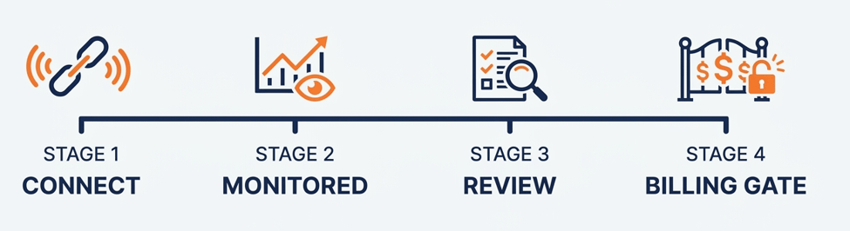
Once agencies are connected, the state moves to phase two: it starts looking at what is actually coming through. This is where EVV stops being a checkbox. The state can see your visit volumes, and it notices when the numbers do not add up. The letters get specific. We have seen states flag a single caregiver clocked into two visits at the same time, or clocked in for another agency while supposedly caring for your client. That is usually the moment an owner realizes the system really works.
Almost every agency has a straggler or two. Sometimes it is an experienced caregiver who is not comfortable with the app. Other times, and you probably already know who, it is a caregiver who never "figured out" the technology because they have been leaving visits early and letting the office finish the clock-out.
In our conversations with agency owners, the pattern is almost always the same. When a state letter shows that one aide was clocked in at two homes at once, the owner is not surprised by which aide it was. They just never had the proof before.
The goal in phase two is to get a strong majority of your visits flowing cleanly, in the range of 75 to 85 percent, so you stay out of the spotlight and buy time to bring the stragglers along. A vendor that knows Oregon should be helping you watch this, not leaving you to learn it from an audit.
Having an EVV vendor is not the same as being covered, because EVV shifts real responsibility onto the agency. Your software cannot confirm on its own that a visit actually happened where and when it should have. You have to review the visits that come back with errors, confirm the locations are right, and resubmit the ones that need fixing.
The best way to prevent errors is to stop a caregiver from clocking in or out unless they are at the correct location. But then you have to handle the legitimate exceptions gracefully. A client might split time between her own home and her daughter's home, or get picked up at an adult day center. Those are real, allowable situations, and your EVV vendor should support them rather than fight you on them. What good software can do is make the review painless: using AI, Ankota surfaces exactly which visits need a human look and why, so your office spends minutes on the handful that matter instead of scrolling through hundreds that are already fine. That is the difference between checking a box and being ready when the state looks. For a deeper build-out of what to confirm, our EVV pillar guide walks through the full compliance picture.

Every EVV mandate ends in the same place: a verified visit becomes the condition for getting paid. Missouri is the clearest example. As of April 1, 2026, MO HealthNet only pays for visits that went through the aggregator and were approved, and non-compliant claims are denied. That does not mean every caregiver has to be perfect every time. It means the visit either has to be clean, or your office has to have reviewed and resubmitted it correctly. Otherwise the claim does not get paid.
Oregon is on the same road. It starts with "just get connected," moves to "we are watching your numbers," and ends with "no verified visit, no payment." We have documented how this played out for agencies in Missouri and how Illinois expanded its EVV requirements, and the throughline is consistent. This is the cross-state view that a vendor working in one market cannot give you, and it is why we treat proactive EVV compliance as a preview of what is coming rather than a fire to fight later.
The practical takeaway is to get connected and tested early, build a real relationship with a vendor who has already completed Oregon's integration, and put a simple visit-review habit in place before the state ever asks. Confirm your system can enforce correct clock-in locations while still handling the exceptions your clients actually live with. Identify your straggler caregivers now, while a low percentage is not yet a problem, so you are not scrambling when the monitoring phase begins. None of this requires heroics. It requires a head start, which is the one advantage that gets cheaper the earlier you take it.
We built and tested Oregon's DCI and Acumen integration, we have Portland-area agencies running on it today, and we have guided agencies through every phase of this transition in other states. If you would rather have a direct partner than a distant vendor for this move, we would welcome the conversation. You can learn more about our EVV software or contact us for a working session focused on your agency's specific situation, not a sales pitch.
Get the free guide: We turned this into a one-page Oregon EVV Transition Guide you can print and share with your office. Download the Oregon EVV Transition Guide (no cost, no obligation).
Ankota's mission is to enable the Heroes who keep older and disabled people living at home to focus on care because we take care of the tech. If you need software for home care, EVV, I/DD Services, Self-Direction FMS, Adult Day Care centers, or Caregiver Recruiting, please Contact Ankota. And if you're ready to see how the most innovative agencies are using AI to empower their caregivers and automate the rest, meet your new companion at www.kota.care.

Ken is the founder and CEO of Ankota, a company that helps any organization that helps older or disabled people live independently in their home of choice. Having grown up with a disability and a passion for healthcare, this is Ken's mission
.png)
.png)



Trusted by home care agencies nationwide