
Adult Day Care Activity Ideas to Keep Clients Engaged
Adult day care centers provide a vital service, offering a ...

The math is brutal. As America’s baby boomers begin turning 80, the need for home care is about to explode. Millions of older adults will want—and deserve—to live independently at home. But the workforce to support them is shrinking fast.
According to federal data, the number of available caregivers has been declining for more than 15 years. The result is an approaching collision: skyrocketing demand on one side, a dwindling supply of workers on the other. The infographic below, “The Coming Caregiver Crisis,” shows just how wide this gap is becoming. We've created an Infographic for you to download and share. Click here
An Aging Nation at a Crossroads
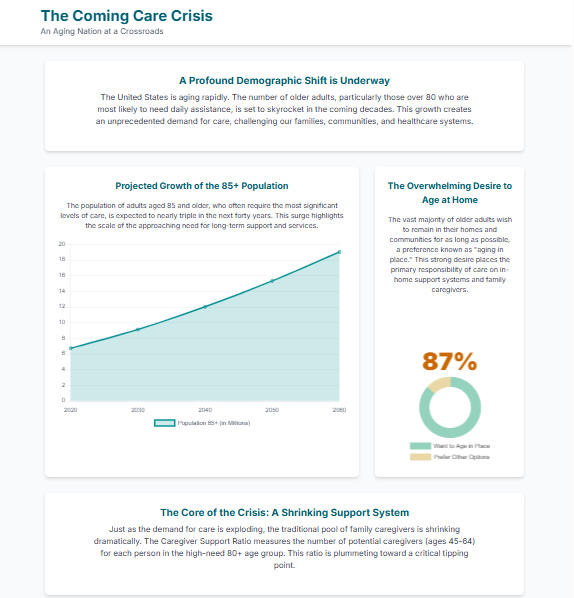
The United States is aging rapidly. The number of older adults, especially those over 80 who are most likely to need daily assistance, is about to skyrocket. This growth creates unprecedented demand for care, challenging families, communities, and healthcare systems.
The population of adults aged 85 and older, who often require the most significant levels of care, is expected to nearly triple by 2060.
85+ population (in millions):
2020 – 6.7 | 2030 – 9.1 | 2040 – 12.0 | 2050 – 15.3 | 2060 – 19.0
The numbers are staggering—dive deeper into the "Silver Tsunami" and the demographic forces driving this urgent need for new care models.
The vast majority of older adults want to remain in their homes and communities for as long as possible—a preference known as aging in place.
87% of older adults prefer to age in place, leaving only 13% who would rather move elsewhere.
This preference places most caregiving responsibility on family and in-home support systems.
As demand for care explodes, the traditional pool of family caregivers is shrinking dramatically.
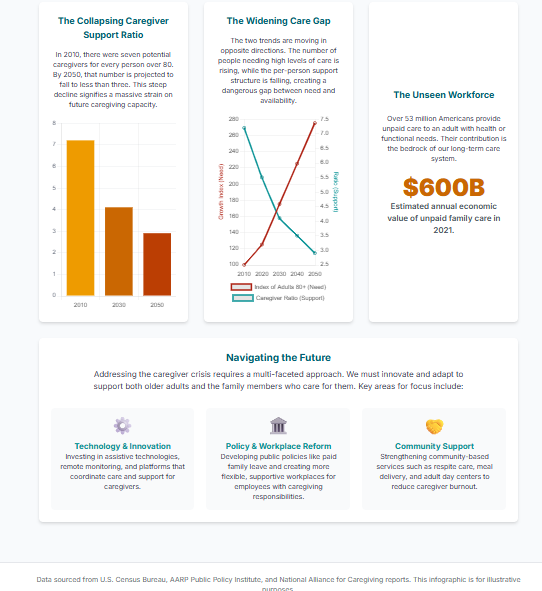
The Caregiver Support Ratio—the number of potential caregivers (ages 45–64) per person aged 80+—is dropping toward a critical tipping point.
2010: 7.2 potential caregivers per person 80+
2030: 4.1
2050: 2.9
This steep decline signals a massive strain on future caregiving capacity.
Two trends are moving in opposite directions:
The number of people needing high levels of care (age 80+) is rising sharply.
The per-person support structure (caregiver ratio) is falling steadily.
Result: a dangerous gap between need and available care.
More than 53 million Americans provide unpaid care to an adult with health or functional needs.
Their contribution is the foundation of our long-term care system.
💰 $600 billion — estimated annual economic value of unpaid family care in 2021.
Addressing the caregiver crisis requires a multi-faceted approach. We must innovate and adapt to support both older adults and their caregivers.
⚙️ Technology & Innovation
Invest in assistive technologies, remote monitoring, and platforms that coordinate care and support caregivers.
While the crisis is daunting, technology offers a way out; find out which AI solutions are actually making an impact today.
🏛️ Policy & Workplace Reform
Expand public policies like paid family leave and create more flexible, supportive workplaces for employees with caregiving responsibilities.
You can’t wait for the crisis to pass—start building a more resilient and sustainable workforce right now.
🤝 Community Support
Strengthen community-based services such as respite care, meal delivery, and adult day centers to reduce caregiver burnout.
Data sources: U.S. Census Bureau, AARP Public Policy Institute, and National Alliance for Caregiving reports.
(This infographic is for illustrative purposes.)
Home care is one of the most human-centered industries there is. But even the most dedicated agencies are being pushed to their limits. Recruiting is harder than ever, caregiver turnover remains high, and administrative burdens continue to grow. Families face longer wait times for services, and older adults risk going without the help they need.
The truth is uncomfortable but unavoidable: the future of caregiving won’t be powered by people alone. It will require a partnership between compassionate professionals and thoughtful technology.
Acknowledgement: The infographic was created with Deep Research and the Infographic creator from Google Gemini.
That’s why Ankota has launched KOTA, a new kind of AI companion that supports both care recipients and the people who look after them. KOTA provides empathetic conversation, reassurance, and daily connection for older adults living at home. When help is needed, it can automatically alert family members, home care agencies, or Ankota’s 24/7 emergency call center—ensuring that someone is always there when it matters most. Because isolation makes seniors more vulnerable.
KOTA isn’t just a product; it’s a platform for the next generation of caregiving technology. It’s designed to evolve, integrate with agency systems, and help extend the reach of human caregivers—without replacing the human touch.
Agencies that embrace technology like KOTA have a chance to lead, not lag. They can offer premium care experiences, stand out in competitive markets, and deliver better outcomes for both clients and caregivers.
As Ankota CEO Ken Accardi puts it in the recent press release, “Agencies that embrace technology will not only survive but thrive. They’ll be the ones offering tech-enhanced care, rather than watching third-party apps move in beside them.”
In short, this is the moment for home care providers to decide how they’ll meet the coming demand. Those who combine people and technology will define the next era of care.
Ankota's mission is to enable the Heroes who keep older and disabled people living at home to focus on care because we take care of the tech. If you need software for home care, EVV, I/DD Services, Self-Direction FMS, Adult Day Care centers, or Caregiver Recruiting, please Contact Ankota.

Ken is the founder and CEO of Ankota, a company that helps any organization that helps older or disabled people live independently in their home of choice. Having grown up with a disability and a passion for healthcare, this is Ken's mission
.png)
.png)




Trusted by home care agencies nationwide