
Adult Day Care Activity Ideas to Keep Clients Engaged
Adult day care centers provide a vital service, offering a ...

TL;DR: A financial management service gets paid to be a fiduciary, then spends most of its day doing data entry. The right fiscal intermediary software closes that gap by handling the work that actually defines the FMS role: prescreening and approving invoices, keeping budgets visible to families in real time, managing the odd rules around family and live-in providers, and turning clean authorizations into clean claims. Most platforms built for self-direction started as payroll or accounting tools and bolted the rest on later. At Ankota, we came at it from the opposite direction, from electronic visit verification and the service-provider side, which is why we built the provider mechanics that FMS-only systems tend to treat as edge cases.
Every state runs its self-direction program a little differently, so not every feature below will matter to your program. Read this as a checklist to hold up against your own operation and your current software, not a demand that you need all of it at once.
Fiscal intermediary software needs to do the fiduciary work, not just the bookkeeping. An FMS, financial management service, or FMSA (Financial Management Services Agency, the term used in Texas Consumer Directed Services) sits between a Medicaid payer and a family that directs its own care. The job is to make sure every dollar is authorized, spent inside the budget, documented, and defensible if anyone ever asks. That is a fiduciary responsibility. Yet in most FMS offices, staff spend their days opening PDFs, squinting at line items, switching to another window to check a budget, doing the math by hand, and repeating it a couple hundred times a month. The software should be doing that checking so your people can do the judgment.
This is the through-line for every feature that follows. When we evaluate what an FMS platform needs, we ask a simple question: does this feature move staff time away from data entry and toward oversight? If it does not, it is decoration. The strongest fiscal intermediary software, financial management software, or self-direction platform earns its keep by absorbing the repetitive checking that a fiduciary is legally on the hook for but should never have to do manually.
Invoice review and visit review are two different jobs, and software that mashes them into one queue slows reviewers down on both. Visit review asks one kind of question: did the caregiver clock in at the right place at the right time? Invoice review asks a completely different one: is this $1,400 tablet an authorized purchase that fits the remaining budget? Those are unrelated decisions, and when a single approval queue mixes them together, reviewers context-switch on every item and get slower at each. At Ankota, we built invoice approval as its own dedicated workflow precisely because the mental model is different.
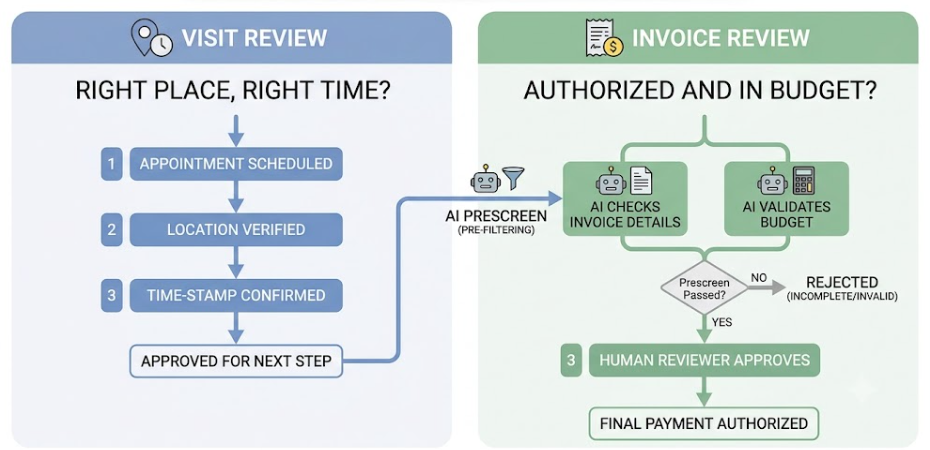
The live invoice approval screen is one half of this. The other half, and our newest addition, is an AI invoice review process that reads the invoice before a human ever opens it. It checks that the date, the vendor, and the amount are correct, that the invoice is eligible and will hold up in an audit, and that the expenditure fits inside the authorized budget. By the time a reviewer looks at it, the routine checking is done and their attention goes to the judgment calls. Approvals that used to sit for days, while vendors called the family and the family called your staff, clear in a fraction of the time.
One of the great benefits of self-direction is that the family takes on a lot of what a full-service agency would normally do - recruiting, retention, managing budgets, overseeing schedules. That means the fiscal intermediary runs on much lower margins than a traditional agency, and for that reason they need to be as efficient as they possibly can. On the EVV side, we've had AI that checks whether a visit is fully compliant with EVV. Now we're offering the corresponding service for invoices, making sure they meet all the criteria a fiscal intermediary is supposed to check.
- Ken Accardi, Ankota
Practical AI like this is one of the areas we cover in our look at what is actually working in home care technology, and invoice prescreening is a clear win rather than hype.
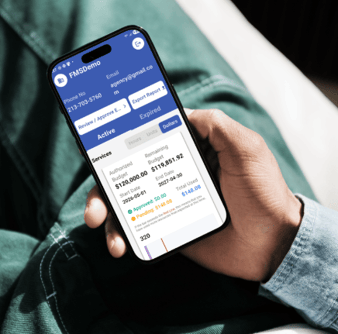
The software should show families exactly where their budget stands, on their own phone, at any moment. Nearly every difficult call an FMS operator fields traces back to a family that could not see its own numbers. One family rations out of fear and leaves money unspent in December. Another blows through the allocation in month nine and calls angry. Both are visibility problems wearing a budget costume, and both land on your staff. A real-time budget position in a family app turns those calls into a glance at a screen.
The other half of visibility is approval. In too many programs, approval is the single bottleneck in the entire payment chain, and it is sitting on a parent's kitchen counter as a paper packet. When a family member can review the last few punches or the current invoices and approve with a one-tap signature on a phone, the whole chain speeds up and the friction that made people approve blind, or not at all, disappears. Giving families that kind of control is a theme we return to often, because putting real control in families' hands tends to reduce call volume and improve care at the same time.
Family and live-in providers follow different rules from other workers, and the software has to encode those rules rather than leave them to a side spreadsheet. This is the pattern that shows up in the most states and gets handled the worst. In many programs, a family or live-in provider is exempt from EVV while drawing from the same authorization as a non-family provider who is not exempt. Then a vacation week arrives, a non-family provider covers, and the rules flip in the middle of the authorization. Most FMS operations run this on manual carve-outs and quiet workarounds that nobody wants to describe to an auditor.
We built the mechanics for this because our electronic visit verification background forced us to. When you come from the EVV world, exemptions and shared authorizations are not exotic; they are Tuesday. Ankota handles the family-provider exemption, the shared-authorization trap, and the vacation-coverage flip inside the system, so the compliance exposure that lives in those side spreadsheets goes away. If your current platform treats family providers as an afterthought, this is one of the first places to press during a demo.
The mechanics that quietly drain staff time are the ones no vendor demos: midnight visit splits, overtime enforcement, multiple providers on site, and scheduling that the program does not actually require. A visit that crosses midnight with no action from the provider becomes a payroll correction every single cycle, forever, unless the software splits it automatically. Overtime rules that are enforced only after the fact mean you discover the violation after you have already paid it; enforced in-system, the rule stops the problem before it costs you. Some states cap daily and weekly hours, some do not, so this is exactly the kind of feature to match against your own program rather than assume.
Self-scheduling belongs on this list too. Self-direction is a model where a family decides on Tuesday what happens Wednesday, and software that demands a fixed schedule fights the program instead of supporting it. The same goes for allowing, or blocking, multiple providers on site depending on what the rule says. None of these mechanics are glamorous, and that is the point. They are the small, constant frictions that add up to a meaningful share of your staff's week, and good self-direction software makes them disappear quietly.
Yes, and the test is whether it can prove the money landed, not just that it was sent. An FMS bills Medicaid and managed care organizations, receives electronic remittance advice, reconciles what was paid against what was billed, and files corrected claims when something comes back wrong. Software that generates a claim but cannot reconcile the remittance leaves you with money that shipped but nobody can prove arrived. Ankota handles the claim, the ERA reconciliation, and the corrected-claim loop so the paper trail is complete from authorization to payment.
One honest boundary matters here. We calculate the gross reimbursement and own the authorization, invoice, budget, and claims layer. We are not a payroll system that moves money out of your bank account and files employment taxes, and we will never imply otherwise. In states like Texas, where the FMSA role leans heavily on payroll processing and tax filing, the right architecture is software that keeps the authorization and reimbursement side clean and audit-ready and feeds your payroll engine, rather than pretending to be one. Knowing exactly where a platform's responsibility ends is part of evaluating it well, a point we make in our practical guide to the fiscal intermediary role.
It can, and this is the feature most FMS-only platforms never built. The entire point of self-direction is a good life in the community, yet most systems can only prove that someone was physically present in a building for a stretch of hours. Person-centered planning, with tasks and goals and reporting against them, is what connects the spending to the outcome the program exists to produce. In the fiscal intermediary model the family directs the services, and historically nobody thought to build outcome tracking for that model, so it is a real differentiator when a platform has it.
This is where our cross-industry vantage point shows up. Because Ankota also serves home care, adult day services, and intellectual and developmental disability providers, we have seen how outcome reporting works in programs that were built around it from the start, and we brought that into self-direction. A platform that can show what a participant is working toward, not just where they clocked in, gives an FMS something to talk about with families and case managers that goes well beyond compliance.
Start by characterizing your own program, because the right feature set depends on it. Is your state a flexible-rate program or a standardized-rate one? Is EVV required across the board or does it carve out family providers? Does the program run on acquisitions and purchase orders, or on service hours? How is approval supposed to work? The answers tell you which of the features above are essential and which are noise for your operation. A flexible-rate program cares about dynamic pay calculation and burden rates across employer models; a standardized-rate program can ignore all of that and should weight person-centered planning and invoice handling instead.
We take a trusted-adviser posture here on purpose. We came from EVV and the service-provider side, that is where we are strongest, and every state's program is different enough that anyone claiming to already understand yours is guessing. So our honest offer is to compare notes. If these patterns match what you are living, or if we have missed the ones that actually hurt in your state, we want to hear it, because that feedback is how the software gets better for the next FMS.
Ankota builds self-direction and fiscal intermediary software for FMS and FMSA teams that want to spend less time on data entry and more time on oversight. Our platform grew out of electronic visit verification and the service-provider side of care, which is why the provider mechanics, the invoice workflow, and the family-facing tools are built in rather than bolted on. If you are evaluating your options, our Self-Direction FMS Software overview and our guide to understanding self-direction and FMS are good starting points, and you can always contact our team to walk through your specific program, your invoice types, and where software could take work off your staff's plate. To see the national picture of how these programs are structured, the Medicaid self-directed services overview is a useful reference, and Texas operators can review the state's own Consumer Directed Services materials.
In practice they refer to the same role. A financial management service (FMS), fiscal intermediary (FI), or Financial Management Services Agency (FMSA, the Texas term) is the organization that handles the administrative and financial side of a self-directed program so the participant can act as the employer of their own providers. Different states use different names for the same fiduciary function.
Not in Ankota's case, and you should be careful with any vendor that claims it does. Ankota calculates the gross reimbursement and owns the authorization, invoice, budget, and claims layer, then feeds a payroll system rather than moving money and filing employment taxes itself. In states where the FMSA is responsible for payroll and tax filing, the cleanest setup is software that keeps the reimbursement side audit-ready and hands off to your payroll engine.
Because they answer different questions. Visit verification confirms that a caregiver was at the right place at the right time. Invoice approval confirms that a purchase is authorized and inside the budget. Mixing both into one queue makes reviewers slower on each, which is why Ankota runs invoice approval as its own workflow with an AI invoice review that checks the vendor, date, amount, audit eligibility, and budget fit before a human opens it.
Good software encodes the rules instead of leaving them to a spreadsheet. Family and live-in providers are often exempt from electronic visit verification while drawing from the same authorization as non-exempt providers, and coverage during a vacation week can flip those rules mid-authorization. Ankota handles the exemption, the shared authorization, and the vacation-coverage flip inside the system, which removes the compliance exposure that manual carve-outs create.
No, and that is the most important thing to know before you buy. Program rules vary by state on rate flexibility, EVV scope, family-provider treatment, and approval requirements. A flexible-rate program needs dynamic pay and burden-rate handling; a standardized-rate program can skip those and prioritize person-centered planning and invoice workflows instead. Match the feature list to your own program shape rather than buying everything.
Yes, though many FMS-only platforms cannot. Person-centered planning with tasks, goals, and reporting against them connects spending to the outcomes a self-direction program is meant to produce. Because Ankota also serves home care, adult day, and I/DD providers, we brought outcome reporting from those models into our self-direction platform, so an FMS can show what a participant is working toward rather than only that they were present.
Ankota's mission is to enable the Heroes who keep older and disabled people living at home to focus on care because we take care of the tech. If you need software for home care, EVV, I/DD Services, Self-Direction FMS, Adult Day Care centers, or Caregiver Recruiting, please Contact Ankota. And if you're ready to see how the most innovative agencies are using AI to empower their caregivers and automate the rest, meet your new companion at www.kota.care.

Ken is the founder and CEO of Ankota, a company that helps any organization that helps older or disabled people live independently in their home of choice. Having grown up with a disability and a passion for healthcare, this is Ken's mission
.png)
.png)




Trusted by home care agencies nationwide