
Most everyone has some experience of home care with their aging relatives and loved ones, but the industry is broad and complex...
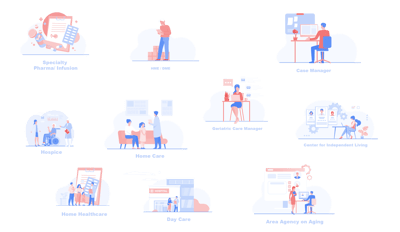

The home care industry is growing very rapidly in the US and worldwide. The primary driver for this growth is the aging of the global population. The drivers for this are that life expectancy in the US has risen into the 80s (and the upper 80s for women) and every day, around 8 to 10 thousand members of the Baby Boomer Generation are reaching retirement age. This page is dedicated to introducing the sectors of the industry, explaining what they do, and looking at the market sizes. It should be noted that although the largest sectors from a financial perspective are home healthcare and home based hospice care that the personal home care sector is the fastest growing from a job creation perspective.
Here are some basic facts and stats:
-
The primary SIC code for Home Care is 80828 and the primary NAICS code is 6216108.
-
The US home care services industry revenue in 2020 is estimated at $96.9B per IBISWorld1 and $97B by Statista2.
-
Currently 15 million patients and more than 600 million patient visits each year.4
-
There are 35,000+ companies in the US.4
-
Home Healthcare providers drive more than 5 billion miles per year.4
-
About 70 % of those using home healthcare services are age 65 and older. In this age group, the most common medical conditions requiring home care are: heart disease, diabetes, and cerebral vascular diseases.2
-
Over 1/3 of the persons requiring in-home care are under age 60, availing assistance for rehabilitation, are disabled, or have chronic health conditions, often requiring patient aids for assistance.2
-
A majority, 80 %, of those over age 60, choose to live independently, in comfort and with an enhanced quality of life.2
-
By 2010, the growth in the demand for healthcare occupations will be twice that of other non-health occupations.
-
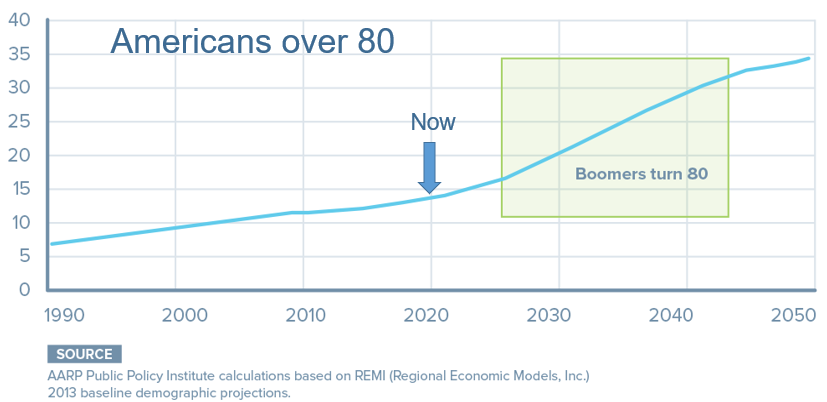
A good estimate of the number of home care recipients is the number of Americans over 80, which is currently ~14 million (AARP)
Note: This report also includes basic information on near neighbor industries that are not represented in the above revenue estimates (such as Adult Day Care, Home Medical Equipment (HME), Home Infusion Therapy and supportive services like Area Agencies on Aging (AAAs) and Centers for Independent Living (CILs).
Check out our Launch Kit to help accelerate your home care business! 
Chapter 1: Home Care - Home Health Aides and Personal Care Aides
Description:
Home care enables the elderly and disabled to stay living in their own home instead of institutional care like nursing homes or mental health institutions. Most of the care is non-medical and instead assists with Activities of Daily Living (ADLs) such as dressing, grooming, light cleaning, meal preparation, and companionship.
Synonyms (also known as):
-
Private Duty Home Care
-
Medicaid Home Care
-
Companion Care
-
Homemaker Service
-
Home Health Aide Care
-
Certified Nursing Assistant (CNA) Care
Jobs:
Key Statistics:
-
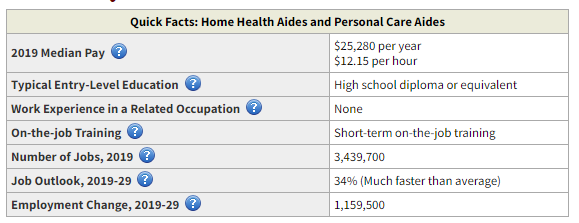
3.4M Caregivers (BLS see above)
-
34% job growth rate
-
17,000 companies
Outlook and Challenges:
Chapter 2: Home Healthcare
Description:
Home Healthcare is a medical service led by nurses and supported by physical, occupational and speech therapists. This service is reimbursed by Medicare and private insurance. The primary goal of home healthcare is for post-acute care, such as after a hip replacement to ensure that the patient recovers. Typical reimbursement is for "episodes of care" up to 60 days, but there are also some reimbursements for chronic disease care that is likely to be more ongoing. Organizations supporting Home Healthcare include the following:
Synonyms (also know as):
-
Home Health
-
Home Nursing
-
Visiting Nurses
Key Statistics:
-
33,000 Home Care and Hospice organizations (per NAHC)
-
$56B Revenue (estimate based on IBISWorld)
-
$30B Wages (estimate based on IBISWorld)
Outlook and Challenges:
The demand for home care services is constant and growing. The effect of COVID-19 is mixed: on the positive side COVID drives an increase in demand for care at home while on the negative side it has driven a reduction in surgeries.
This part of the industry has seen a decline in reimbursement rates leading to overall lower earnings. This has resulted in consolidation.
Here's an article from Tim Rowan's Home Care Technology Report entitled NAHC Study Shows Home Health Care is in Fragile State.
Chapter 3: Home Health Therapy
Description:

-
Physical Therapy (PT)
-
Occupational Therapy (OT)
-
Speech Therapy (ST)
-
Behavioral Health Therapy
-
Early Intervention (EI - care for infants up to age 3)
-
Advanced Behavioral Analysis (ABA)
-
Lymphedema Therapy (a specialty of Physical Therapy)
Synonyms (also know as):
Key Statistics:
-
2020 Revenue estimated at $8.6B (IBISWorld)
Chapter 4: Hospice Care / Home Hospice and Palliative Care
Description:
Hospice care is dedicated to the last 6 months of life. Qualifying for hospice requires a physician's order. Most hospice patients begin their care in just the last few weeks of life, whereas there are also cases of folks living for longer than 6 months after a hospice order is given or even "graduating from hospice." By accepting hospice care, the care recipient gives up their right to emergency life saving treatments in exchange for palliative care.
If you'd like to learn about elderly care and end of life from a human perspective, I highly recommend Atul Gawande's Book "Being Mortal" We've done a synopsis of each chapter of the book. You can start here.

Synonyms (also know as):
-
End of Life Care
-
Palliative Care
Key Statistics:
-
US Death Rate: 868 per 100,000 population (CDC)
-
Annual Deaths in the US: 2.84M (CDC)
-
Individuals receiving hospice care: 1.55M in 2018 (Statista)
Chapter 5: Area Agencies on Aging (AAAs) / Centers for Independent Living (CILs)
Description:
Area Agencies on Aging were introduced as part of the Older American's Act in 1973. They provide a variety of services to individuals 60 and older including guidance on where they can find care and other related services. Many AAAs are hired by state Medicaid programs to perform independent needs assessments on individuals who request services. A near neighbor to AAAs are Title 6 Organizations that provide similar services to native Americans.
Centers for Independent Living provide resources to the disabled, helping them to find care services and in many cases delivering these programs directly. Part of the charter of CILs is to hire disabled individuals. Their mission is "NCIL advances independent living and the rights of people with disabilities." Their vision: "NCIL envisions a world in which people with disabilities are valued equally and participate fully."
Synonyms (also know as):
-
AAAs (this acronym is well known within the home care community but not as much outside of home care)
-
CILs (pronounced like "sills")
How to Learn More:
-
National Association of Area Agenecies on Aging (N4A.org)
-
National Council on Independent Living (NCIL.org)
Chapter 6: Adult Day Healthcare / Adult Daycare
Description:
Synonyms (also know as):
-
Adult Day Care
-
Adult Day Health Care (ADHC)
-
PACE Programs
Key Statistics:
-
Over 7,500 day centers (per NADSA)
-
286,300 average daily participants (per CDC)
Outlook and Challenges:
Chapter 7: Case Management / Geriatric Care Management
Description:
Geriatric Care Managers (GCMs) and Case Managers are professionals who advocate and provide services for the elderly and disabled with the intention of helping them to age in place successfully.
Some of the services provided by case managers and GCMs are as follows:
-
Needs assessment
-
Advocacy (e.g., with landlords and service providers)
-
Managing transitions of care (e.g., from hospital to home)
-
Level of care needs assessments
Here's an article by AARP describing Geriatric Care Managers as an emerging profession.
Here's an article entitled What is a Geriatric Care Manager, provided by the National Institute on Aging (which is part of NIH).
Synonyms (also know as):
-
GCMs
-
Social Workers
Chapter 8: Durable Medical Equipment (DME / HME) / Home Infusion / Specialty Pharma
Description:
Durable Medical Equipment (DME) and Home Medical Equipment (HME) are two terms that seem to be used interchangably. However, an industry news source HMENews, explains "Durable Medical Equipment is what we use. Home Medical Equipment is what we do."
Advanced Scheduling Solutions-1 As the name implies, this segment of the industry is providing durable medical equipment for use at home. Some top examples of DME/HME are as follows
-
Wheelchairs
-
Who provides care
-
Medical beds
-
Blood sugar monitors and test strips
-
Commodes
-
Power Scooters
-
Home Infusion Therapy (providing IV medications in the home for Kidney Disease, Cancer, Chron's Disease and more)
-
Specialty Pharma (providing compounded [i.e., for IV] and non compounded drugs for home treatment.
Key Statistics:
-
SomeanalysistsincludingGrandview Researchestimate the US home healthcare market revenue to be over $300B. The key difference from the $96.9B figure described above is that the Grandview report includes the equipment market.
Sample of Top DME Suppliers:
-
McKesson
-
Medtronic
-
Medline
-
Fresenius
-
Baxter
-
3M
Chapter 9: Population Health Management in Home Care
Description:
Population Health Management is an approach to improving health outcomes and quality of life for a group of individuals.
Population Health Solutions One of the mantras that we embrace is The Triple Aim of Health Care, created by the Institute for Healthcare Improvement (IHI)
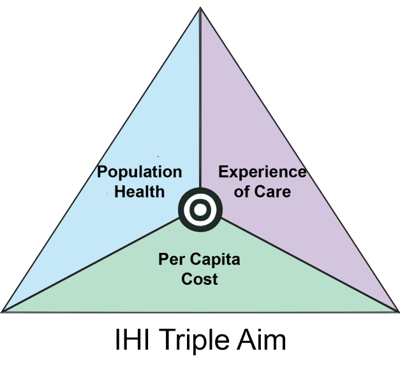

Simply explained, the Triple Aim compels the health care industry to provide the best experience of care, at the lowest cost to the broadest population.
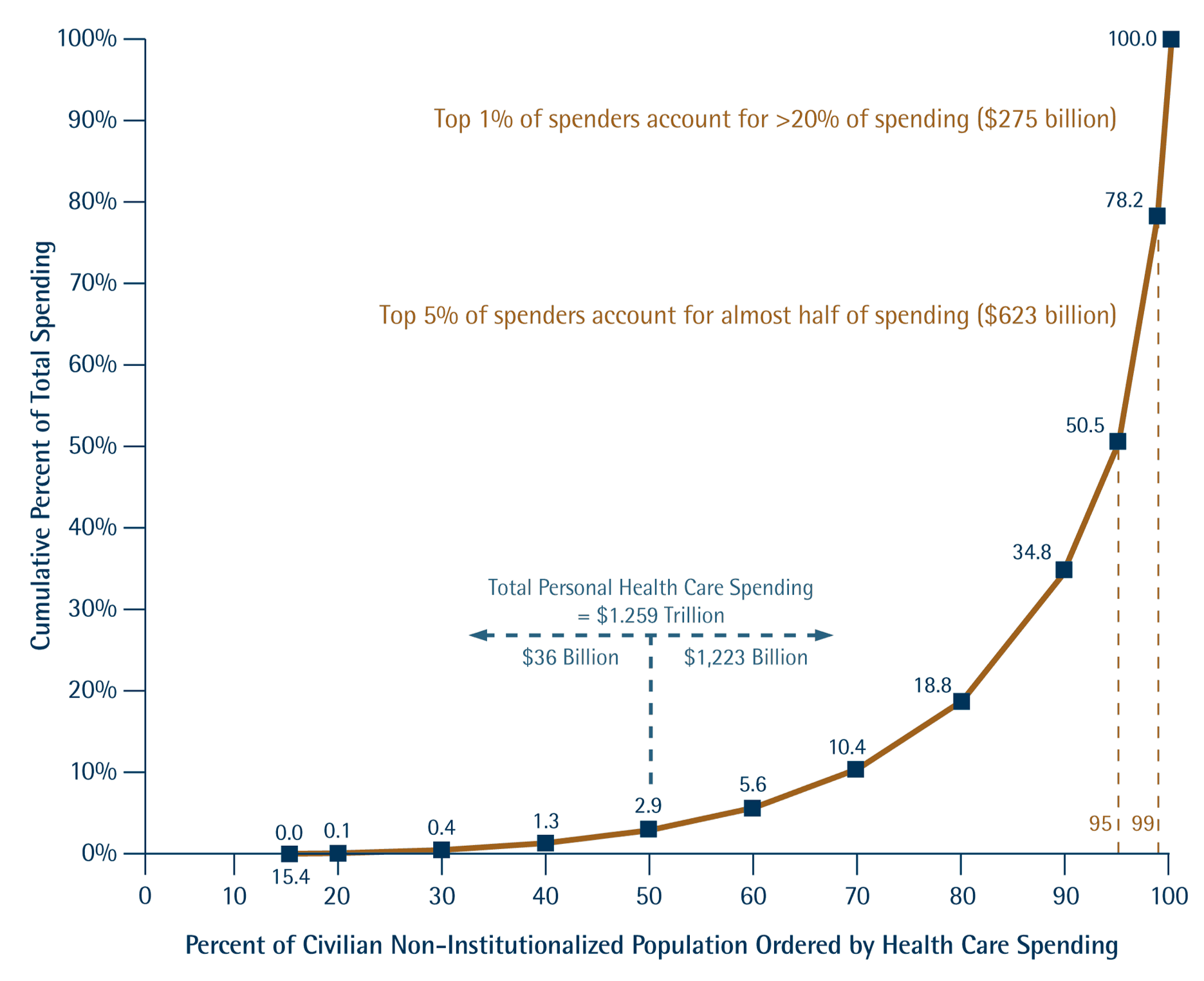
Attempts at population health are generally targeted towards the top 1 percent of the population (who account for 20% of medical spending) or the top 5% of the population who account for 50% of medical costs. This is shown in the graphic below.
Synonyms (also know as):
-
Pop Health
-
PHM (Population Health Management)
Outlook and Challenges:
Chapter 10: References and Related Information

pses:Being Mortal: Chapter by Chapter Synopses:
Blog Articles and Podcasts:
References:
1. IBISWorld Home Care Providers in the US
2. Statista: Home Care in the US Statistics and Facts
3. Statista: Hospice Patients served from 2009 to 2018
4. NAHC: Home Care Statistics (note that this data was last updated in 2010 and as such, some of the above statistics have been adjusted based on the market growth from reference 1)
6. Grand View Research: Home Healthcare Market Size, Growth Report, 2020-2027
7. Institute for Healthcare Improvement (IHI) The Triple Aim of Healthcare
8. SIC information and NAICS Information
Start your free trial