Adult Day Care Activity Ideas to Keep Clients Engaged
Adult day care centers provide a vital service, offering a ...
2027 is the year Medicaid home care gets complicated in a way most agencies are not ready for.
Federal work requirements take effect January 1, 2027, meaning clients who were covered at intake may lose coverage mid-service. Six-month eligibility redeterminations begin, doubling the frequency of potential authorization gaps.
Provider tax phase-downs start in late 2027, beginning to remove a funding tool states have used to supplement Medicaid rates. The federal match rate for Medicaid expansion populations drops from 90% to 80%, phased in from FY 2027.
At the same time, the CMS 80/20 rule's first state readiness deadline arrives July 9, 2027. Some states are raising rates aggressively to hold their workforces together. Others are already cutting. The agencies that will be fine in 2027 are not the ones waiting to see which way their state lands. They are the ones that have already built the operational infrastructure to survive either outcome. This article tells you what is actually coming, state by state and policy by policy, and what to do now while there is still time to prepare.
Medicaid Home Care Reimbursement in 2027: What's Coming and How to Prepare Before It HitsMost home care industry content about Medicaid reimbursement is written after the fact. A rate change gets announced, someone writes about what it means, agencies read it and react. That is a perfectly fine way to stay informed. It is a terrible way to run a business!
This article is written differently. We are writing it in late 2026 about 2027, specifically because 2027 is the year a cluster of federal policy changes become operational rather than theoretical.
The work requirements that have been discussed for months become mandatory on January 1, 2027.
The eligibility redetermination frequency doubles in 2027.
The federal match rate for expansion populations starts stepping down from FY 2027.
The first provider tax phase-down begins in late 2027.
And the CMS 80/20 rule's first hard deadline arrives July 9, 2027.
NONE OF THIS IS SPECULATION. THESE ARE DATES WRITTEN INTO LAW. The agencies that understand them now and adjust their operations accordingly will absorb 2027 as a manageable transition. The agencies that discover these changes mid-year will spend the second half of 2027 in damage control.
ken's quote go here -- Ken Accardi - Ankota
Let's go through what is actually happening in 2027 and what each change means for agencies billing Medicaid.
The One Big Beautiful Bill Act, signed July 2025, established federal work requirements for Medicaid. Beginning January 1, 2027, most Medicaid recipients will need to meet work requirements of 80 hours per month through employment, training, or volunteer activities to maintain their coverage. This represents the largest component of the cuts, reducing federal funding by $325.8 billion over ten years.
Several states are not waiting for the federal deadline. Nebraska started enforcement in May 2026, and Montana and Arkansas began in July 2026. By January 2027, every state in the Medicaid expansion will have implemented some version of this.
For HCBS agencies, the client-facing question is who is exempt. The exemptions matter because your caseload almost certainly contains people in multiple different categories:
Exempt from work requirements are:
individuals aged 19 and under or 65 and older
HCBS waiver participants; SSI or SSDI recipients
people who are medically frail or have special medical needs; parents or guardians caring for a dependent child under 14 or for a disabled individual
pregnant or postpartum enrollees.
The majority of HCBS and IDD waiver participants sit outside the work requirement entirely because they receive services through a waiver that specifically establishes their disability-related need. This is important to understand clearly: the work requirement primarily affects the Medicaid expansion population, which is non-pregnant adults aged 19 to 64 who are not enrolled in Medicare and do not receive SSI or SSDI. Most people receiving ongoing HCBS waiver services do not fall in this group.
However, there are two open questions that matter operationally for specific program types:
The first is the age cutoff for the dependent child exemption. The exemption applies to parents or guardians of a child under 14. A parent of a 15-year-old does not qualify under this exemption. This is a harder line than most agencies realize and it will catch families who assumed the exemption covered any dependent child.
The second is unresolved at the federal level as of this writing: whether a self-directed caregiver's paid hours delivering care count toward their own 80-hour work requirement.

The interim final rule hands verification of both work compliance and exemption status to states under broad "state flexibility" language, which means the honest answer is not a uniform yes or no. It is ask your state.
For self-directed programs specifically, documenting hours, pay records, and the caregiving relationship comprehensively now rather than assuming the exemption will hold up is the conservative and correct approach.
Hot Take
We finally have an answer on the age cutoff, but the self-direction question is still open, and CMS handed that decision to fifty different states. IF YOU'RE RUNNING A SELF-DIRECTED PROGRAM, DON'T WAIT FOR FEDERAL CLARITY THAT MAY NOT COME BEFORE JANUARY. Document everything now. Every past rollout of work requirements has the same failure mode: it's not that people don't qualify. It's that the paperwork didn't reach the right person in time. That is not a benefits problem. That is a systems problem.
This is the part that will surprise agencies that feel comfortable because most of their caseload is exempt. Even exempt individuals may need to respond to a state notice or confirm their exempt status. A missed notice, a data-matching gap, or a paperwork error causes a procedural termination: coverage lost for an administrative reason, not an eligibility one.
A previous effort to implement work requirements in Arkansas led to 18,000 people losing coverage before the initiative was stopped by a court order. Later analysis found most losses were procedural. THOSE 18,000 PEOPLE DID NOT LOSE COVERAGE BECAUSE THEY FAILED TO MEET THE WORK REQUIREMENT. THEY LOST IT BECAUSE THE PAPERWORK SYSTEM DID NOT WORK. Nebraska, which began early enforcement in May 2026, ran a 53% procedural termination rate in prior renewal cycles, with some verification protocols still being defined close to launch.
For agencies, this creates a specific operational responsibility: watch for the state notice, help families recognize it, and build a tracker for who has been notified, who has responded, and whose exemption status still needs confirming. The agencies that will avoid the coverage gap problem in 2027 are not the ones whose participants happen to be exempt. They are the ones whose coordinators are actively managing the notice-response cycle across a full caseload rather than waiting for a family to call in a panic.
Before the OBBBA, states checked Medicaid eligibility annually. In 2027, they check every six months. This increase in frequency is estimated to save the federal government $191 billion. The mechanism is straightforward: more frequent checks mean more opportunities for procedural terminations, and the cumulative savings come partly from people who are eligible but fail to complete the paperwork in time.
For home care agencies, this is an authorization management problem. If a participant's eligibility lapses during a redetermination cycle, their service authorization lapses with it. Services delivered during that gap are not reimbursable. The agency absorbs the cost of care it delivered in good faith but cannot bill.
The agencies that handle this well in 2027 will be the ones with authorization tracking systems that flag expiration risk 30 to 45 days in advance and coordinators who follow up with case managers before the gap arrives rather than discovering a denial after the billing window closes. This is not a new discipline. It is a discipline that becomes twice as important when the redetermination cycle doubles in frequency.
State-directed payments add another layer. Federal oversight will expand starting in 2029: any claim paid without verified eligibility will be treated as an erroneous payment, increasing audit and funds recoupment risk for states that fall behind on documentation.
Agencies that deliver services against lapsed eligibility in 2027 are not just losing the immediate revenue. They are building an audit exposure that the 2029 oversight expansion will make significantly more consequential. Our guide to avoiding Medicaid waiver billing denials in HCBS covers the authorization management practices that catch eligibility gaps before they become denied claims or audit flags.
Tip
A participant confirmed eligible in January 2027 faces redetermination in July 2027, then again in January 2028. For an agency managing 150 active participants, THAT MEANS ROUGHLY 75 ELIGIBILITY REVIEWS IN PROGRESS AT ANY GIVEN TIME, double the previous annual cycle. Coordinators tracking this manually will be overwhelmed. That is an operational infrastructure question, not a staffing headcount question.
This is the change with the least visible direct impact on agencies in the short term and the most consequential downstream effect on state Medicaid budgets.
The OBBBA reduces the enhanced federal match rate for Medicaid expansion populations from 90% down to 80%, phased in starting federal fiscal year 2027. To understand what this means in practice: for every dollar a state spends on Medicaid expansion services, the federal government currently contributes 90 cents. Starting FY 2027, that contribution starts stepping down toward 80 cents.
The difference is not absorbed by the federal government. It is absorbed by states. KFF's analysis of state fiscal conditions heading into FY 2027 is direct about what states do when federal Medicaid funding decreases: they raise revenue, cut benefits, or reduce what they pay providers. In a tight fiscal environment, all three happen simultaneously.
The states most exposed are those with both high Medicaid expansion enrollment and large reliance on provider taxes to fund their share. KFF estimates roughly two-thirds of states will see reduced revenue from provider-based taxes on hospitals and certain health care organizations once the OBBBA provisions phase in. For home care agencies in those states, the pressure on rates will be real even when state leadership wants to maintain rate investment in HCBS.
The states that invested heavily in HCBS rate increases in 2025 and 2026, North Carolina, New York, Colorado, Pennsylvania, are the ones facing the hardest choices in 2027 and 2028: how to maintain those investments with a shrinking federal match. Some will find the revenue. Others will not.
State budget pressures and the 2025 reconciliation law may result in additional rate cuts in FY 2027 budgets. Idaho is already extending a 4% across-the-board Medicaid provider rate cut into FY 2027. Colorado's governor has proposed Medicaid reimbursement rate reductions in the FY 2026 to 2027 budget.
Provider taxes are the mechanism many states use to fund their share of Medicaid costs. A state taxes hospitals and healthcare providers, uses that revenue to fund Medicaid, and draws down federal matching funds on top. It is an important and widely used tool. The OBBBA is constraining it.
Starting in late 2027, expansion states that exceed the new federal limits must begin ratcheting down their provider tax rates, from the current maximum threshold of 6% of net patient revenue down to 3.5% by FY 2032. The Congressional Budget Office estimates all OBBBA provider tax provisions will cut federal Medicaid spending by $191.1 billion over ten years. Because about a third of state-directed payment arrangements that pay above Medicare rates are financed with provider taxes, this imposes further reductions in states' state-directed payment spending.

For agencies currently receiving supplemental payments above the base Medicaid rate, this is the change to watch most carefully. Payments above the new levels begin phasing down in 2028. State-directed payment cuts in 2028 are estimated at $8.7 billion annually, representing more than 2.5% of total Medicaid spending in nine specific states. If you are in one of those states and your financial model treats supplemental payments as reliable baseline revenue, 2028 is when that assumption starts becoming expensive.
The conservative posture for agencies in states with high provider tax reliance is to model their 2027 and 2028 finances assuming supplemental payments step down rather than assuming they hold. If they hold, YOU HAVE MARGIN YOU DID NOT PLAN FOR. If they step down, YOU ARE NOT CAUGHT SHORT. For an in-depth look at the full financial model implications, our breakdown of how home care agencies leak profits without knowing it covers each structural revenue gap and the operational fixes available.
The CMS Ensuring Access to Medicaid Services final rule requires that by 2030, at least 80% of Medicaid payments for personal care, homemaker services, and home health aide services reach direct care worker compensation. The first hard deadline in that timeline is not 2030. It is July 9, 2027, when states must report their readiness to collect the compensation data from providers.
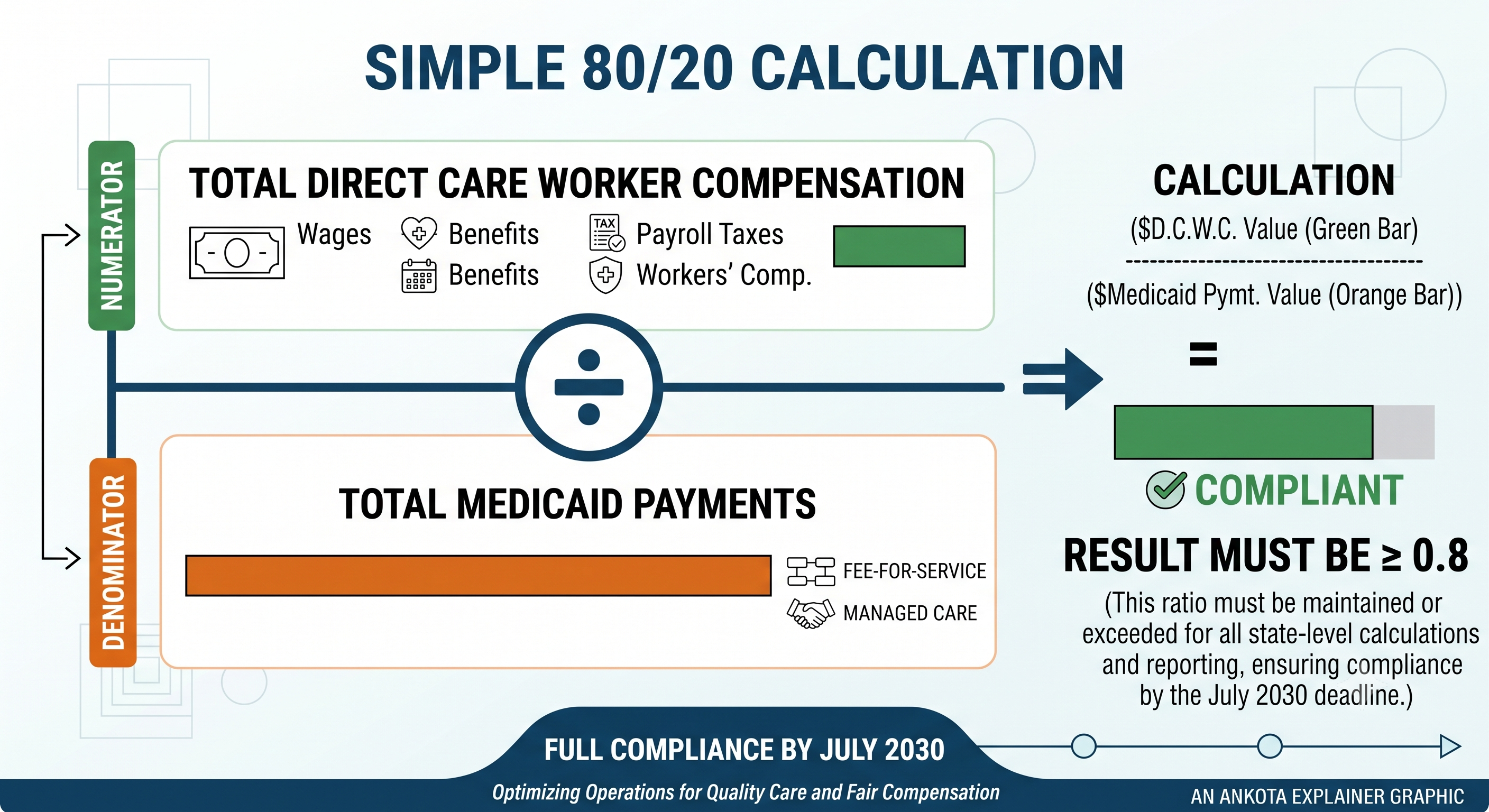
The practical question for every HCBS agency heading into 2027 is whether their accounting and payroll systems can currently answer this question: for every Medicaid dollar we received for personal care services last quarter, what fraction went to direct care worker compensation including wages, employer-paid benefits, payroll taxes, and workers' compensation insurance?
If answering that requires a weekend of manual reconciliation across three systems, the agency has a data infrastructure gap that will cost them more to fix under pressure than it costs to fix now. Our full guide to the 80/20 rule and what HCBS agencies need to start tracking before the 2027 deadline covers exactly what the rule requires and why 2026 is the right time to build this capacity.
Tip
Before you wait for your state to ask, run the 80/20 calculation yourself. Take last quarter's total Medicaid payments for personal care services. Now pull your payroll data for the same period: wages, employer-paid benefits, payroll taxes, workers' comp. Divide the compensation total by the Medicaid payments total. THAT RATIO IS YOUR 80/20 SCORE. If it's below 0.75, you have a structural problem that won't fix itself under deadline pressure. If it's above 0.85, you're in a strong position and your documentation just needs to be cleaner. Either way, knowing now is better than discovering it in a state audit letter.
The policy changes above are federal. Their impact on individual agencies is filtered through state decisions, and the variation is enormous.
States that invested heavily in HCBS rate increases in 2025 and 2026 North Carolina with its 18% increase, New York at $19.65 per hour for NYC agencies, Colorado at $17 base, Pennsylvania at up to 9% are the ones entering 2027 with better workforce stability and more competitive wages. They are also the states facing the hardest math as federal matching drops and provider tax capacity shrinks. Whether they maintain those rates, freeze them, or reduce them will depend heavily on state-specific fiscal conditions and political priorities.
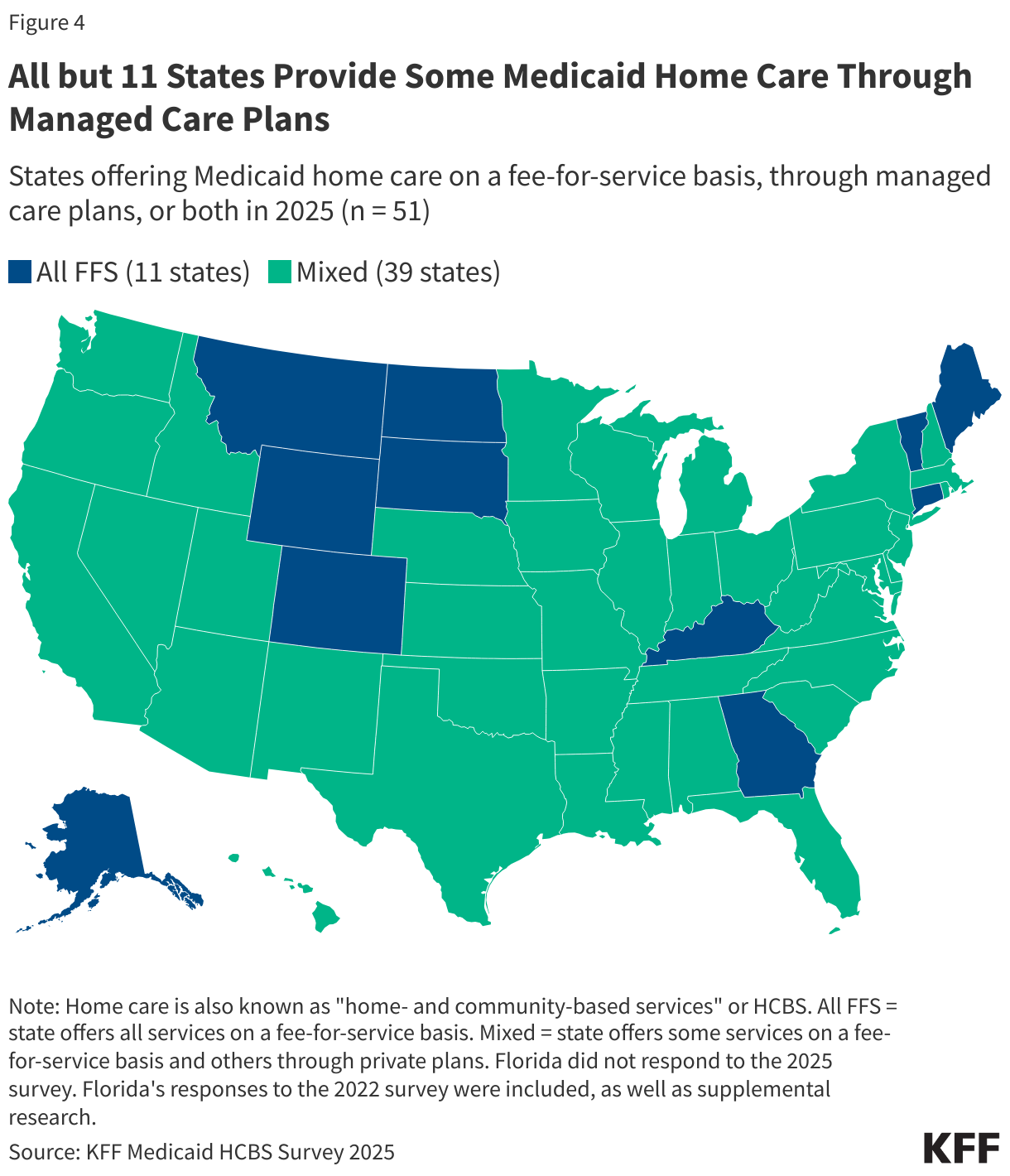
States that were already running tight on reimbursement are in a more immediately exposed position. Low-reimbursement states like Louisiana, Mississippi, and Alabama are paying agencies between $15 and $20 per hour. At those rates, the margin for error on authorization utilization, EVV capture, and billing denials is essentially zero without the 2027 federal changes adding additional pressure. For agencies in these states, the operational discipline that determines survival in 2027 is already the operational discipline required to survive 2026.
The KFF FY 2027 state fiscal conditions analysis is worth reading directly if you want to understand where your specific state sits. The KFF state-by-state breakdown covers expansion status, provider tax reliance, and state fiscal condition, the three variables that most determine which states will maintain rate investments and which will cut.
In a tightening reimbursement environment, the gap between authorized revenue and billed revenue is not a rounding error. It is often the difference between a sustainable margin and a deficit.
In Medicaid HCBS, undelivered authorized hours cannot be carried forward or billed retroactively. THEY SIMPLY DISAPPEAR WHEN THE AUTHORIZATION PERIOD CLOSES. An agency whose authorization utilization rate runs at 85% is leaving 15% of its approved revenue permanently on the table every single month, regardless of how well everything else works. That 15% is not deferred. It is gone.
Then there is the EVV compliance layer. Under the 21st Century Cures Act, visits that are not verified correctly do not get paid. With the 2029 erroneous payment expansion making it even more consequential to have clean eligibility and EVV records, the agencies that treat EVV exception management as a proactive daily discipline rather than a monthly cleanup task are building the audit-resilient record the 2029 environment will demand. Our guide to essential EVV software features covers exactly what to look for in a platform designed to keep those rates above 90% without drowning coordinators in manual correction work.
For a full map of where Medicaid billing revenue disappears before it reaches the bank account, our breakdown of faster billing and better cash flow for home care agencies covers each stage of the revenue cycle and the operational fixes available at each point.
Across the providers navigating the current environment without significant financial strain, the operational patterns are consistent enough to be worth naming explicitly as a 2027 preparation checklist.
They know which participants are billed through an HCBS waiver, clearly and immediately. Not because they think they know, but because their records reflect it in a format that satisfies a state data match. When work requirements generate notices to Medicaid enrollees in their first wave in January 2027, waiver participants should be identifiable as exempt from existing data without a coordinator having to manually verify each one.
They are building a notice tracking workflow now. A spreadsheet or a software module that tracks, by participant, whether a work requirement or redetermination notice has been received, whether a response has been confirmed, and whether the exemption or compliance status is current. Not because most of their clients are at risk. Because the ones who are at risk will not identify themselves until coverage lapses.
They are modeling their 2027 and 2028 finances with and without supplemental payments. Two scenarios, not one. If supplemental payments hold, the conservative scenario shows available margin. If they step down as the OBBBA timelines suggest, the conservative scenario is the operating reality and the agency has already planned for it.
They are running their compensation ratio calculation for the 80/20 rule. Not because the July 2027 deadline requires agencies to submit data directly. But because states need to demonstrate readiness in July 2027, which means they will be building data collection infrastructure from agencies before then. Agencies that can produce this number cleanly will make their state Medicaid agency's compliance job easier. Agencies that cannot will become a problem their state has to solve.
They are treating the HCBS rate environment as a variable, not a constant. The agencies that build their financial model around base rates rather than peak reimbursement scenarios are the ones whose budget holds when a state freezes or reduces rates in response to a 2027 or 2028 fiscal crisis. For the longer view on what building this kind of resilience looks like operationally, our analysis of the agencies that will thrive through 2030 covers the operational and financial characteristics that separate the ones that make it from the ones that plateau or close.
THE 2027 CHANGES ARE NOT PRIMARILY A POLICY PROBLEM FOR HCBS AGENCIES. THEY ARE A DATA AND DOCUMENTATION PROBLEM. The agencies that get through 2027 without disruption are the ones whose systems can answer the questions states will ask before those questions become urgent:
Which participants are billed through a waiver? Which have responded to redetermination notices? Which authorizations are within 45 days of expiration? What percentage of last month's delivered hours were EVV-verified without manual override? What is the compensation ratio for personal care services this quarter? Which MCO payers are running above benchmark on Days Sales Outstanding?
These are not exotic analytical questions. They are operational data points that any connected home care platform should be able to surface in real time. Ankota's platform links scheduling, EVV verification, authorization tracking, billing, and caregiver records into one operational data layer so that the answers to these questions are dashboard queries rather than weekend projects. For the agencies that are billing both private pay and Medicaid HCBS across multiple program types, the connected architecture matters especially because authorization management, EVV compliance, and compensation ratio tracking all require the same underlying data linkages, just for different regulatory purposes.

For agencies running I/DD and broader HCBS programs alongside home care, the HCBS software overview and best software options for managing I/DD HCBS programs cover how a connected platform handles the program-type complexity without requiring separate systems for each regulatory environment. And for the workforce context that makes the reimbursement picture even more urgent, our analysis of why boomer aging is forcing new care models explains why demand is not slowing down even as funding becomes more constrained.
"State flexibility sounds reasonable until you're the agency explaining to a family why Nebraska's answer is different from Ohio's answer. The agencies that will be ready for 2027 are the ones whose records are strong enough to answer whatever their state asks, whatever their state decides. Build that documentation infrastructure now, not in January." -- Ken Accardi, Ankota
Want to see where your agency stands on 2027 readiness across authorization tracking, EVV compliance, eligibility monitoring, and compensation ratio reporting? Talk to our team. We will walk through your current infrastructure and show you exactly what the data picture looks like and where the gaps are before January arrives.
Four major changes become operational in 2027. First, federal work requirements of 80 hours per month take effect January 1, 2027 for most Medicaid expansion enrollees. Second, six-month eligibility redeterminations replace annual ones, doubling the frequency of potential coverage gaps. Third, the enhanced federal match rate for Medicaid expansion populations begins stepping down from 90% toward 80%, starting FY 2027. Fourth, the CMS 80/20 rule's first hard deadline arrives July 9, 2027, when states must report their readiness to collect direct care worker compensation data from providers. Provider tax phase-downs begin in late 2027, reducing states' ability to fund supplemental Medicaid payments. KFF's FY 2027 state fiscal conditions analysis is the most comprehensive reference for understanding how each of these affects your specific state.
Generally no. HCBS waiver participants are specifically exempt from the work requirements, as are SSI and SSDI recipients, people determined to be medically frail, parents or guardians of a child under 14, and pregnant or postpartum enrollees. The work requirement primarily affects the non-disabled Medicaid expansion population: non-pregnant adults aged 19 to 64 who are not enrolled in Medicare and do not receive SSI or SSDI. However, even exempt participants may need to respond to a state notice or confirm their exempt status. A missed notice causes procedural termination: coverage lost for an administrative reason, not an eligibility one. The Arkansas precedent, where 18,000 people lost coverage procedurally under a prior work requirement pilot, is the clearest available data on how this risk plays out in practice. Our guide to avoiding Medicaid waiver billing denials in HCBS covers the documentation and tracking practices that protect against procedural gaps.
Starting in 2027, states check Medicaid eligibility every six months rather than annually. For agencies, this doubles the frequency of potential authorization gaps in their active caseload. If a participant's eligibility lapses during a redetermination cycle, their service authorization lapses with it, and services delivered during the gap are not reimbursable. For an agency managing 150 participants, approximately 75 eligibility reviews will be in progress at any given time rather than a rolling annual cycle. Agencies need authorization tracking that flags expiration risk 30 to 45 days in advance and coordinator workflows that follow up before the gap arrives. Beginning in 2029, federal oversight expansion will treat claims paid without verified eligibility as erroneous payments, making the 2027 and 2028 period particularly important for building clean eligibility documentation habits.
Provider taxes are a mechanism states use to fund their share of Medicaid costs. The OBBBA requires expansion states to begin ratcheting down provider tax rates from the current 6% maximum toward 3.5% by FY 2032, starting in late 2027. For agencies in states that rely heavily on provider taxes to fund supplemental Medicaid payments, this constrains states' ability to maintain current payment rates. State-directed payment cuts are estimated at $8.7 billion annually starting 2028, representing more than 2.5% of total Medicaid spending in nine specific states. Agencies whose financial models rely on supplemental payments should model 2027 and 2028 finances with a scenario where those payments step down, not just a scenario where they hold. If they hold, you have upside. If they step down as the law suggests, you have already planned for it.
July 9, 2027 is when states must report their readiness to collect the data needed to measure whether at least 80% of Medicaid payments for personal care, homemaker, and home health aide services are reaching direct care worker compensation. States will be building the data collection infrastructure from agencies before this deadline, meaning agencies should expect to be asked for payroll and service compensation data during 2026 and early 2027. Agencies that can currently answer "what percentage of our Medicaid payments for personal care went to direct care worker compensation last quarter" with a clean, defensible number will make their state's compliance work easier. Agencies that cannot will become a problem their state has to solve. Our guide to the 80/20 rule and the 2027 deadline covers exactly what to track and when.
Five actions that matter most before January 2027: First, confirm which participants are billed through an HCBS waiver in a format that satisfies a state data match, not just in staff knowledge. Second, build a notice tracking workflow for work requirement and redetermination notices by participant, with fields for notice-received, response-confirmed, and exemption-status-current. Third, for self-directed programs, document hours, pay records, and caregiving relationships comprehensively since the question of whether a self-directed caregiver's paid hours satisfy their own work requirement is still unresolved at the federal level and decided state-by-state. Fourth, run the 80/20 compensation ratio calculation for your covered service types now. Fifth, model 2027 and 2028 finances with a supplemental payment step-down scenario, not just a hold scenario. Identifying where authorized revenue is already leaking is the immediate operational priority alongside this policy preparation work.
Ankota's mission is to enable the Heroes who keep older and disabled people living at home to focus on care because we take care of the tech. If you need software for home care, EVV, I/DD Services, Self-Direction FMS, Adult Day Care centers, or Caregiver Recruiting, please Contact Ankota. And if you're ready to see how the most innovative agencies are using AI to empower their caregivers and automate the rest, meet your new companion at www.kota.care.

Ken is the founder and CEO of Ankota, a company that helps any organization that helps older or disabled people live independently in their home of choice. Having grown up with a disability and a passion for healthcare, this is Ken's mission





Trusted by home care agencies nationwide